Is Becoming an MRI Technologist the Right Career Move for You?
How to Become an MRI Technologist: Education, Certification, and Career Path is a question with a clear, achievable answer — and this guide walks you through every step.
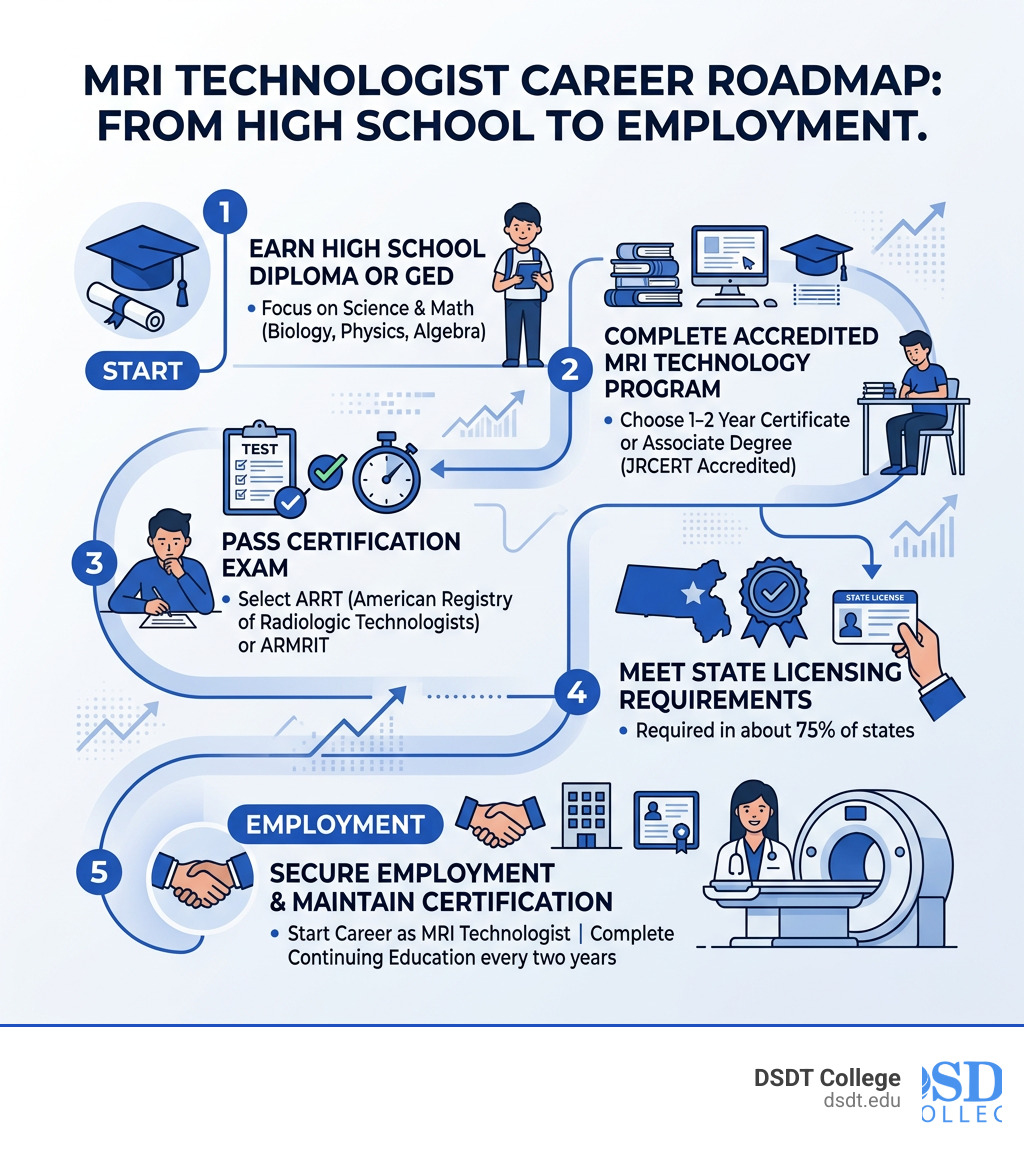
Here’s the short version:
- Earn a high school diploma or GED (with a focus on science and math)
- Complete an accredited MRI technology program — typically a 1-2 year certificate or associate degree
- Pass a certification exam through ARRT or ARMRIT
- Meet state licensing requirements (required in about 75% of states)
- Maintain your certification with continuing education every two years
MRI technologists earn a median annual salary of $88,180 (May 2024, BLS), with strong job growth of 5% through 2034 — faster than average. About 15,400 job openings are projected each year over the coming decade.
This is a career that offers real stability, solid pay, and the chance to make a direct impact on patient health — without medical school.
What Does an MRI Technologist Do?
Magnetic Resonance Imaging (MRI) technologists are the specialized professionals who operate the high-tech scanners used to create detailed images of the human body. Unlike X-rays or CT scans, MRI uses powerful magnetic fields and radio waves, making it a radiation-free way to look at soft tissues, organs, and bones.
On a daily basis, we aren’t just “pushing buttons.” The role is a blend of high-level physics, patient care, and technical precision. According to the Task Inventory provided by the American Registry of Radiologic Technologists (ARRT), a technologist’s scope of practice includes:
- Patient Screening: This is the most critical safety step. Because the MRI magnet is always “on,” we must ensure patients have no metal implants, pacemakers, or shrapnel that could be dangerous.
- Image Acquisition: We select specific “pulse sequences” and adjust parameters to get the clearest possible image for the radiologist to interpret.
- Patient Positioning: Getting a high-quality scan requires the patient to be perfectly still. We use coils and padding to ensure comfort and accuracy.
- Contrast Administration: In some cases, we administer contrast agents (like Gadolinium) intravenously to highlight specific blood vessels or tumors.
- Collaboration: We work closely with radiologists to determine if additional views are needed and ensure the diagnostic goals of the exam are met.
Essential Skills and Personal Traits
To thrive in this career, you need more than just a love for science. Here are the traits we see in the most successful technologists:
- Empathy: Many patients are claustrophobic or in pain. Being able to calm a nervous patient is just as important as knowing how to run the machine.
- Attention to Detail: A tiny error in positioning or a missed safety screening question can have major consequences.
- Technical Proficiency: You’ll be working with complex software and multi-million dollar hardware. You need to be comfortable with technology.
- Physical Stamina: Expect to be on your feet for most of your shift, helping move patients and adjusting heavy equipment.
- Problem-Solving: If an image doesn’t look right, you need to figure out why—is it patient motion, a software glitch, or a metal artifact?
How to Become an MRI Technologist: Education, Certification, and Career Path
The journey to becoming a technologist is structured but offers a few different forks in the road depending on your starting point. Whether you are a high school senior in Detroit or a veteran transitioning to civilian life in Killeen, Texas, the foundational steps remain consistent.
First, you must have a high school diploma or GED. During high school, focusing on biology, physics, and algebra will give you a significant head start. Once you have your diploma, the next step is choosing an accredited educational program.
At DSDT College, we emphasize the “Primary Pathway.” This means you don’t necessarily need to be an X-ray tech first. Our Associate of Applied Science in MRI Technology is designed to take you from zero experience to being exam-ready. These programs typically last between 18 to 24 months and combine classroom learning with hands-on clinical rotations.
During your education, you’ll study:
- Sectional Anatomy: Learning how the body looks in “slices.”
- MRI Physics: Understanding magnetism, radiofrequency, and signal production.
- Patient Care: Learning vitals, safety protocols, and emergency response.
- Clinical Rotations: This is where you work in a real hospital or imaging center under supervision to meet the Primary Handbook requirements.
Navigating the How to Become an MRI Technologist: Education, Certification, and Career Path
There are two main ways the ARRT allows you to become eligible for the big exam:
1. The Primary Eligibility Pathway This is the most direct route for new students. You enroll in an associate degree program (like the one we offer at DSDT) that is specifically for MRI. You complete your degree, finish your clinical hours, and sit for the MRI exam. You do not need a prior license in another imaging field.
2. The Post-Primary Eligibility Pathway This is for people who are already “R.T.s” (Radiologic Technologists). If you are already certified in Radiography, Sonography, or Nuclear Medicine, you can “cross-train” into MRI. This requires meeting Structured Education Requirements, which involves 16 hours of targeted learning and a specific number of clinical repetitions.
Regardless of the path, ensuring your program has JRCERT accreditation or is recognized by the ARRT is vital. This ensures your education meets the national quality standards required for employment.
Certification and Licensing Requirements
Once you finish your degree, the real work begins: getting those initials after your name. Most employers require you to be “Registry Eligible” or already certified to even land an interview.
The gold standard is the ARRT (American Registry of Radiologic Technologists). To earn this, you must pass a rigorous exam that covers everything from patient safety to complex pulse sequences. You can review the Examination Content Specifications to see exactly what’s on the test.
There is also an alternative credentialing body called ARMRIT (American Registry of Magnetic Resonance Imaging Technologists). While ARRT is more common, ARMRIT is a specialized registry that focuses solely on MRI. Some employers accept either, but ARRT is generally the most widely recognized across all 50 states.
State Licensing and Maintenance
Don’t forget about your state! About 75% of states require a separate license to practice. This usually involves showing proof of your national certification and paying a fee to the state health board.
Once you are certified, you have to stay sharp. The ARRT requires Continuing Education (CE) credits every two years to ensure you are up to date on the latest technology and safety protocols. If you are using the post-primary route, you’ll want to keep the Postprimary Handbook handy to track your requirements.
Career Outlook: Salary and Job Growth
If you’re looking for a career with a high “return on investment,” MRI technology is a top contender. The training is relatively short (2 years) compared to the earning potential.
According to the Bureau of Labor Statistics data, the median annual wage for MRI technologists reached $88,180 in 2024. To put that in perspective, that is significantly higher than many other healthcare roles that require the same level of education.
Where You Work Matters
Your paycheck can vary depending on the setting. Here is a breakdown of median wages by work environment:
| Work Environment | Median Annual Salary (Approx.) |
|---|---|
| Outpatient Care Centers | $128,000 |
| Medical and Diagnostic Labs | $90,000 |
| Hospitals (State, Local, Private) | $82,000 |
| Physician Offices | $78,000 |
Geographically, the market is booming. While California remains a high-pay leader with medians over $122,000, we see strong demand in our local markets like Detroit, Chicago, and Dallas. The BLS projects a 5% growth rate, which translates to about 15,400 job openings annually as older technologists retire and the population ages, requiring more diagnostic imaging.
Advancement and Specialization Opportunities
Getting your MRI certification is just the beginning. We’ve seen many technologists leverage their experience into even higher-paying or more flexible roles:
- MRI Safety Officer (MRSO): With an ABMRS safety certification, you can become the lead expert on magnetic safety in a large hospital.
- Travel MRI Technologist: If you like adventure, travel techs take 13-week assignments across the country, often earning significantly higher hourly rates plus housing stipends.
- Management: Many lead techs move into Radiology Department Management or Hospital Administration.
- Clinical Instructor: You can help train the next generation of students at colleges like ours.
- Research: Work at major universities or tech companies to develop new imaging sequences (like functional MRI or fMRI).
Frequently Asked Questions
How to Become an MRI Technologist: Education, Certification, and Career Path: Common Questions
How long does the program take? Most associate degree programs take 24 months. If you are already an X-ray tech, a certificate program might only take 12 months.
Can I do my training online? Yes and no. At DSDT College, we offer online coursework for the “book work” (physics, anatomy), but you must complete in-person Clinical Experience Requirements at a local hospital or clinic to get your certification.
Do I need a bachelor’s degree? No. An associate degree is the standard entry-level requirement. However, a bachelor’s can help if you want to move into high-level management later.
What is the difference between ARRT and ARMRIT?
The ARRT is the most widely recognized and requires an associate degree (in any subject) plus specific MRI training. It is the “gold standard.” The ARMRIT is a specialized registry that focuses only on MRI and is sometimes preferred by private imaging centers, but it may not be recognized by all hospitals or states.
How much does it cost to become an MRI technologist?
Tuition for MRI programs generally ranges from $5,000 to $20,000. You also need to factor in textbook costs and the ARRT exam fee (roughly $225 for the first attempt). At DSDT, we provide clear information on Tuition and financial aid to help students navigate these costs, including options for veterans and those seeking career changes.
Conclusion
The path to becoming an MRI technologist is one of the most rewarding “fast-track” careers in healthcare. It offers a unique combination of patient interaction and cutting-edge technology, all while providing a salary that supports a high quality of life.
Whether you are in the Midwest—near our campuses in Detroit, Ann Arbor, or Grand Rapids—or in the South near Houston or Tampa, the demand for skilled imagers is only going up. We are here to support your transition every step of the way.
If you’re ready to start your journey in How to Become an MRI Technologist: Education, Certification, and Career Path, we invite you to explore our Associate of Applied Science in MRI Technology. You can learn more about our Admissions process and see how we can help you make a lasting impact on the future of healthcare.