1. You Understand the Difference Between Primary and Postprimary Pathways
An Online ARRT MRI Program is a structured, web-based course that prepares radiologic technologists to earn their ARRT certification in Magnetic Resonance Imaging — combining online didactic education with hands-on clinical training.
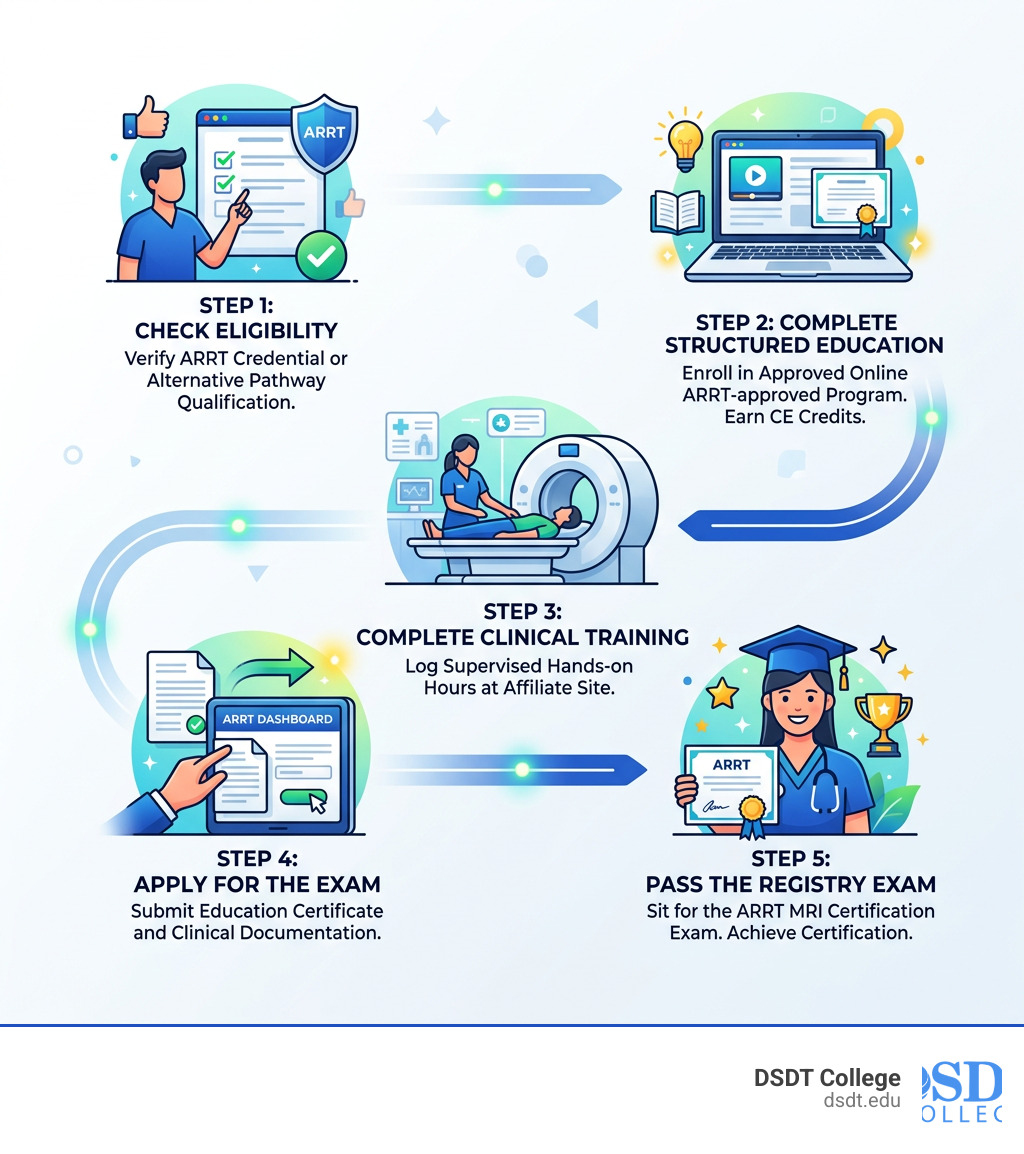
Here is a quick overview of what to expect:
| Step | What Happens |
|---|---|
| 1. Check eligibility | Confirm you hold an ARRT credential or qualify through an alternative pathway |
| 2. Complete structured education | Finish an ARRT-approved online program (typically 14 weeks) earning 25.5 ASRT Category A CE credits |
| 3. Complete clinical training | Log supervised hands-on hours at an approved affiliate site |
| 4. Apply for the ARRT exam | Submit your structured education certificate and clinical documentation through the ARRT dashboard |
| 5. Pass the registry exam | Sit for the ARRT MRI certification exam |
Choosing the right program is a big decision. Only 14% of registered radiologic technologists hold an MRI certification — meaning those who do stand out in a competitive job market, with average salaries reaching $73,142 and climbing as high as $82,590 with advanced credentials.
But not every online program is the same. Some offer clinical placement support across 1,300+ locations nationwide. Others offer only exam prep. The format, cost, accreditation, and support services vary widely.
This guide walks you through five clear signs that an online ARRT MRI program is the right fit for your career goals, schedule, and background.
The first sign that an Online ARRT MRI Program is right for you is knowing which door you’re walking through. The American Registry of Radiologic Technologists (ARRT) offers two distinct routes to becoming a certified MRI technologist. If you don’t know which one applies to you, you might end up in a program that doesn’t meet your needs.
The Postprimary Pathway
This is the most common route for current professionals. If you are already a Registered Technologist (R.T.) in Radiography, Nuclear Medicine Technology, Sonography, or Radiation Therapy, you are likely looking for a postprimary program. These programs provide the “Structured Education” required by the ARRT to add an MRI credential to your existing license. You can find detailed rules in the Postprimary Handbook.
The Primary Eligibility Pathway
What if you aren’t an R.T. yet? This is where many people get confused. If you are starting from scratch—perhaps as a high school graduate or someone changing careers entirely—you need a Primary Eligibility Pathway. This usually involves enrolling in an associate degree program specifically for MRI.
At DSDT College, we focus on helping students navigate these requirements. To be eligible via the primary path, you must:
- Earn an associate degree (or higher) from an accredited institution.
- Complete an ARRT-approved educational program in MRI.
- Demonstrate good moral character through an ethics review.
If you aren’t currently an R.T. but hold credentials from the NMTCB or ARDMS, you may need to complete the non-RT online account access form to begin your journey. For a deep dive into the primary route, check out the Primary Handbook for MRI Certification.
2. Evaluating the Curriculum of an Online ARRT MRI Program

When you look at the syllabus for an Online ARRT MRI Program, does it look like a list of chores or a roadmap to success? A high-quality curriculum should be “compact and dense,” meaning it gives you exactly what you need for the registry exam without the fluff.
Typical program lengths vary:
- 14-week structure: Common for postprimary “Structured Education” certificates.
- 18-month Associate of Applied Science: Necessary for the Primary Pathway, providing a more robust foundation for those new to the field.
The curriculum must align with the Magnetic Resonance Imaging 2025 Content Specifications. You should see modules covering MRI physics (the “scary” stuff that’s actually quite cool), patient safety (crucial because magnets never turn off!), image acquisition, and cross-sectional anatomy.
Meeting the Online ARRT MRI Program Structured Education Requirements
The ARRT requires at least 16 hours of structured education. Most top-tier programs go far beyond that, providing approximately 25.5 ASRT Category A CE credits. This ensures you aren’t just checking a box but actually mastering didactic competency. You can review the full Structured Education Requirements 2025 to see exactly how your coursework must be documented.
How an Online ARRT MRI Program Arranges Clinical Placements
This is the “make or break” for many students. You can learn the physics online, but you can’t scan a patient through a Zoom call. A great program will have a network of clinical affiliates—sometimes over 1,300 locations—to help you find a spot in cities like Detroit, Chicago, or Columbus.
During clinicals, you’ll perform supervised procedures to meet the Clinical Experience Requirements for 2025. Look for programs that provide a clinical coordinator to help you schedule these hours around your life.
3. You Are Motivated by High Salary Potential and Job Stability
Let’s be honest: we all want a job that pays the bills and then some. If you are looking for a career with a high “ceiling,” MRI is a fantastic choice. The average MRI technologist salary sits around $73,142, but with advanced certification and experience, that number can jump to $82,590 or more.
Why is the pay so good? It’s a matter of supply and demand. Only about 14% of Registered Technologists are certified in MRI. When you have a specialized skill that few others have, you become much more valuable to hospitals and imaging centers.
| Position | Average Annual Salary | Job Growth Outlook |
|---|---|---|
| Radiographer (X-Ray) | $61,900 | Steady |
| Certified MRI Technologist | $73,142 | High |
| Senior MRI Specialist | $82,590+ | Excellent |
Beyond the paycheck, there’s the “hire rate.” Many programs boast a 90% hire rate for their graduates. When you combine an Online ARRT MRI Program with job placement assistance, you aren’t just getting an education; you’re getting a career upgrade. We see this in Midwest markets like Detroit and Ann Arbor, where healthcare providers are constantly looking for skilled imaging professionals.
4. You Need Flexibility to Balance Education with a Full-Time Job
Are you a “night owl” who studies best at 2:00 AM? Or maybe a busy parent who can only squeeze in a lesson during a lunch break? If you need 24/7 access to your education, an online program is definitely the right fit.
The beauty of a self-paced Online ARRT MRI Program is that the “classroom comes to you.” You don’t have to worry about commuting to a campus after a long shift. You can access lectures, peer-to-peer training, and even remote scanning labs from your laptop or phone.
To keep you on track, these programs typically use:
- Weekly post-tests: To make sure you actually understood that last chapter on pulse sequences.
- Mock registry exams: These are “practice runs” for the big day. Some programs offer 220-question mock exams that mirror the actual ARRT experience.
- Expert instructor support: Just because it’s online doesn’t mean you’re alone. You should have access to instructors who can answer your questions when you get stuck.
The results speak for themselves. Top-tier online programs often see a 94% first-attempt pass rate on the ARRT registry exam. And for those who don’t nail it the first time? The second-attempt pass rate often hits 100%. That kind of success is only possible when the program is designed for the way busy adults actually learn.
Frequently Asked Questions about Online MRI Certification
How much does an online MRI program cost?
Tuition for an Online ARRT MRI Program can vary based on what’s included. You might find “Registry Review Only” courses for around $600, while comprehensive 14-week programs that include clinical placement support can cost around $3,900. Some specialized prep modules are available for as low as $99.
We know that’s a lot of money to put down at once, which is why most reputable schools offer payment plans or interest-free options. If you are pursuing a full Associate of Applied Science degree, you may also be eligible for federal financial aid or veteran benefits.
What is the process for applying for the ARRT MRI exam?
Once you’ve finished your coursework and logged your clinical hours, it’s time to make it official. You’ll use your ARRT dashboard to submit:
- Your Structured Education Certificate (proving you did the 16+ hours of study).
- Your Clinical Documentation (signed off by your supervisor).
- The application fee.
The ARRT will then review your materials. If everything is in order, they’ll send you an exam window. For more details on this process, refer to the Postprimary Eligibility Pathway Handbook.
Can I complete my clinical training at my current place of employment?
Yes! In fact, this is often the easiest way to do it. If you already work at a hospital or clinic that has an MRI machine, you can talk to your employer about “cross-training.”
Your school will usually need to sign an affiliation agreement with your employer. Once that’s done, you can log your supervised hours and complete your clinical workbooks right where you already work. This is a great way to transition into a new role without having to find a new “commute” for your clinical rotations.
Conclusion
Stepping into Magnetic Resonance Imaging is a powerful way to future-proof your career. Whether you are a veteran transitioning to civilian life in Fayetteville, a recent high school grad in Detroit, or a working R.T. in Chicago looking for a raise, an Online ARRT MRI Program offers the path to get there.
At DSDT College, we believe in practical education that leads directly to a paycheck. Our Associate of Applied Science in MRI Technology is designed to meet workforce needs right here in the Midwest and beyond. If you’re ready to stop just “having a job” and start “having a career,” we’re here to help.
Ready to take the next step? Discover more about our MRI Technology Associate Degree programs and see how we can help you join the elite 14% of technologists certified in MRI.