Why an AI Sports Analytics Course Is Your Ticket Into the New Era of Sports
The best AI sports analytics courses teach you how to apply artificial intelligence and data science to real-world sports problems — from predicting player injuries to optimizing game strategy and personalizing fan experiences.
Here are the top options to know about:
| Program Type | Format | Duration | Price | Best For |
|---|---|---|---|---|
| Technical Bootcamp | Live online (Zoom) | 8 weeks | $1,650 | Technical career changers |
| Professional Certification | Self-paced online | 3-4 months | $950 | Sports professionals, all levels |
| University Certificate | Async online | Up to 2 years | ~$6,000 | Serious career builders |
| Introductory Course | Self-paced online | 1 week (intensive) | Free/paid | Beginners with Python basics |
| Management Specialization | Self-paced online | 1-2 weeks per course | Free/paid | Sports managers and coaches |
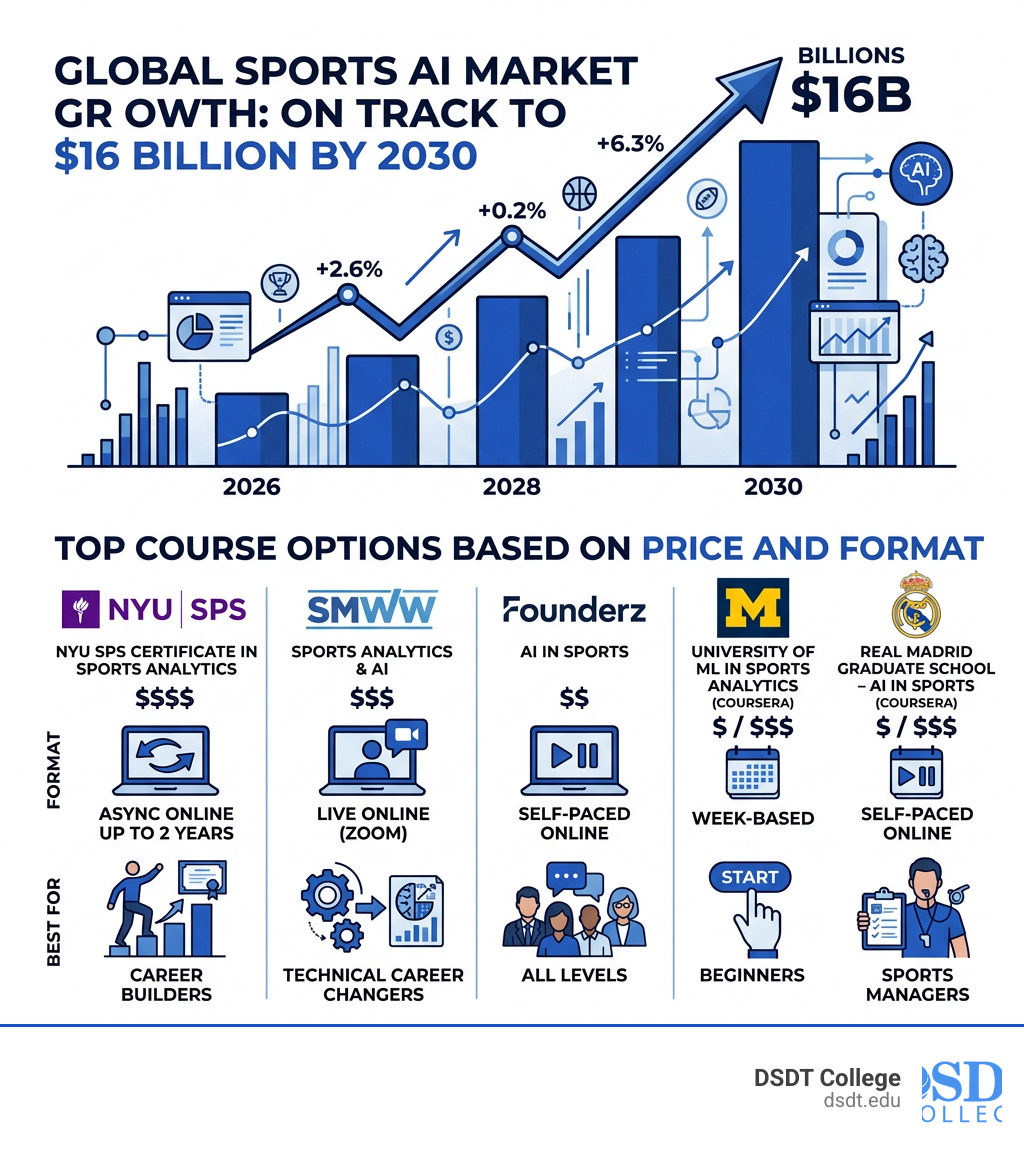
The sports world has always loved numbers. But something shifted. Teams are no longer just counting stats — they are running machine learning models, processing wearable sensor data, and using generative AI to make decisions in real time. The global sports AI market is on track to hit $16 billion by 2030, and the demand for people who can bridge data science and sports strategy is growing fast.
Think of it as Moneyball — but supercharged. Where Billy Beane used spreadsheets, today’s front offices use Python, SQL, neural networks, and predictive models built on millions of data points.
Whether you are a recent high school grad, a career changer looking for a foothold in tech, or a sports professional who wants to level up — an AI sports analytics course can open doors that raw passion alone cannot.
I’m Jamie Kothe, a workforce development specialist and veteran training program developer with experience building career-focused learning pathways in fast-moving technical fields, including AI sports analytics courses designed to connect real skills with real job outcomes. In the sections ahead, I’ll break down exactly what these programs teach, what they cost, and which ones are worth your time.
The Evolution of the Game: Why Enroll in an AI Sports Analytics Course?
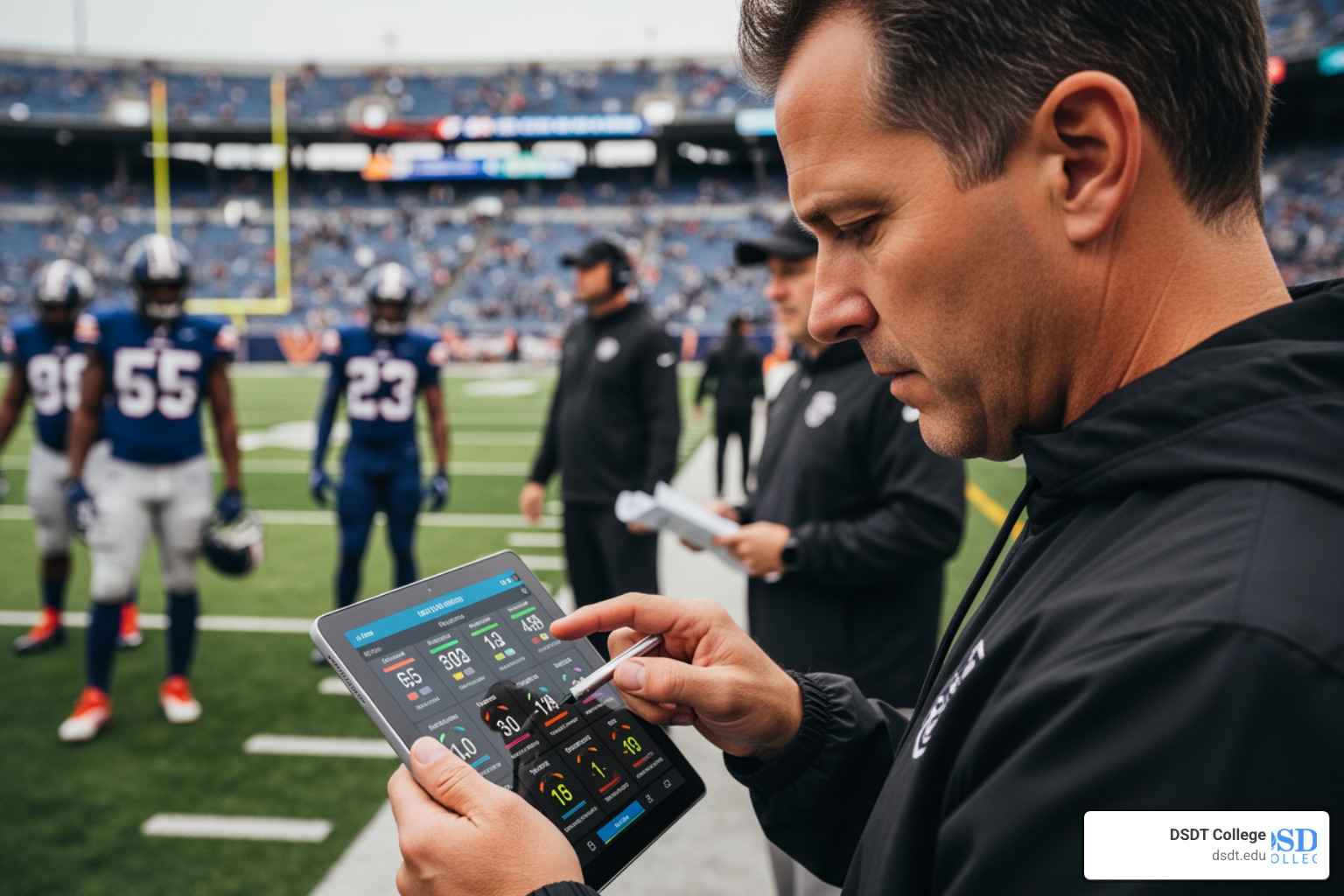
We’ve come a long way from the days of scouts chewing tobacco and “eye-balling” talent. Today, the “eye” is a high-speed camera backed by a convolutional neural network. The evolution of sports from a gut-feeling industry to a data-driven powerhouse is what we call “Sabermetrics 2.0.”
Enrolling in an AI sports analytics course isn’t just about learning to code; it’s about understanding the new language of the locker room and the front office. Why is this shift happening? Because at the elite level, the margins for victory are razor-thin. When a single win can be worth millions in broadcasting rights or playoff revenue, teams are desperate for a competitive advantage.
Performance Optimization and Real-Time Strategy
Imagine being able to predict the probability of a goal or a touchdown based on the real-time positioning of all 22 players on the field. Modern AI does exactly that. By analyzing spatio-temporal data, coaches can adjust their strategies mid-game. We aren’t just looking at what happened; we are using predictive modeling to see what might happen next.
Injury Prevention: The $16 Billion Safeguard
The global sports AI market is projected to reach $16 billion by 2030 for a very good reason: it saves players’ careers. AI models can now detect “fatigue signatures” in an athlete’s movement long before a human trainer notices a limp. By monitoring workload through wearable devices like the Oura Ring or GPS vests, teams can adjust training loads to prevent ACL tears or hamstring pulls. This keeps the stars on the field and the fans in the seats.
Fan Engagement and Smart Venues
It’s not just about the athletes. AI is revolutionizing how we experience the game. From personalized content that increases fan engagement by 20% to building “Smart Venues” that use AI for security, smart ticketing, and even dynamic pricing for hot dogs, the business side of sports is just as tech-heavy as the performance side.
Core Skills Taught in Modern AI Sports Programs
If you’re worried that you need to be a math genius to succeed, take a deep breath. While the tech is advanced, many of the best AI sports analytics courses are designed to take you from the basics to professional-level proficiency. We see these programs focusing on a specific “tech stack” that every modern sports organization uses.
The Technical Foundation: Python, SQL, and R
- Python Programming: This is the Swiss Army knife of data science. You’ll use libraries like
scikit-learn(sklearn) to build machine learning models that predict game outcomes. - SQL Databases: Data is useless if you can’t find it. SQL is how you talk to databases to pull out player stats or historical game data.
- R Language: Still a favorite for statistical modeling and creating those beautiful, complex visualizations you see on sports broadcasts.
The AI Frontier: Machine Learning and GenAI
- Machine Learning (ML): You’ll dive into supervised learning techniques like Random Forests, Decision Trees, and Support Vector Machines (SVM). These are the tools used to classify “punch types” in boxing or “hit probabilities” in baseball.
- Generative AI (GenAI): The newest addition to the curriculum. Students are now learning how to use tools like ChatGPT and Copilot to summarize scouting reports or query 3D motion-capture data using plain English.
- Neural Networks and Deep Learning: This is how computers “see” the game, enabling object recognition for tracking ball movement and player biomechanics.
Data Visualization and Business Intelligence
It doesn’t matter how smart your model is if the head coach can’t understand it. That’s why programs emphasize Power BI and Data Visualization. You’ll learn to create interactive dashboards that turn millions of rows of data into a simple green or red light for decision-makers.
Wearable Data and MLOps
You’ll learn to handle data from IMUs (Inertial Measurement Units) and Apple Watches. Furthermore, advanced courses touch on MLOps—the practice of making sure your AI models keep working correctly season after season.
What to Look for in an AI Sports Analytics Course
With so many options popping up, how do you choose? We recommend looking for programs that offer a balance of “the what” and “the how.”
- Hands-on Projects with Real Data: Avoid courses that only use “dummy” data. You want to work with actual NHL or MLB datasets. There is no substitute for cleaning and analyzing real-world athletic data.
- Industry Mentors: Look for instructors who have actually been in the room. For instance, some programs feature pioneers like Ari Kaplan, who built analytics departments for the Chicago Cubs and Los Angeles Dodgers.
- Curriculum Depth: Does the course cover the ethics of AI? Data ownership and privacy are massive issues in sports right now. A good program will teach you how to implement AI responsibly.
- No-Code Tools: For the less technically inclined, some courses focus on building chatbots or virtual assistants using no-code platforms. This is great for sports managers who need to understand the tech without writing 500 lines of code.
Choosing the Right AI Sports Analytics Course for Your Career
Your choice should depend on where you are starting from.
- For Technical Professionals: If you’re already a coder or an engineer, look for “bootcamp” style programs. These focus on high-level technical application and MLOps.
- For Sports Managers and Coaches: If you are more interested in the application of AI rather than building the models yourself, management-focused programs are fantastic. They focus on business applications, fan engagement, and strategic simulations.
- For Career Changers and Beginners: If you are in Detroit, Chicago, or Phoenix and looking for a fresh start, look for programs that offer flexible pacing and live mentorship. Asynchronous lectures are great, but having a weekly Zoom chat to ask questions is a game-changer for those new to the field.
Career Outcomes and Industry Certifications
So, what happens after you get that certificate? The job market for AI in sports is wide open. Teams, leagues, and tech vendors are all hiring.
Common Job Roles
- Sports Data Scientist: Building the predictive models that decide which free agent to sign.
- Performance Analyst: Working directly with players to optimize their physical output.
- Scouting Director (Data-Driven): Using AI to find “diamonds in the rough” in international leagues.
- AI Engineer: Developing the software that tracks player movement in real-time.
Industry Certifications and Credentials
Completing a course often yields more than just knowledge. You can earn:
- GSIC (Global Sports Innovation Center) Certification: Highly recognized in the international sports community.
- Microsoft Credentials: Certifying your mastery of AI tools like Azure and Power BI.
- University Credits: Some programs offer credits that can sometimes be applied toward further degrees.
| Role | Focus | Typical Tools |
|---|---|---|
| Entry-Level Analyst | Data cleaning, basic reporting, SQL queries | Excel, SQL, Tableau |
| Mid-Level Data Scientist | Predictive modeling, injury forecasting | Python, R, Machine Learning |
| Senior AI Engineer | Neural networks, real-time tracking systems | TensorFlow, PyTorch, MLOps |
Flexible Learning: From Microlearning to Master’s Levels
We know that life is busy. Whether you are a veteran transitioning to a civilian career or a high school grad in Grand Rapids or Dallas, you need options that fit your schedule.
- 8-Week Bootcamps: These are intensive and designed for rapid skill acquisition. They often limit class sizes (sometimes to just 15 students) to ensure you get personal attention.
- 3-Month Certifications: These programs often use a “microlearning” methodology. This means 5 to 15-minute videos you can watch on your lunch break, followed by practical activities.
- Subscription Models: Some online platforms offer a “pay-as-you-go” model. You might pay a flat fee for three months, and if you need more time, it rolls into a monthly subscription.
- Installment Plans: Many premium courses (costing $1,650 and up) offer payment plans. For example, you might pay in three monthly installments to make the cost more manageable.
Frequently Asked Questions about AI in Sports
What are the prerequisites for an AI sports analytics course?
You might be surprised to learn that many programs have no specific educational requirements. While a passion for sports is a must, many courses are designed to be “all-levels.” However, for technical tracks, a basic understanding of math or a “beginner-level” familiarity with Python will give you a head start.
How much does a professional certification in sports AI cost?
The price range is broad. You can find introductory specializations on Coursera for the cost of a monthly subscription (around $49–$79). Mid-range professional certifications sit around $950. Premium, university-backed certificates can reach $6,000.
Can I get a job with a pro sports team after finishing a course?
Absolutely. While a course doesn’t guarantee a job, it gives you the portfolio and the “language” to pass a technical interview. Many programs include a “Resume Redesign” service and provide access to a network of thousands of alumni working in leagues like the NBA, MLB, and LaLiga.
Conclusion
The “Moneyball” era was just the beginning. We are moving into a world where every pitch, every sprint, and every fan interaction is powered by artificial intelligence. For those living in Detroit, Michigan, or any of our Midwest and nationwide hubs, the opportunity to enter this high-demand industry has never been more accessible.
At DSDT College, we believe in practical education that leads directly to the workforce. Whether it’s through healthcare imaging, cybersecurity, or the cutting-edge world of AI, our focus is on providing students with the certifications and hands-on training needed to succeed. The sports industry is transforming, and with the right AI sports analytics course, you can be the one driving that change.
Ready to start your journey into the future of technology? More info about AI training programs