Why MRI Associate Degrees Are One of the Smartest Career Moves Right Now
MRI Associate Degrees are two-year accredited programs that train students to operate MRI scanners, care for patients, and earn national certification — with no prior X-ray license required.
Quick answer: What is an MRI Associate Degree?
| Feature | Details |
|---|---|
| Degree type | Associate of Applied Science (AAS) or Associate of Science (AS) |
| Program length | 18–24 months (accelerated options available) |
| Entry requirement | High school diploma or GED — no SAT/ACT needed |
| Certification pathway | ARRT Primary Pathway and/or ARMRIT exam eligibility |
| Median salary | $83,740/year (BLS, May 2023) |
| Job growth | 7% nationally; up to 39% in high-demand states like Arizona |
| Format | Online, hybrid, or in-person with clinical externship |
The demand for skilled MRI technologists is growing fast. An aging population, expanding outpatient clinics, and advances in diagnostic imaging are all driving that growth. And unlike many healthcare careers, you can enter this field directly — without years of prerequisite clinical training.
Whether you are a veteran using your Post-9/11 GI Bill®, a high school graduate looking for a faster alternative to a four-year university, or a career changer ready for something meaningful — an MRI associate degree offers a clear, structured path into a stable, well-paying healthcare career.
At DSDT College, our team brings deep expertise in accredited MRI technology training through the ARRT Primary Pathway, helping students across every U.S. state earn their MRI Associate Degrees 100% online with no waitlists and maximum flexibility.
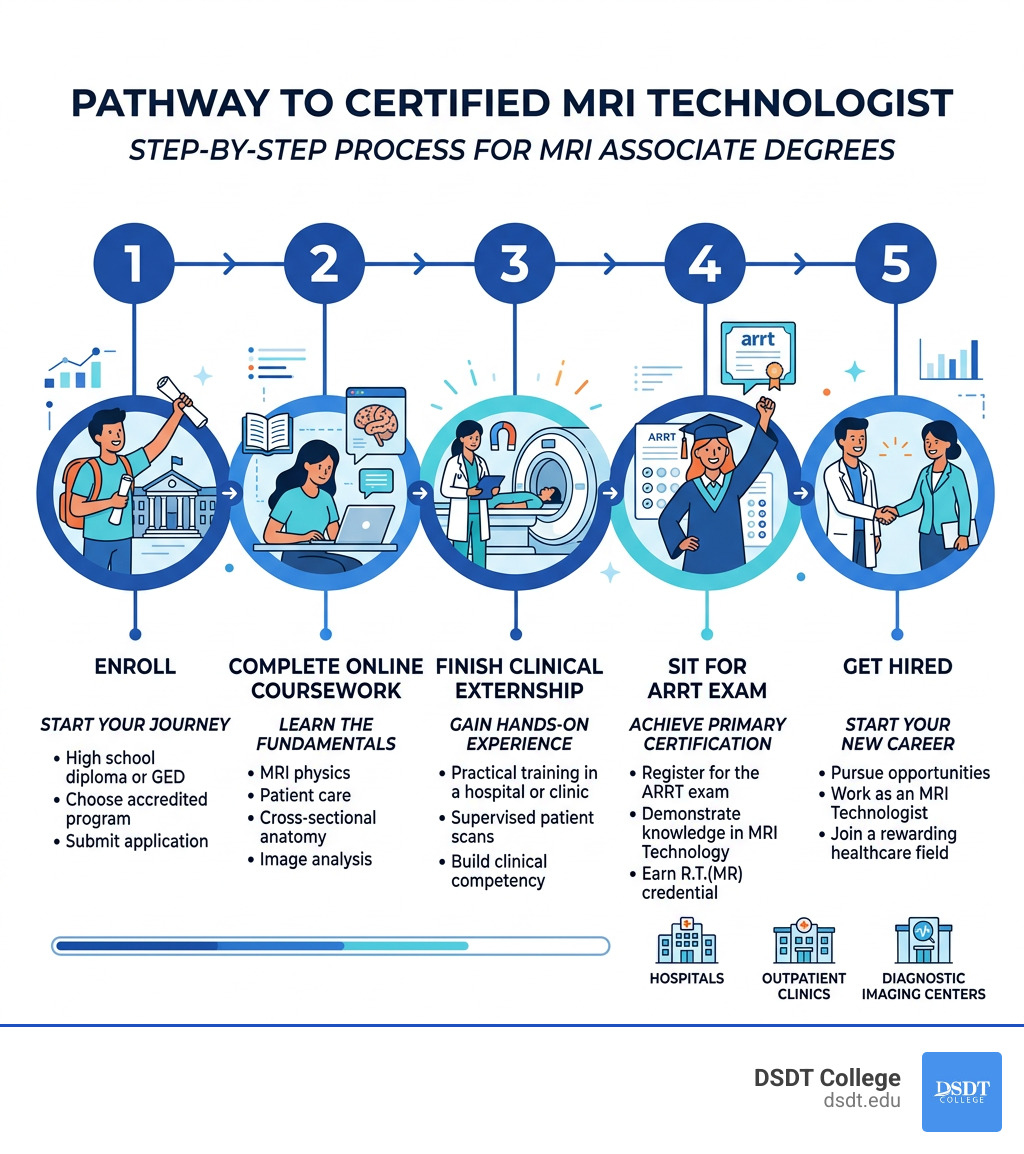
Understanding MRI Associate Degrees and the Primary Pathway

An Associate of Applied Science (AAS) in MRI Technology is more than just a piece of paper; it is a comprehensive technical foundation. For many years, the traditional route to becoming an MRI technologist required first becoming a Radiologic Technologist (X-ray tech). However, the Primary Pathway changed the game.
This pathway allows students to go straight into MRI specialization. By choosing a program recognized by the American Registry of Radiologic Technologists (ARRT) as a primary eligibility route, you focus exclusively on magnetic resonance imaging from day one. This means you don’t have to spend years learning about ionizing radiation or X-ray positioning if your ultimate goal is the MRI suite.
Graduates of these programs are eligible to sit for national certification exams through the ARRT or the American Registry of Magnetic Resonance Imaging Technologists (ARMRIT). According to the Radiologic and MRI Technologists: Occupational Outlook Handbook, this field is not just growing; it is evolving with technological advancements that make MRI a cornerstone of modern medicine.
Benefits of MRI Associate Degrees vs. Certificates
While shorter certificate programs exist, they often require you to already hold a degree in another imaging modality. MRI Associate Degrees offer several distinct advantages:
- Academic Credibility: An AAS degree is a recognized college credential that carries weight with major hospital systems and HR departments.
- Comprehensive Training: You receive a well-rounded education including general education courses that improve communication and critical thinking skills.
- Higher Earning Potential: Many employers offer higher starting pay grades for degree holders compared to those with non-degree certificates.
- Long-term Employability: A degree provides a stronger foundation if you eventually decide to pursue a Bachelor’s degree or move into management.
Prerequisites and Admission Requirements
At DSDT College, we believe in accessibility. We have removed many of the traditional barriers to higher education to help you get started faster. Typical requirements include:
- High School Diploma or GED: A standard requirement for any accredited college program.
- No SAT/ACT Required: We focus on your potential and your future, not standardized test scores from the past.
- Background Checks & Screenings: Because you will be working in clinical environments with patients, you must pass a criminal background check and drug screening.
- Immunization Records: Standard healthcare vaccinations are required to ensure the safety of both the student and the patients during clinical rotations.
Curriculum and Technology: From Classroom to ScanLab
The curriculum for MRI Associate Degrees is a blend of hard science, technical skill, and compassionate patient care. You won’t just be reading textbooks; you’ll be diving into the physics of how magnetic fields interact with human tissue.
Key areas of study include:
- Sectional Anatomy: Learning to identify organs and tissues from a cross-sectional perspective.
- MRI Physics: Understanding radiofrequency pulses, gradients, and T1/T2 relaxation times.
- Pathophysiology: Recognizing how diseases appear on an MRI scan.
- Patient Care & Safety: Mastering the “MRI Safety Zone” protocols to prevent accidents involving the strong magnetic field.
To see the specific skills required for this role, you can explore O*NET OnLine: MRI Technologist Skills and Knowledge.
The Role of ScanLab Simulators in Online Learning
One of the biggest hurdles for online healthcare education used to be the “hands-on” component. We have solved this by utilizing ScanLab, a state-of-the-art MRI simulator.
ScanLab allows us to offer virtual training that mirrors a real clinical environment. Students can practice:
- Protocol Optimization: Learning how to adjust parameters to get the clearest image.
- Risk-Free Practice: Making mistakes on a simulator is a vital part of learning that can’t happen on a multi-million dollar machine with a live patient.
- Remote Hands-on: You can master the interface of an MRI scanner from your laptop, whether you are in Detroit, Miami, or stationed at a military base.
Core Coursework and Credit Requirements
A typical program, such as the ones we offer, involves a structured sequence of courses. You might start with Medical Terminology and Anatomy, then progress into MRI Instrumentation and Advanced Procedures. Most programs require around 70 to 100+ credit hours, depending on the institution’s specific semester or clock-hour structure. At DSDT College, our focus is on an accelerated path that respects your time without sacrificing the quality of the education.
Clinical Externships and Professional Certification
While the “classroom” part of MRI Associate Degrees can be done 100% online, the clinical externship is where the magic happens. This is your opportunity to step into a real hospital or imaging center and work alongside seasoned professionals.
Daily Responsibilities of an MRI Technologist
What does a day in the life look like? It’s a mix of technology and people:
- Patient Screening: This is the most critical step. You must ensure the patient has no metal implants, pacemakers, or shrapnel that could be dangerous in the magnet.
- Contrast Administration: Many scans require an injection of contrast media (gadolinium) to highlight specific areas.
- Positioning: You’ll use your knowledge of anatomy to place the patient and the “coils” (the antennas that receive the signal) perfectly.
- Scanning: Operating the computer console to run sequences and evaluate image quality in real-time.
- Collaboration: Working with radiologists to ensure they have the exact views needed for a diagnosis.
Preparing for National Registry Exams
The goal of any reputable program is to get you certified. We provide extensive preparation for the ARRT and ARMRIT exams. This includes mock exams and registry reviews that mimic the 200-question national tests.
By following the ARRT Primary Pathway, our students are eligible for certification immediately upon graduation and completion of their clinical competencies. You can find more about these standards through the Recognized Educational Programs – ARRT.
Career Outlook: Salaries and Job Opportunities
The financial rewards for pursuing MRI Associate Degrees are substantial. As of May 2023, the median annual wage for MRI Technologists was $83,740.
The job market is incredibly diverse. While over half of MRI techs work in hospitals, there are increasing opportunities in:
- Outpatient Imaging Centers: Often offering more “9-to-5” schedules.
- Mobile Imaging Units: Traveling to different facilities to provide MRI services.
- Research Facilities: Working on the cutting edge of medical science.
- Physician Offices: Specialized clinics (like orthopedics) that have their own in-house scanners.
How to Enroll in MRI Associate Degrees Online
We have streamlined the enrollment process to be as mobile-friendly and flexible as possible. At DSDT College, we offer:
- Accelerated Paths: Complete your degree in as little as 18–24 months.
- Nationwide Accessibility: Our online theory courses allow you to study from anywhere in the U.S.
Military and Veteran Education Benefits
We take great pride in being a military-friendly institution. If you are a veteran or an active-duty service member, your education could be fully or partially funded.
- Post-9/11 GI Bill®: We accept VA benefits to help veterans transition into high-paying civilian careers.
- MyCAA: Military spouses can take advantage of the MyCAA program for career-focused training.
- Tuition Assistance (TA): Active-duty soldiers can use TA to advance their education while serving.
- Portability: Because our theory is 100% online, your education moves with you if you are PCS’ing (Permanent Change of Station).
Frequently Asked Questions about MRI Degrees
Can I become an MRI tech without being an X-ray tech first?
Yes! This is the primary benefit of the Primary Pathway. You can enroll directly in an MRI-specific associate degree program. You will learn all the necessary patient care and safety protocols without needing a prior radiography license.
How long does it take to complete an MRI associate degree?
Most students complete their degree in 18 to 24 months. This includes your online coursework, ScanLab simulations, and your hands-on clinical externship at a local facility.
Are online MRI programs accredited?
Yes, but you must ensure the program is nationally accredited and recognized by the ARRT. DSDT College is a nationally accredited institution, ensuring your degree meets the high standards required for national certification and employment.
Conclusion
The path to a rewarding healthcare career doesn’t have to be a decade-long journey. With MRI Associate Degrees, you can combine your interest in technology with a desire to help others in a high-demand, high-paying field.
At DSDT College, we provide the tools, the technology (like ScanLab), and the military-friendly support you need to succeed. Whether you are in Detroit, Houston, Phoenix, or anywhere in between, our 100% online theory and nationwide clinical partnerships are designed to get you career-ready.