The Real Path to High-Paying Tech Jobs Training in 2026
High-paying tech jobs training is one of the fastest ways to break into a six-figure career — no four-year degree required. Here are the top roles you can target right now:
| Tech Role | Average Salary | Training Path |
|---|---|---|
| Cybersecurity Analyst | $91,000 | CompTIA Security+, bootcamp |
| UX Designer | $85,000 | Google Career Certificate, self-taught |
| Systems Analyst | $84,000 | Certifications + on-the-job training |
| Web Developer | $82,484 | Coding bootcamp, online courses |
| Data Analyst | $73,823 | Google Career Certificate, bootcamp |
These roles are accessible through short-term programs — often just 3 to 6 months long.
The tech industry has a skill shortage, not a people shortage. This means the door is open — if you have the right training.
Whether you are a recent high school graduate, a career changer, a veteran, or someone exploring healthcare technology like MRI, there is a structured path into tech that fits your timeline and budget.
This guide breaks down exactly which roles pay the most, which certifications get you there fastest, and how to land the job once you are trained.
I’m Jamie Kothe, a workforce development specialist and veteran training program developer with experience building tech-focused career pathways — including high-paying tech jobs training programs — across multiple industries. In the sections ahead, I will walk you through every step of the process so you can make a confident, informed choice.
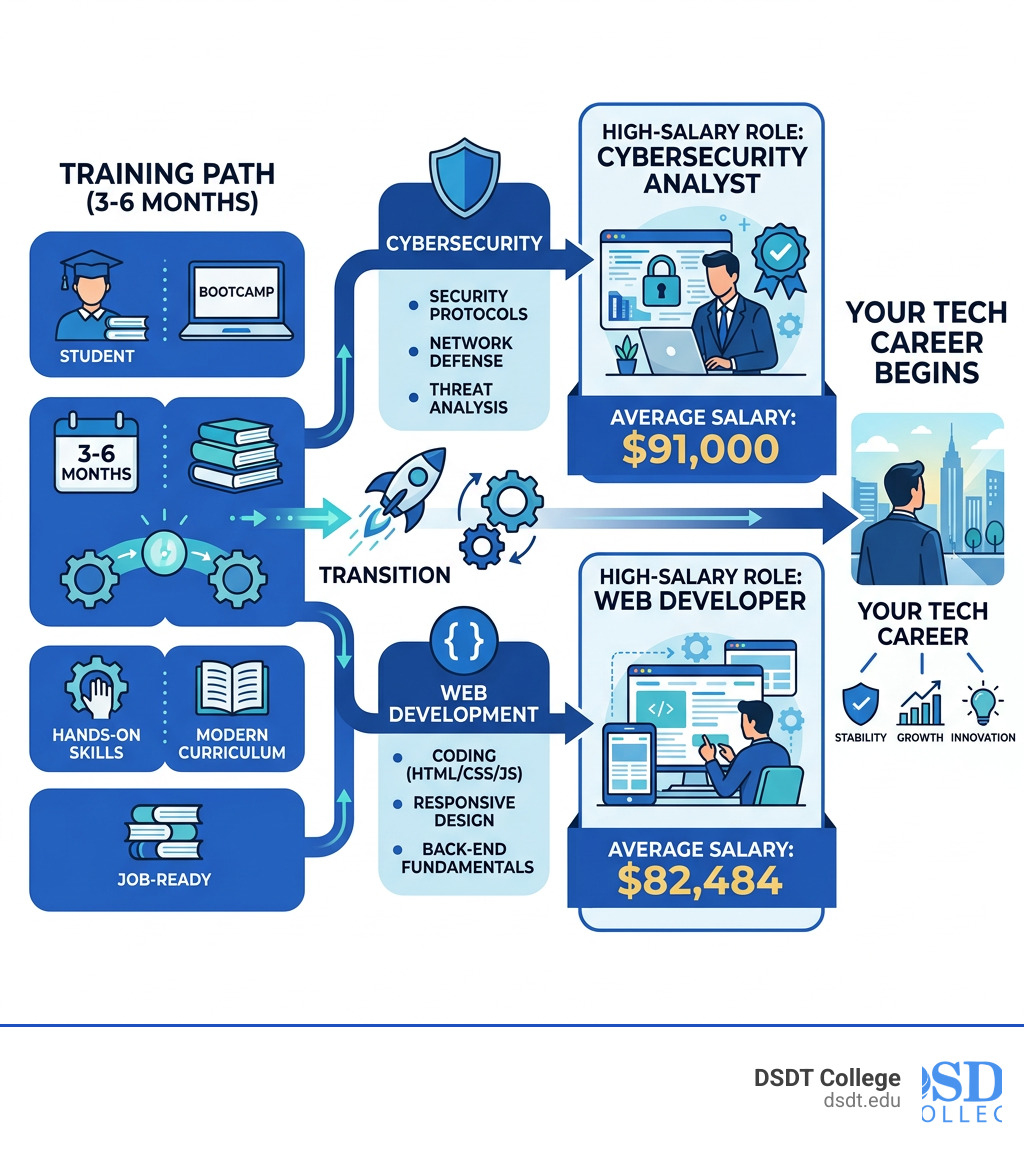
Top Roles Accessible via High-Paying Tech Jobs Training
In the current economy, the traditional four-year degree is no longer the only gatekeeper to a lucrative career. Companies are shifting toward “skills-first” hiring, where what you can do matters more than where you went to school. This shift has opened the floodgates for high-paying tech jobs training that focuses on specific, high-demand skill sets.

Cybersecurity Analyst
Cybersecurity remains one of the most critical fields in the modern world. These professionals protect an organization’s computer networks and systems from increasingly sophisticated cyber threats. With a median salary of $91,000 per year, this role is highly accessible without a degree if you possess the right certifications. The field offers substantial growth opportunities as security becomes paramount for every business, from small startups to global banks.
Web Developer
Web developers are the architects of the digital world. With an average salary of $82,484, this career is a staple of the bootcamp model. Whether you are building front-end interfaces or back-end databases, the ability to write clean, functional code is a high-value currency.
Data Analyst
Data is the new oil, and data analysts are the ones who refine it. By analyzing complex data sets to uncover trends and generate insights, these professionals help businesses make informed decisions. The average salary sits around $73,823, and entry is entirely possible through alternative training pathways like specialized certificates.
UX (User Experience) Designer
If you have an eye for design and an interest in how people interact with technology, UX design is a fantastic path. UX designers earn an average of approximately $85,000. Many start through self-taught paths, internships, or short-term immersive programs that focus on building a strong portfolio rather than a design degree.
Systems Analyst
Systems analysts command a median salary of around $84,000 per year. They bridge the gap between business requirements and IT solutions, ensuring that an organization’s tech infrastructure aligns with its goals. This role often requires a mix of technical knowledge and business acumen, both of which can be developed through targeted training.
AI Engineer and Machine Learning Specialist
As we move further into 2026, AI and Machine Learning (ML) are amplifying the impact of software solutions exponentially. AI engineers are responsible for building the models that drive automation and intelligence. While some high-level research roles require a Master’s degree, many implementation and development roles are becoming accessible to those who have mastered Python and specific AI frameworks through intensive high-paying tech jobs training.
Comparative Salary and Growth Table
| Occupation | Average Salary | Education/Training Needed |
|---|---|---|
| Software Developer | $130,160 | Bootcamp or Degree |
| Information Security Analyst | $120,360 | Certifications (CompTIA, CISSP) |
| Database Architect | $134,700 | Specialized Certs or Degree |
| Network Architect | $129,840 | CompTIA A+ Certification + CCNA |
| Machine Learning Engineer | $206,000 | Advanced Training/Bootcamp |
Essential Certifications for High-Paying Tech Jobs Training
When you are looking for the best return on investment (ROI), certifications are your best friend. They provide a standardized way to prove your skills to employers in a fraction of the time it takes to earn a degree.
The 3-6 Month Fast Track
Short-term certificates are designed to get you “job-ready.” For example, the Google Career Certificates are highly respected and even offer a recommendation from ACE® for up to 15 college credits. This is equivalent to five bachelor’s level courses, providing a bridge if you eventually decide to pursue a degree.
Core IT and Cybersecurity Certifications
- CompTIA A+: This is the industry standard for establishing a career in IT. It covers mobile devices, networking technology, hardware, and cloud computing.
- CompTIA Security+: A global certification that validates the baseline skills necessary to perform core security functions.
- Cisco Certified Network Associate (CCNA): This cert proves you have what it takes to navigate the ever-changing landscape of IT, covering networking fundamentals, IP services, and security fundamentals.
- Certified Information Systems Security Professional (CISSP): While more advanced, this is often cited as a “gold standard” in cybersecurity for those looking to move into senior roles.
Specialized Pathways: AI, NLP, and Healthcare
For those interested in the cutting edge, Python programming is the foundational language for Natural Language Processing (NLP) and AI. Training in these areas often involves building real-world “AI Agents” or working with datasets like Waymo for autonomous vehicle technology.
In the Midwest—specifically in cities like Detroit, Lansing, and Cleveland—there is also a massive demand for healthcare technology. The ARRT Primary Pathway for MRI Technology is a prime example of a non-traditional tech role. By completing an Associate of Applied Science in MRI Technology, you can enter a high-paying medical imaging field that relies heavily on advanced software and hardware systems.
Technical and Soft Skills for Career Success
Mastering the technical side is only half the battle. To truly excel in a high-paying tech career, you need a balanced toolkit.
Technical Mastery
- Programming Languages: JavaScript remains essential for web development, while Python is the king of data science and AI.
- AI/ML Integration: Knowing how to responsibly wield AI and ML is becoming a requirement for modern software engineers. It’s about more than just coding; it’s about choosing where and when to apply these powerful tools.
- Software Engineering Fundamentals: Understanding data structures, algorithms, and systems design is what separates a “coder” from an “engineer.”
The Power of Soft Skills
In the tech industry, soft skills are often on par with technical skills. We have found that the most successful graduates are those who can bridge the gap between business needs and technical solutions.
- Problem-Solving and Critical Thinking: You aren’t just writing code; you are solving a business problem.
- Technical Communication: Can you explain a complex cloud architecture to a non-technical stakeholder? If so, you are ahead of the pack.
- Empathy and Resourcefulness: Especially in UX design and systems analysis, understanding the user’s pain points is vital.
- Ethical AI Development: As AI becomes more influential, the ability to develop it ethically and securely is a major selling point for employers.
Proven Strategies for Landing a Tech Role Without a Degree
Once you have completed your high-paying tech jobs training, the next step is the job hunt. This requires a strategic approach.
Portfolio Building and Proof of Work
In tech, your portfolio is your resume. Use platforms like GitHub to host your code and show your progression. If you are a UX designer, a clean, case-study-driven portfolio is non-negotiable.
- Freelance Marketplaces: Don’t wait for a full-time offer to start working. Platforms like Upwork and Fiverr allow you to take on project-based work that builds your resume and proves your skills to future employers.
Networking and Community
The “hidden job market” is real. Networking through LinkedIn, attending local tech meetups in cities like Chicago or Dallas, and joining online forums or Slack groups can lead to referrals.
- Mentorship: Finding a mentor who is already in the role you want can provide invaluable guidance and potentially lead to job leads.
- Apprenticeships: Many large organizations, including major banks, have invested hundreds of millions into workforce development initiatives to connect youth and career changers to tech jobs via paid apprenticeships.
Interview Preparation
Tech interviews can be grueling. They often involve technical tasks, coding challenges, and multiple rounds.
- Research: Look into the company’s specific interview process.
- Fundamentals: Refresh your knowledge of computer science basics.
- Communication: Practice explaining your problem-solving process out loud. Employers want to see how you think, not just the final answer.
Frequently Asked Questions about High-Paying Tech Jobs Training
Can I get a high-paying tech job without a degree?
Absolutely. The research shows that roles like Cybersecurity Analyst ($91k), Systems Analyst ($84k), and Web Developer ($82k) are all accessible through alternative pathways. Major global corporations frequently hire graduates from intensive coding bootcamps and certification programs. The key is having a strong portfolio and industry-recognized certifications to prove your competence.
Which certifications offer the best ROI for high-paying tech jobs training?
For quick entry, the CompTIA Security+ and Google Career Certificates offer excellent ROI. They are relatively low-cost and can be completed in under six months. For those looking at networking, the CCNA is a heavy hitter. If you are looking at the medical side of tech, the ARRT certification for MRI Technologists provides a very stable, high-paying career path with a clear regulatory framework.
How long does high-paying tech jobs training typically take?
Most intensive programs and certifications take between 3 to 6 months. Some part-time “learn while you earn” programs may take 9 months to a year, allowing you to balance training with your current job. For example, an IT certification or a cybersecurity program can often be completed in just 3 to 6 months, while specialized clinical training for MRI technology follows a structured timeline designed for rapid career entry.
Conclusion
The digital economy is evolving faster than traditional education can keep up. This has created a unique window of opportunity for anyone willing to put in the work through high-paying tech jobs training. Whether you are mastering the nuances of NLP, securing networks against cyber threats, or driving the evolution of intelligence systems, the path to a high-salary career is more accessible than ever.
At DSDT College, we focus on this exact intersection of technology and opportunity. Our programs in Information Technology, Cybersecurity, and MRI Technology are designed to be practical, flexible, and aligned with what employers actually need today. We serve high school graduates, adult learners, and military veterans across our locations from Detroit to Dallas, providing the hands-on learning and industry certification pathways required to succeed.
Continuous learning is the hallmark of a great tech career. From your first CompTIA cert to advanced AI engineering, the journey never truly ends—it just keeps getting more rewarding.
Start your journey with online tech training today and take the first step toward a future-proof career.