Why an Associate’s Degree in MRI Technology Is Worth Your Attention
An associate’s degree in MRI technology is one of the fastest, most direct paths into a high-demand healthcare career — and if you’re weighing your options, here’s what you need to know upfront:
Quick Facts: Associate’s Degree in MRI Technology
| Factor | Details |
|---|---|
| Program Length | 18–21 months (some up to 2 years) |
| Credential Earned | Associate of Applied Science (AAS) or Academic Associate of Science |
| Certification Pathways | ARRT (MR) or ARMRIT |
| Median Annual Salary | $77,360 |
| Job Growth (National) | 6% through 2031 |
| Typical Work Settings | Hospitals, clinics, outpatient imaging centers |
| Clinical Hours Required | ~1,000 hours (externship/clinical rotations) |
MRI technology sits at the intersection of cutting-edge equipment and direct patient care. Demand is rising fast — some states like Arizona project 39% employment growth through 2030. Yet many people don’t realize you can enter this field with just a two-year degree.
This guide breaks down everything: what programs look like, how accreditation and certification work, what the job actually pays, and how to compare your options.
I’m Jamie Kothe, an academic leader at DSDT College, where I support career-focused programs including allied health imaging — the very field that an associate’s degree in MRI technology prepares students to enter. My work connecting curriculum to real employer needs gives me a practical perspective on what it actually takes to succeed in this career path.
What is an MRI Technologist and What Do They Do?
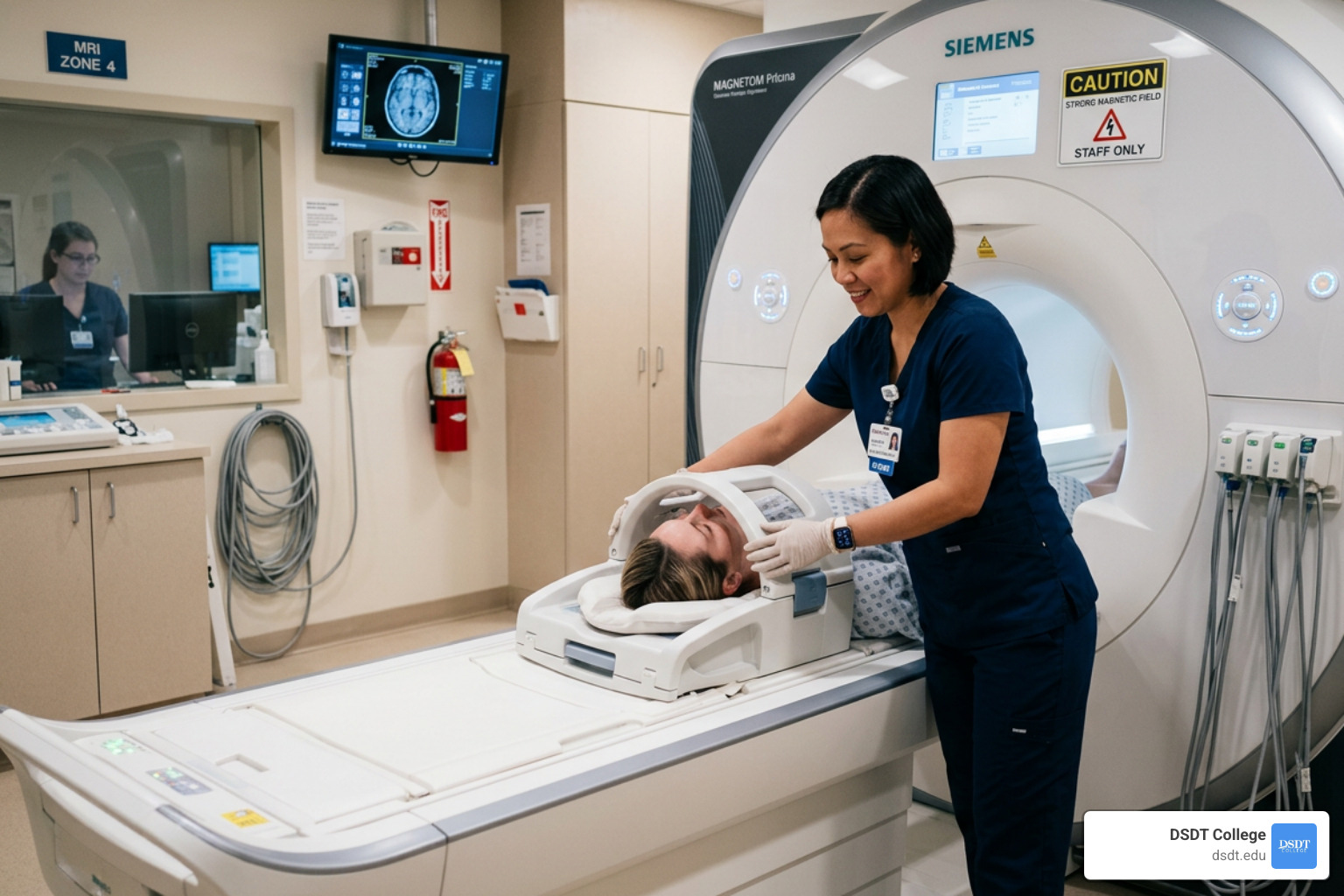
If you’ve ever wondered who operates those massive, humming machines that produce incredibly detailed images of the human body, that’s an MRI technologist. Magnetic Resonance Imaging (MRI) technologists are specialized healthcare professionals who use a combination of powerful magnetic fields and radio waves to create 3D images of internal organs, soft tissues, and bones.
Unlike X-rays or CT scans, MRI doesn’t use ionizing radiation. This makes it a vital tool for diagnosing everything from ligament tears to neurological disorders. But the job is about much more than just pushing buttons. As an MRI tech, we are responsible for:
- Safety Screening: This is the most critical part of our day. Because the MRI magnet is always “on,” we must screen every patient for internal metal implants (like pacemakers or shrapnel) that could be dangerous. You can learn more about these rigorous MRI safety and certification standards to see just how much responsibility falls on the technologist.
- Patient Care: Many patients are claustrophobic or anxious about the loud noises of the scanner. We are the ones who calm them down, explain the procedure, and ensure they are comfortable throughout the scan.
- Image Evaluation: We don’t just take the picture; we evaluate it in real-time. We check for clarity and ensure that the cross-sectional anatomy is captured accurately so the radiologist can make a proper diagnosis.
- Equipment Maintenance: We keep the scanners in top shape, ensuring they are calibrated and cleaned between every patient.
Essential Skills for an Associate’s Degree in MRI Technology
To thrive while earning your associate’s degree in MRI technology, you’ll need a specific blend of “soft” and “hard” skills.
- Attention to Detail: Missing a tiny piece of metal during a safety screen or a slight blur in an image can have serious consequences.
- Technical Proficiency: You’ll be working with some of the most advanced computers in the medical world. You need to be comfortable navigating complex software.
- Compassion: You’ll meet people on some of their worst days. Being able to provide a steady, kind presence is non-negotiable.
- Math and Science Skills: You’ll need to understand the physics of magnetism and be able to calculate contrast dosages or adjust imaging parameters.
- Physical Stamina: Expect to be on your feet most of the day, helping position patients and moving heavy equipment.
Choosing an Associate’s Degree in MRI Technology
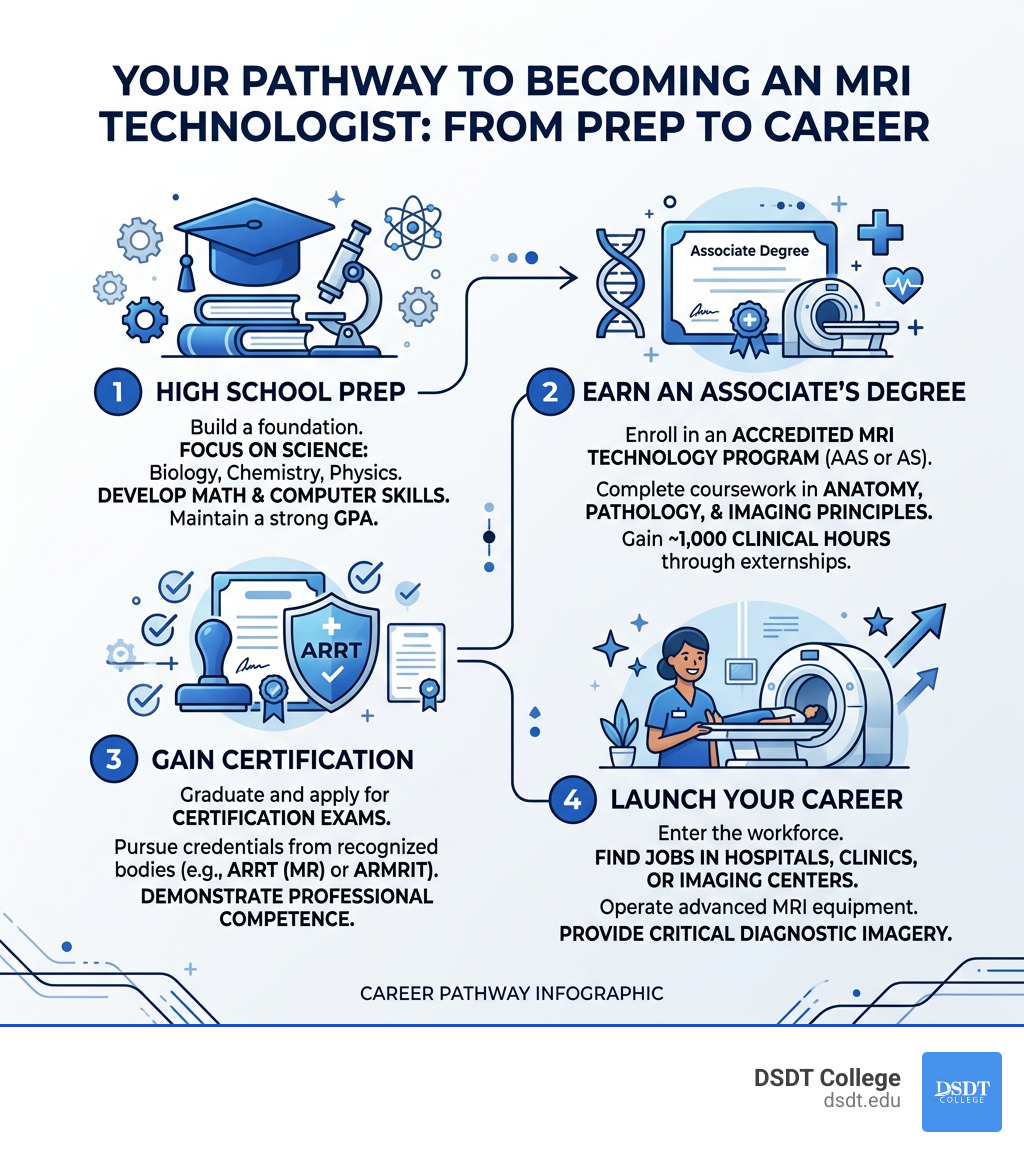
When you start looking at schools, you’ll notice a few different paths. The most common choice is the associate’s degree in MRI technology, usually offered as an Associate of Applied Science (AAS). These programs generally take between 18 and 21 months to complete.
One of the most important decisions you’ll make is choosing between the ARRT Primary Pathway and the ARMRIT Pathway.
- ARRT Primary Pathway: This is the “gold standard” for many employers. By graduating from an ARRT-approved associate program, you become eligible to sit for the American Registry of Radiologic Technologists (ARRT) exam immediately. This pathway is designed for those who want to enter MRI as their primary specialty.
- ARMRIT Pathway: The American Registry of Magnetic Resonance Imaging Technologists focuses specifically on MRI. You can find ARMRIT accredited programs that provide a direct route into the field without requiring a general radiology background.
Many modern programs now offer a hybrid learning model. This is great for busy adults because you can complete your lectures and “book work” online, then come to campus or a local lab for your hands-on training. This flexibility is a game-changer for those of us balancing work or family while pursuing our degrees.
Curriculum and Clinical Experience
What exactly do you study in an associate’s degree in MRI technology? It’s a mix of heavy science and practical medical ethics. You aren’t just learning how to run a machine; you’re learning how the human body works at a cellular level.
Typical coursework includes:
- Anatomy and Physiology: A deep dive into the systems of the body.
- MRI Physics: Understanding how magnets and radiofrequency pulses create images.
- Pathophysiology: Learning how diseases look on a scan so you know what to look for.
- Cross-Sectional Anatomy: Learning to recognize body parts from a “sliced” perspective (axial, sagittal, and coronal planes).
- Patient Care and Ethics: Handling sensitive patient data and ensuring professional conduct.
Most programs also require you to complete CPR and first aid training before you can step foot in a clinical setting. In fact, many states now require high school graduates to have CPR training as a baseline.
Hands-on Training in an Associate’s Degree in MRI Technology Program
You can’t learn MRI solely from a textbook. Clinical experience—often called an externship—is the heart of any reputable program. Most associate degrees require around 1,000 hours of clinical experience.
During your clinical rotations, you’ll work in actual hospital settings or diagnostic imaging centers. You’ll be paired with a mentor (a registered MRI tech) who will guide you as you:
- Screen real patients for safety.
- Position patients for various types of scans (head, spine, joints, etc.).
- Select the correct pulse sequences on the computer.
- Learn how to maintain and troubleshoot the equipment.
This hands-on time is often where students find their first jobs. Many hospitals use externships as a “long-form interview” to see who has the best skills and work ethic.
Certification and Licensing Requirements
Once you have your associate’s degree in MRI technology in hand, you aren’t quite finished. To work in most reputable facilities, you need to become “registered.”
The most common credential is the ARRT certification and registration. To earn this, you must demonstrate clinical competency (those 1,000 hours we talked about) and pass a rigorous national exam. If you chose the ARMRIT route, you’ll take their specific certification exam.
Wait, what about licensing? Certification is national, but licensing is state-level. About 75% of states require a license to practice. You should always check with your state-specific licensing boards to see exactly what paperwork you need to file after passing your exams.
To keep your “Registered Technologist” (RT) status, you’ll need to complete continuing education (CE). For ARRT, this usually means 24 credits every two years. For ARMRIT, it’s a three-year renewal cycle. This ensures that as technology changes, we change with it!
Career Outlook: Salary and Job Growth
Is the investment in an associate’s degree in MRI technology worth it? The data says yes. MRI technologists generally earn more than general radiologic (X-ray) techs because of the specialized nature of the equipment.
According to Bureau of Labor Statistics data, the median annual salary for MRI technologists was $77,360 as of May 2021. The top 10% of earners—often those in high-cost-of-living areas or with advanced safety certifications—made over $100,870.
The job growth is also very encouraging:
- National Average: 6% growth through 2031.
- New Jersey: 12% growth in New Jersey over the next decade.
- California: Projected 22% growth in California (2018-2028).
- Arizona: A staggering 39% growth in Arizona through 2030.
Where MRI Technologists Work
Once you graduate, you aren’t limited to just big city hospitals. MRI techs are needed everywhere.
- Hospitals: About half of all MRI techs work in state, local, or private hospitals. These roles often involve emergency cases and shift work.
- Diagnostic Laboratories: These are dedicated imaging centers where patients come specifically for scans.
- Physician Offices: Some large orthopedic or neurology practices have their own in-house MRI suites.
- Mobile Imaging Units: Some techs travel in specially equipped trailers to provide MRI services to rural areas or smaller clinics that don’t have their own machines.
Frequently Asked Questions about MRI Technology
What are the typical admission requirements for an MRI program?
Every school is a little different, but most will require a high school diploma or GED. Many programs, including those at DSDT College, look for strong grades in math and science. You may need to pass an entrance exam like the Wonderlic (often requiring a score of 21 or higher). Because you’ll be working in healthcare, expect a background check, drug screening, and a list of required immunizations. Also, don’t forget the high school CPR requirements that many states now have in place.
How much does an associate’s degree in MRI technology cost?
Tuition varies based on whether you choose a public community college or a private career college. However, almost all accredited programs offer financial aid to those who qualify. This can include federal Pell Grants, student loans, and veteran benefits for those transitioning from the military. We always recommend students search for outside scholarships on sites like FastWeb scholarships to help bridge the gap.
Can radiologic technologists transition into MRI?
Absolutely! This is known as the post-primary pathway. If you are already an RT(R) (Registered Technologist in Radiography), you don’t need to earn a whole new associate’s degree in MRI technology. Instead, you can complete “structured education” and document a specific number of clinical repetitions to become eligible for the ARRT (MR) credential. It’s a great way to “level up” your career and increase your earning potential.
Conclusion
The path to becoming a medical imaging professional is clearer than ever. By pursuing an associate’s degree in MRI technology, you are positioning yourself in a field that offers stability, a great salary, and the chance to truly help people every single day. Whether you are a high school graduate looking for a practical career or a veteran transitioning to civilian life, the allied health industry has a place for you.
At DSDT College, we are committed to providing the hands-on training and certification-based education that leads directly to employment. If you’re ready to take the next step toward a future in diagnostic imaging, we invite you to explore our Associate of Applied Science in MRI Technology and see how our ARRT Primary Pathway can launch your career. The “lowdown” is simple: the technology is amazing, the demand is high, and the opportunity is yours for the taking.