From Service to Scanner: Why an MRI Career for Veterans Makes Perfect Sense
An MRI career for veterans is one of the most natural transitions out of military service — combining technical precision, mission-driven work, and strong earning potential in a field that’s actively hiring.
Here’s a quick overview of what this career path looks like:
| Factor | Details |
|---|---|
| Role | Diagnostic Radiologic Technologist (MRI) |
| Key Certifications | ARRT (R) + Advanced ARRT (MR) |
| Education Required | 24-month JRCERT-accredited program |
| VA Salary Range | $56,061 – $110,441/year (GS-5 to GS-10) |
| Top Employer | Department of Veterans Affairs (VA) |
| Job Demand | Listed on VA FY25 Occupational Staffing Shortages |
| Annual PTO | 37–50 days (leave + sick days + federal holidays) |
Veterans bring something most candidates simply don’t have: real experience working in high-stakes environments where precision and protocol aren’t optional. Military training builds exactly the mindset that MRI work demands — attention to detail, strict safety compliance, and calm under pressure.
And the demand is real. The VA has flagged MRI technologist roles as an active staffing shortage for FY25, meaning qualified candidates — especially those with military backgrounds — are genuinely needed right now.
I’m Jamie Kothe, an academic leader and workforce development professional at DSDT College, where I help veterans and career changers find clear pathways into high-demand fields like allied health imaging. Supporting students in building an MRI career for veterans is central to the work we do every day at DSDT. Let’s walk through exactly what this career path looks like — and how you can get there.
The Transition: How Military Experience Prepares You for an MRI Career for Veterans
Transitioning from a military uniform to scrubs might seem like a leap, but the core competencies required for a successful MRI career for veterans are often already forged in the heat of service. Whether you served in a technical MOS, healthcare, or combat arms, the “veteran mindset” is a premium asset in the radiology suite.
Attention to Detail and Safety Protocols
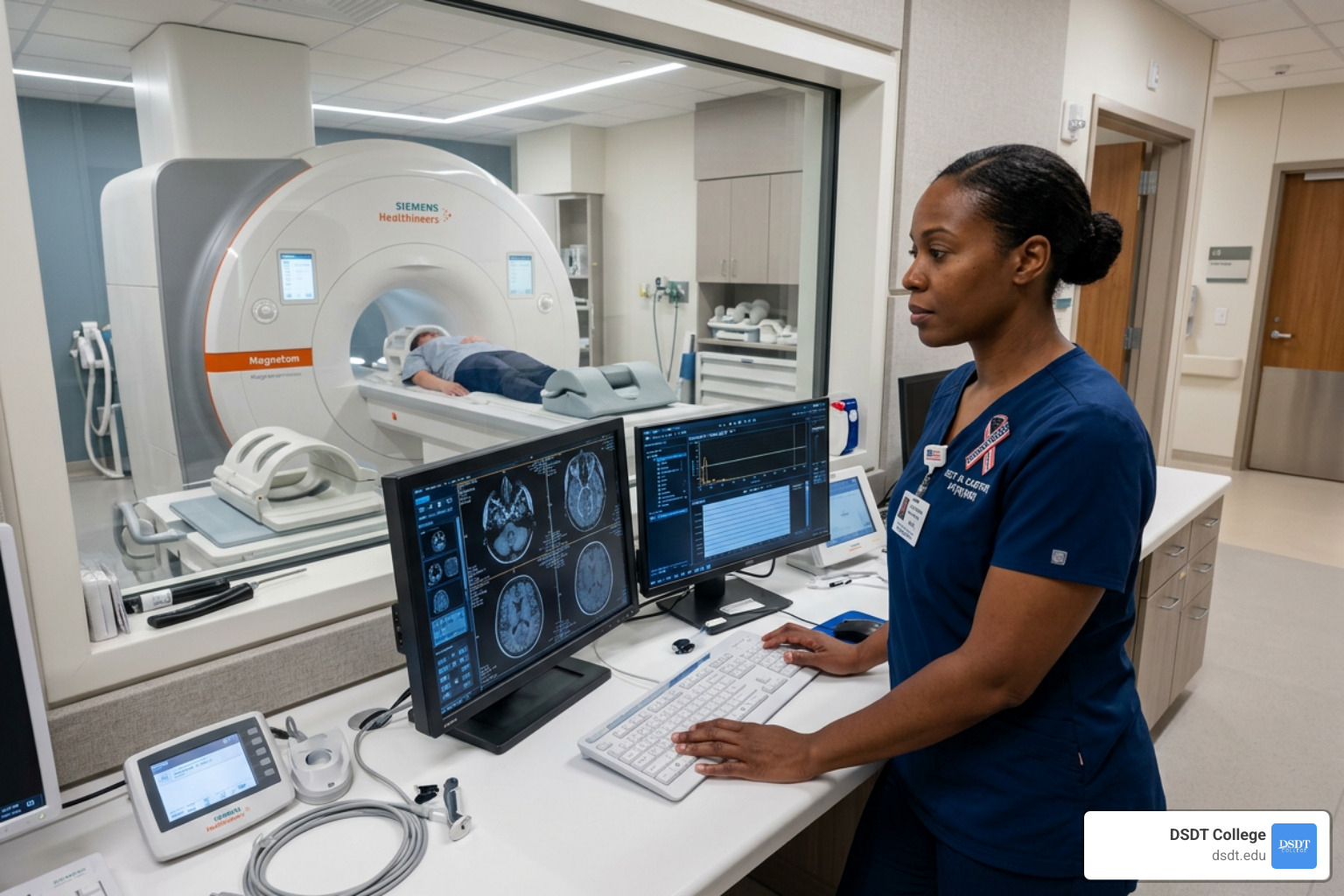
In Magnetic Resonance Imaging, there is no room for “close enough.” Operating a superconducting magnet requires a fanatical devotion to safety protocols. Just as a soldier clears a weapon or a technician checks a manifest, an MRI technologist must meticulously screen patients for ferrous objects, pacemakers, and implants. A single oversight in the magnetic environment can be catastrophic. Veterans understand that “Standard Operating Procedures” (SOPs) are written in blood, making them the most reliable candidates for maintaining a safe imaging environment.
Thriving in High-Pressure Environments
MRI suites can be intense. You may be scanning a patient who is claustrophobic, someone on a ventilator, or a fellow veteran dealing with significant service-connected injuries. The ability to remain calm, follow complex technical protocols, and provide compassionate patient care under pressure is a hallmark of military service. According to Magnetic Resonance Imaging Technicians — Today’s Military, military MRI roles often involve working in mobile field hospitals during combat situations. If you can handle a diagnostic scan in a tent near a flight line, a modern VA hospital in Miami or Chicago will feel like a well-oiled machine.
Navigating Certification and Education for an MRI Career
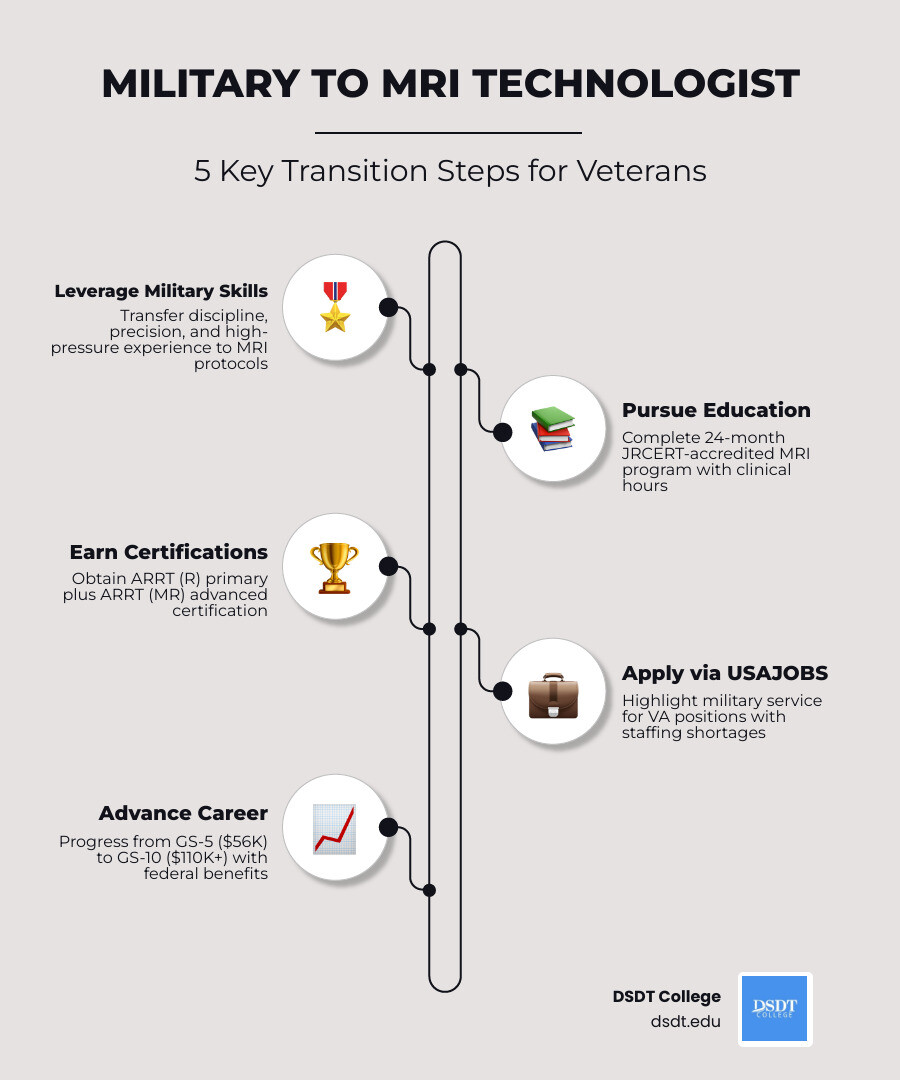
While your experience is a massive head start, the civilian and federal workforce requires specific credentials. To secure a high-paying MRI career for veterans, you typically need to follow the ARRT (American Registry of Radiologic Technologists) pathway.
- ARRT (R): Most start by becoming a Registered Radiologic Technologist (X-ray).
- ARRT (MR): This is the advanced specialty certification required for independent MRI duties.
- JRCERT Accreditation: Federal employers like the VA specifically look for candidates who have completed a program accredited by the Joint Review Committee on Education in Radiologic Technology (JRCERT).
At DSDT College, we recognize that veterans need a streamlined, supportive environment to bridge the gap between service and certification. Our MRI Technology Associate Degree is designed to meet these rigorous standards while offering the flexibility that adult learners and transitioning service members require.
Transferable Skills from Military Health Science
If you worked in a medical capacity while serving, you likely already have a foundation in:
- Cross-sectional Anatomy: Understanding how the body looks in “slices” is the bread and butter of MRI.
- Radiation Protection: While MRI uses magnets rather than ionizing radiation, the principles of ALARA (As Low As Reasonably Achievable) and medical ethics carry over perfectly.
- Equipment Calibration: Military technicians are experts at ensuring hardware operates within strict tolerances—a vital skill when adjusting radio-frequency coils and pulse sequences.
Working at the VA: Roles, Responsibilities, and Advanced Technology
For many, the ultimate goal of an MRI career for veterans is to work at the Department of Veterans Affairs (VA). It is the largest integrated healthcare system in the nation, and it offers a unique opportunity to serve your brothers and sisters in arms.
The Daily Life of a VA MRI Technologist
Your role at the VA goes far beyond “pushing a button.” You are a critical part of the diagnostic team. Key responsibilities include:
- Patient Screening: Verifying patient identification using at least two identifiers per Joint Commission standards.
- Protocol Management: Adjusting imaging parameters mid-scan to better visualize pathology based on the radiologist’s direction.
- Contrast Administration: Monitoring patients for physiological changes during contrast injections and responding to any adverse reactions.
- Safety Leadership: Ensuring that only “MRI Safe” equipment enters the magnetic zone.
Impact of an MRI Career for Veterans on the VA Mission
Working at the VA provides a level of mission-driven fulfillment that the private sector often lacks. You aren’t just processing “customers”; you are providing personalized care to those who served. As Samantha Kurtz, a lead technician at the Butler VA, points out, having in-house radiology is vital because it prevents the slow process of sending veterans to external partners. By being part of the VA team, you ensure that your fellow Vets get faster diagnoses and quicker treatment.
Advanced Imaging and AI in Federal Healthcare
The VA is at the forefront of medical technology. They are currently piloting AI tools to serve as a “second pair of eyes” for radiologists. As a technologist, you will work with:
- 3D Reconstruction: Turning “slices” into detailed 3D models of the heart, brain, or joints.
- Interventional Radiology: Assisting in minimally invasive procedures guided by imaging.
- Advanced PACS Systems: Seamlessly sharing images across the entire VA network so a veteran can be scanned in Detroit and have their results reviewed by a specialist in Tampa instantly.
To learn more about how our curriculum prepares you for these advanced environments, check out more info about DSDT programs.
Compensation and Benefits: GS Pay Grades and Federal Perks
One of the most attractive aspects of an MRI career for veterans within the federal system is the transparency and stability of the General Schedule (GS) pay scale. Unlike the private sector, where salaries can be a “black box,” the VA provides clear pathways for raises and promotions.
Understanding the GS Scale for MRI Technologists
In the VA, MRI technologists typically fall between GS-5 and GS-10, depending on education and experience.
| Grade | Typical Salary Range | Experience/Education Requirements |
|---|---|---|
| GS-5 | $56,061 – $72,880 | Entry-level; completion of 24-month accredited program. |
| GS-7 | $64,443 – $83,778 | 1 year of experience equivalent to GS-6. |
| GS-9 | $84,248 – $109,521 | 1 year of experience equivalent to GS-8; ARRT (MR) required. |
| GS-10 | $84,959 – $110,441 | Advanced specialist or lead roles; high-level technical expertise. |
Note: Salaries vary by location. For example, a GS-9 role in Miami, FL, ranges from $84,248 to $109,521 per year.
Salary Growth and Career Progression
The VA offers incredible upward mobility. Many positions are advertised with “promotion potential,” meaning you can move from a GS-5 to a GS-10 without having to compete for a new job, provided you meet the performance and experience requirements. Furthermore, federal employees receive “Step” increases within their grade, ensuring that your salary grows the longer you stay with the agency.
Federal Benefits: More Than Just a Paycheck
The total compensation package for an MRI career for veterans at the VA is nearly unmatched:
- Time Off: You can accrue between 37 and 50 days of paid time off per year (combining 13–26 days of annual leave, 13 days of sick leave, and 11 paid federal holidays).
- Retirement: You get the “three-legged stool” of federal retirement: a traditional pension (after 5 years), Social Security, and the Thrift Savings Plan (TSP) with up to a 5% VA match.
- Health Insurance: Access to the Federal Employees Health Benefits (FEHB) program, which offers some of the best coverage options in the country.
- Child Care: Eligible families can receive a child care subsidy of up to $416.66 monthly.
How to Apply for VA MRI Positions on USAJOBS
Ready to make the move? The application process for a federal MRI career for veterans is specific, but manageable if you know the steps.
The Federal Resume and USAJOBS
Your civilian resume won’t cut it here. A federal resume needs to be detailed, often 4-6 pages long, highlighting every “Knowledge, Skill, and Ability” (KSA) mentioned in the job announcement.
- Create a Profile: Head to USAJOBS and set up your account.
- Upload Documents: You will need your DD-214 (Member Copy 4), ARRT certifications, and transcripts from your JRCERT-accredited program.
- Military Service Credit: One of the perks for veterans is that your active-duty time can often be credited toward your annual leave accrual rate, meaning you start with more vacation time than a typical new hire.
- Occupational Questionnaire: Be honest but confident. This self-assessment determines if your application even makes it to the hiring manager’s desk.
Key Locations with Current Openings
The VA is currently facing a shortage of radiology professionals. We see high demand in several of our service areas, including:
- Miami, FL: Competitive salaries for GS-9 technologists.
- Madison, WI: Wide range of opportunities from entry-level to GS-10.
- Chicago, IL: Frequent openings at the VA Chicago Health Care system.
- Detroit, MI: A hub for veteran healthcare in the Midwest.
Because these roles are on the “Occupational Staffing Shortages” list for FY25, some facilities may offer recruitment incentives or expedited hiring processes.
Physical Demands and Work Schedules
Before you apply, it’s important to understand the physical nature of the job. You should expect:
- Standing: You’ll be on your feet for much of your shift.
- Patient Lifting: Assisting patients onto the MRI table requires physical strength and proper technique.
- Flexibility: While many roles are 8-hour shifts, the VA operates 24/7. You may be required to work evenings, weekends, or be “on-call” for emergencies.
Frequently Asked Questions about MRI Careers
What certifications do I need for a VA MRI role?
To work independently as an MRI technologist at the VA, you generally need the ARRT (R) (Radiography) certification as a base, followed by the advanced ARRT (MR) (Magnetic Resonance Imaging) specialty certification. Some entry-level roles (GS-5/6) may allow you to start while you work toward the specialty credential, but GS-9 and above almost always require the ARRT (MR).
How much do MRI technologists make at the VA?
The salary typically ranges from $56,061 (GS-5) to over $110,000 (GS-10) per year. This varies significantly based on your geographic location and years of experience. For instance, technologists in high-cost areas like Miami or Seattle often see higher locality pay.
Does my military medical training count toward ARRT requirements?
Often, yes! However, the ARRT has specific educational requirements. You must have graduated from an accredited program. If your military training was through a JRCERT-accredited school (like the Medical Education and Training Campus at Fort Sam Houston), you are in great shape. If not, you may need to complete an Associate Degree program, like the one offered at DSDT College, to meet the eligibility requirements for the ARRT exam.
Conclusion: Your Mission Continues in Medical Imaging
Choosing an MRI career for veterans isn’t just about finding a “job”—it’s about finding a new mission. You’ve already proven you can handle the toughest environments; now, you can use those same skills to provide life-saving diagnostic images for your community.
At DSDT College, we are proud to serve the veteran community in Detroit, Michigan, and across our many locations from Florida to Washington. We provide the career-focused education, hands-on clinical training, and certification preparation you need to step confidently into the radiology suite.
Whether you’re looking to work at a major VA medical center in Miami or a private imaging clinic in Chicago, the path starts with the right education. Your military journey gave you the discipline; let us give you the technical expertise.
Ready to start your next chapter? Explore more info about DSDT programs and see how we can help you transition from service to a successful career in MRI technology.