What Veteran Readiness and Employment Chapter 31 Actually Covers (And Why It Matters)
Veteran Readiness and Employment Chapter 31 is a federal VA program that helps veterans and service members with service-connected disabilities prepare for, find, and keep a job — or achieve independence in daily living if they cannot work.
Here’s a quick overview of what it offers:
- Who it’s for: Veterans with a service-connected disability rating of at least 10–20%, or active-duty members expecting an honorable discharge
- What it covers: Job training, education, counseling, resume help, employment accommodations, and independent living services
- How long you have: A 12-year window from separation or first disability rating notification to use benefits
- How much training: Up to 48 months of vocational training
- How to apply: Online at VA.gov, by mailing VA Form 28-1900, or in person at a VA Regional Office
The program is authorized under Title 38, U.S. Code, and is commonly called “Chapter 31.” It is not just an education benefit — it’s primarily an employment program that uses education and training as tools to get you into a sustainable career.
Whether you’re transitioning out of the military, changing careers, or navigating a disability that limits your work options, Chapter 31 can be a powerful resource.
I’m Jamie Kothe, an academic leader and workforce development professional at DSDT College, where I work directly with veterans and career changers exploring programs that align with veteran readiness and employment chapter 31 benefits. Understanding how this program works is the first step toward putting it to use — and that’s exactly what this guide will walk you through.
What is the Veteran Readiness and Employment Chapter 31 Program?
At its core, the veteran readiness and employment chapter 31 program (formerly known as Vocational Rehabilitation and Employment) is designed to bridge the gap between military service and a stable civilian career for those who have sustained service-connected injuries. We often see veterans who are unsure how their military skills translate to the civilian world, especially when physical or mental health limitations change the type of work they can do.
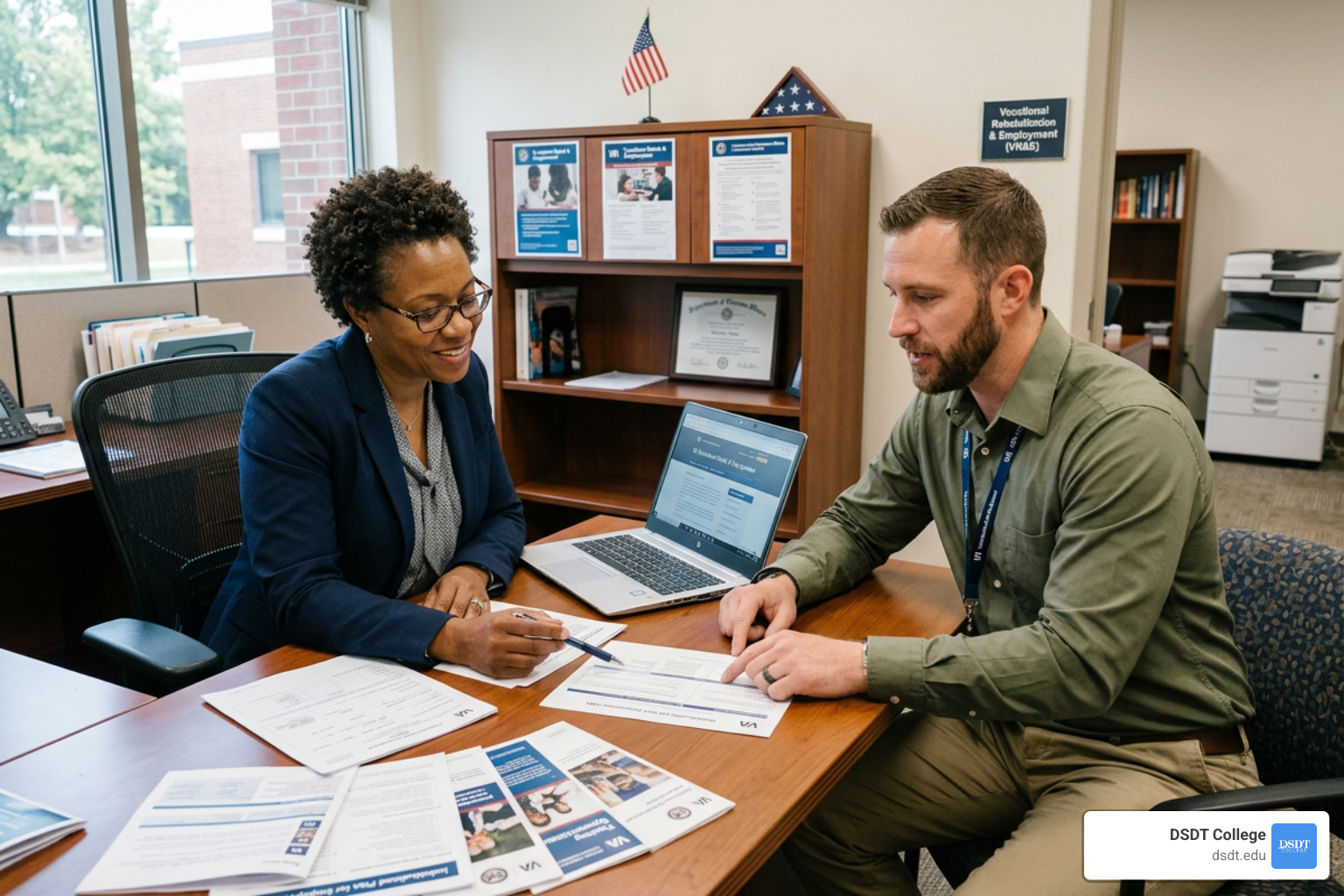
When you enter the VR&E program, you aren’t just given a check for tuition. You are paired with a Vocational Rehabilitation Counselor (VRC). This professional acts as your guide, helping you navigate VR&E Process and Services such as:
- Comprehensive Evaluations: Assessing your interests, aptitudes, and abilities to see what careers fit you best.
- Job Training and Education: This includes post-secondary training at colleges or vocational schools like DSDT College.
- Employment Accommodations: Helping you and your future employer make necessary adjustments so you can perform your job effectively.
- Resume Development and Coaching: Crafting a narrative that shows employers why your military background makes you the best candidate.
- Independent Living Services: For those with disabilities so severe they may not be able to work right away, VR&E provides services to help them live more independently.
The ultimate goal is “suitable employment.” This isn’t just any job; it’s a career that matches your skills, doesn’t aggravate your disability, and provides long-term stability.
Eligibility and Entitlement for VR&E Services
Understanding if you qualify for veteran readiness and employment chapter 31 is the first hurdle. Eligibility and entitlement are actually two different things. Eligibility means you meet the basic requirements to apply; entitlement means a VRC has determined that you need the services to overcome an “employment handicap.”
Basic eligibility criteria include:
- For Veterans: You must have a discharge that is other than dishonorable and a service-connected disability rating of at least 10% from the VA.
- For Active-Duty Servicemembers: You must be expecting an honorable discharge and have a memorandum disability rating of 20% or higher, or be participating in the Integrated Disability Evaluation System (IDES).
Once you apply, you’ll undergo an evaluation. The VA looks for an “employment handicap,” which exists if your service-connected disability impairs your ability to prepare for, obtain, or retain suitable employment. If you have a 10% rating, you must also have a “serious employment handicap” (SEH) to qualify.
For those still transitioning, Education and Career Counseling can provide a head start on this process.
Eligibility for Active-Duty Personnel in Veteran Readiness and Employment Chapter 31
If you are still in uniform but know you are headed for medical separation, you don’t have to wait until you have your DD214 in hand. Active-duty servicemembers can access VR&E services early if they have a memorandum rating of 20% or more.
This is particularly vital for “Wounded Warriors” or those in the IDES process. By starting early, you can explore career training programs while still on active duty, ensuring that the day you hang up the uniform, you already have a plan for your first day of school or work. We’ve seen this lead to much smoother transitions for our students in locations like Killeen, Texas, and Fayetteville, North Carolina, where military presence is high.
Veteran Entitlement and the 12-Year Eligibility Window
For many years, veterans had a strict 12-year window to use their Chapter 31 benefits, starting from their date of separation or the date they were first notified of their disability rating.
However, there is great news: if you were discharged from active duty on or after January 1, 2013, the 12-year basic period of eligibility no longer applies to you! This change allows veterans to seek retraining later in life if their disability worsens or if their industry changes. If you were discharged before 2013, the 12-year window still applies, but it can be extended if a VRC determines you have a Serious Employment Handicap (SEH). You can find more Official GI Bill® Information regarding how these timelines interact with other benefits.
The Five Tracks to Employment and Rehabilitation
The veteran readiness and employment chapter 31 program isn’t a one-size-fits-all solution. It is organized into five distinct “tracks” based on your specific needs:
- Reemployment: For those who want to return to the job they held before active duty.
- Rapid Access to Employment: For veterans who already have the skills to work but need help with a quick job search and minor accommodations.
- Self-Employment: For those with the skills and drive to start their own business.
- Employment Through Long-Term Services: This is where many of our students land. It covers the cost of college or vocational training needed to enter a new field.
- Independent Living: For those who cannot work due to the severity of their disabilities, focusing on daily life independence.
Many veterans find that the Long-Term Services track is the perfect fit for high-demand fields. For instance, an MRI Technology Associate Degree offers a clear path into medical imaging, a field that is growing rapidly and offers a stable environment for those transitioning from more physically demanding military roles.
Developing Your Rehabilitation Plan for Veteran Readiness and Employment Chapter 31
Once you are found entitled, you and your VRC will develop an Individualized Written Rehabilitation Plan (IWRP). This is a signed agreement that outlines exactly what you will do and what the VA will provide.
Your IWRP development involves:
- Vocational Exploration: Looking at different career paths.
- Labor Market Research: Ensuring there are actually jobs available in your chosen field in cities like Detroit, Chicago, or Phoenix.
- Transferable Skills: Identifying what you already know (like leadership or technical troubleshooting) and how it applies to a new role.
For those interested in tech, an Information Technology Associate Degree can be a central part of this plan, providing the certifications (like CompTIA A+, Network+, and Security+) that employers demand.
Subsistence Allowances and Financial Support
While you are in training, the VA doesn’t just pay for your school; they also provide a monthly subsistence allowance to help you cover living expenses. This is one of the most common questions we get at DSDT College.
The amount you receive depends on several factors:
- Your number of dependents (spouse, children, or dependent parents).
- Your training time (full-time, three-quarter time, or half-time).
- The type of training you are pursuing.
VR&E Subsistence vs. Post-9/11 GI Bill® BAH
If you are eligible for both veteran readiness and employment chapter 31 and the Post-9/11 GI Bill® (Chapter 33), you have a very important choice to make. You can choose to receive the standard Chapter 31 subsistence rate OR the Post-9/11 subsistence allowance (P911SA) rate.
The P911SA rate is usually higher because it is based on the Basic Allowance for Housing (BAH) for an E-5 with dependents in the zip code of your school. To choose this higher rate, you must have at least one day of remaining Post-9/11 GI Bill® entitlement.
Beyond the monthly check, Chapter 31 is incredibly generous. It covers 100% of tuition and fees, and it also pays for all required books, supplies, and even equipment (like a laptop) if your VRC determines it’s necessary for your program. This makes it an excellent choice for intensive programs like our Digital Marketing Professional Program.
How to Apply for Chapter 31 Benefits
Ready to get started? The application process is straightforward, but it requires some patience.
- Apply Online: The fastest way is via the eBenefits portal or VA.gov using VA Form 28-1900.
- Mail or In-Person: You can also mail your form to the VA Regional Office in Janesville, WI, or visit a local office in person.
- The Interview: Once your application is processed, you’ll be scheduled for an orientation and an interview with a VRC. This is your chance to “sell” your career goals. Bring any documentation of your disability, your military transcripts, and any ideas you have for your future career.
- The Decision: The VRC will determine if you are entitled to services and which track fits best.
Many of our students in the Cybersecurity and Tech Training programs found that having a clear goal—like becoming a Security Specialist—made their VRC interview much more successful.
Frequently Asked Questions about VR&E
Can I use VR&E and the GI Bill® at the same time?
You cannot “double dip” by receiving payments from both at the exact same time for the same classes. However, you can use VR&E first and save your GI Bill® for later, or vice versa. Many veterans prefer using VR&E for their undergraduate degree because it doesn’t count against their 36 months of GI Bill® entitlement, allowing them to save the GI Bill® for a Master’s degree later.
What is a Serious Employment Handicap (SEH)?
An SEH is a significant impairment caused by a service-connected disability that makes it very difficult to prepare for or get a job. If you have an SEH, the VA can offer more flexibility, such as extending the 48-month limit on training or providing services even if your 12-year window has closed.
Does VR&E pay for a Master’s degree?
Yes, but only if it is a “vocational necessity.” Your VRC must agree that you cannot get a suitable job in your field with just a Bachelor’s degree. For example, if your career goal is to be a licensed counselor or a specialized scientist, a Master’s may be approved under the Long-Term Services track.
Conclusion
The veteran readiness and employment chapter 31 program is one of the most comprehensive tools available to those who served. It’s about more than just a degree; it’s about a total support system designed to ensure you thrive in civilian life.
At DSDT College, we are proud to serve veterans in Detroit, Michigan, and across our many locations from Seattle to Tampa. We specialize in career-focused education that aligns perfectly with the VR&E mission—providing hands-on learning in high-demand fields like MRI technology, IT, and digital marketing.
If you’re ready to take that next step and turn your military experience into a rewarding civilian career, we are here to help you navigate the process. Start your career journey at DSDT College today and let’s build your future together.