Why Artificial Intelligence and Machine Learning Examples Matter Right Now
The rapid expansion of artificial intelligence and machine learning examples across industries highlights a major shift in how we live and work. Machine learning is already a $21 billion global industry — and it is projected to hit $209 billion by 2029. That kind of growth happens because ML is solving real problems, in real time, across nearly every sector of the economy.
A 2020 Deloitte survey found that 67% of companies are already using machine learning, and 97% are either using it or planning to within the next year. This is not a future trend; it is the present reality.
Whether you are a veteran exploring a tech career, a student looking for a future-proof path, or simply curious about how these tools shape your daily life — understanding AI and ML is no longer optional.
I’m writing on behalf of DSDT College, where we train the next generation of technology and healthcare professionals — including those pursuing our Machine Learning and AI Prompt Engineering programs — making artificial intelligence and machine learning examples directly relevant to the careers we help build. Read on for a complete breakdown of how this technology works, where it shows up, and why it matters.
Defining the Tech: AI vs. Machine Learning
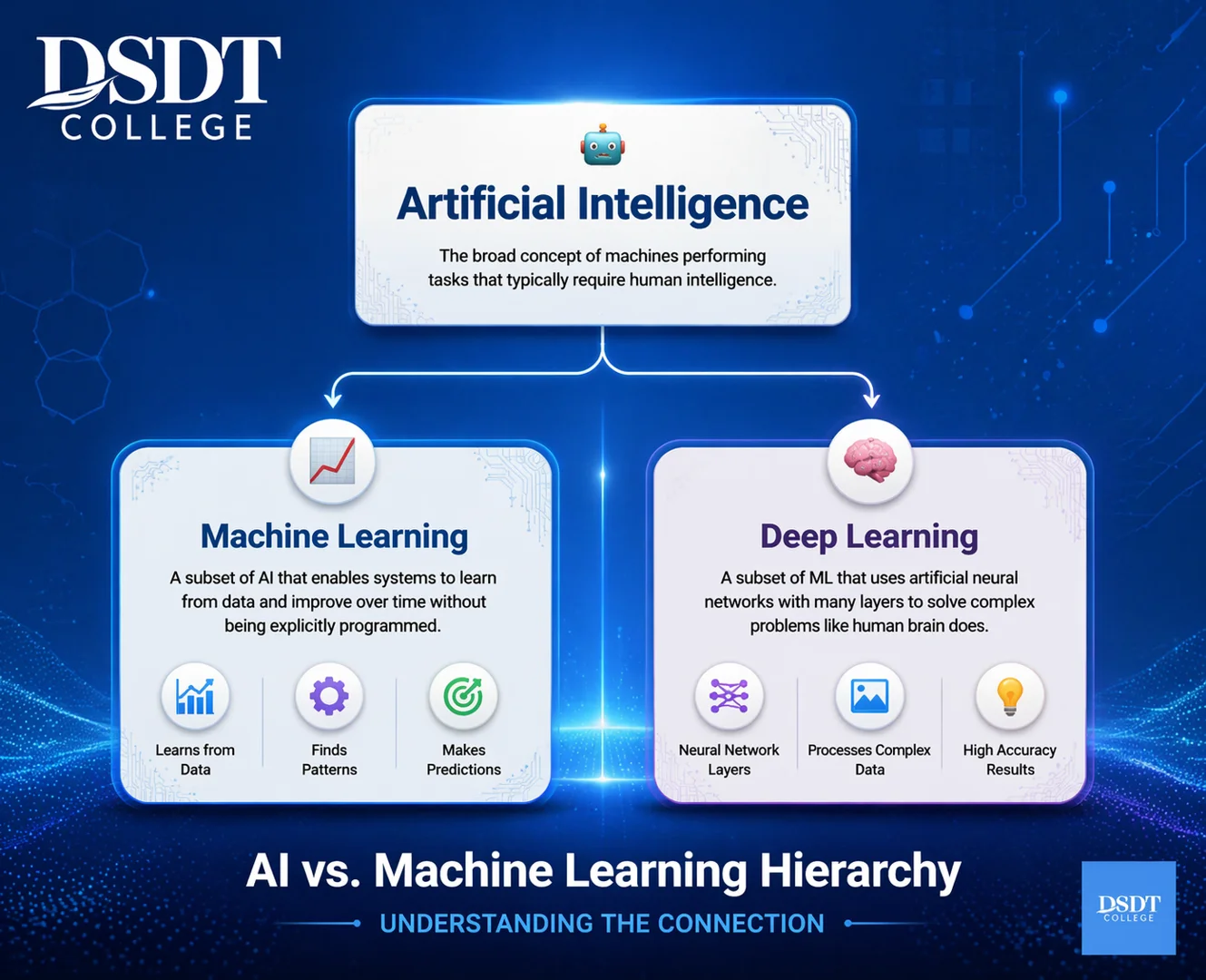
While people often use the terms interchangeably, there is a distinct difference between Artificial Intelligence (AI) and Machine Learning (ML). Think of AI as the broad “umbrella” and ML as the engine that makes the umbrella functional.
AI refers to the overarching concept of machines being able to carry out tasks in a way that we would consider “smart.” This includes everything from a basic chatbot to complex robotics. Machine Learning is a specific subset of AI that focuses on the idea that we can give machines access to data and let them learn for themselves.
How Machine Learning Works
At its core, ML involves training data, algorithms, and prediction processes. Instead of a human programmer writing every single rule, we feed an algorithm massive amounts of data. The model identifies patterns within that data to make predictions about new, unseen information.
| Feature | Artificial Intelligence (AI) | Machine Learning (ML) |
|---|---|---|
| Definition | The broad science of mimicking human abilities. | A subset of AI that trains a machine how to learn. |
| Goal | To create a smart system that can simulate human reasoning. | To allow machines to learn from data so they can give accurate output. |
| Scope | Wide: includes robotics, NLP, and expert systems. | Limited: focused on patterns and predictive accuracy. |
| Key Example | A humanoid robot or a smart home system. | An algorithm that predicts stock market fluctuations. |
The Three Main Subcategories of ML
- Supervised Learning: This is the most common form. We give the computer “labeled” data (e.g., thousands of photos labeled “dog” or “not dog”). The computer learns the characteristics of a dog and can then identify one in a new photo.
- Unsupervised Learning: Here, the data isn’t labeled. The computer looks for hidden patterns or structures on its own. A great example is a business using ML to cluster customers into different “personas” based on buying habits without being told what those personas are beforehand.
- Reinforcement Learning: This is a “trial and error” approach. The AI is given a goal and receives “rewards” or “penalties” based on its actions. This is how AI learns to play complex games or how self-driving cars learn to navigate obstacles.
Benefits and Limitations
The benefits are massive: higher efficiency, 24/7 operation, and the ability to process data at a scale humans simply cannot match. However, there are limitations. ML models are only as good as the data they are fed. If the training data is biased or incomplete, the predictions will be too. This is why scientific research on AI and fundamental rights is so critical—we must ensure these systems are fair and transparent.
Real-World Artificial Intelligence and Machine Learning Examples
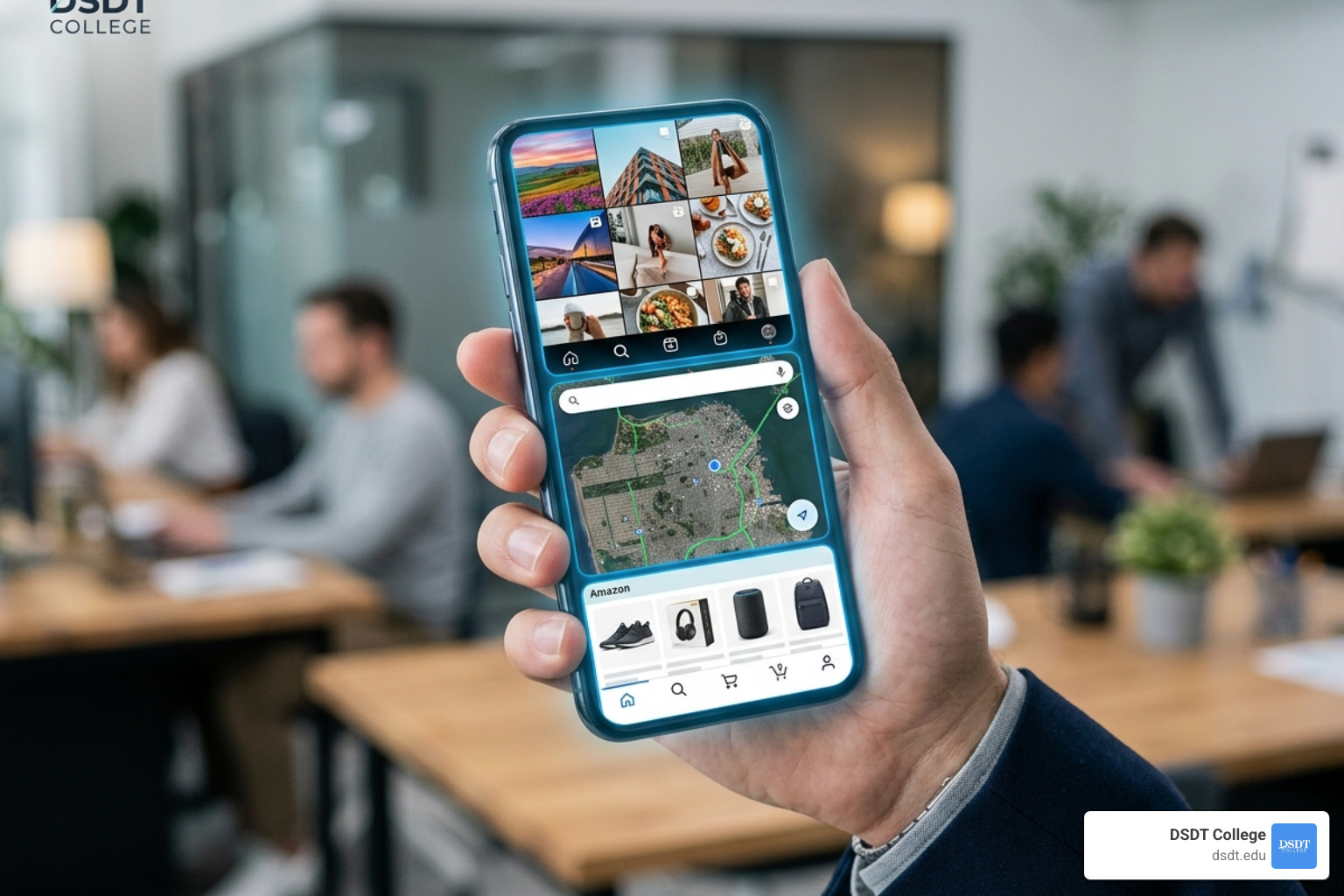
We often don’t realize how much of our day is powered by these algorithms. From the moment you wake up and check your phone to the moment you settle in for a movie at night, you are interacting with artificial intelligence and machine learning examples.
Everyday Artificial Intelligence and Machine Learning Examples in Consumer Tech
- Voice Assistants: Siri, Alexa, and Google Assistant use Natural Language Processing (NLP) to understand your voice and ML to improve their responses over time. When Amazon sold over 5 million Echo devices by 2016, it wasn’t just selling a speaker; it was deploying millions of ML nodes.
- Social Media: Ever wonder why your Instagram “Explore” page is so addictive? ML analyzes your likes, shares, and even how long you hover over a photo to curate a feed specifically for you. Facebook uses “DeepText” to understand the intent behind your posts in over 20 languages.
- Gmail Spam Filters: Gmail is a powerhouse of ML. It successfully filters 99.9% of spam by analyzing metadata, word patterns, and user feedback. If you mark an email as spam, you are essentially “teaching” the algorithm to be better for everyone else.
- Netflix Recommendations: Netflix doesn’t just show you what’s popular; it shows you what you will like. Their recommendation engine is so effective that it drives the majority of what people watch on the platform.
- Uber and Ridesharing: ML powers the “Estimated Time of Arrival” (ETA) you see in the app. It analyzes historical traffic patterns, current road conditions, and driver locations to give you a precise pickup time.
- Facial Recognition: Whether it’s tagging friends in a photo or unlocking your iPhone, facial recognition uses deep learning to map your features and verify your identity in milliseconds.
Emerging Artificial Intelligence and Machine Learning Examples to Watch
While the examples above are part of our daily routine, new advancements are pushing the boundaries of what’s possible:
- Self-Driving Cars: Companies like Tesla and Waymo use unsupervised learning and computer vision to navigate complex city streets. Interestingly, the average Boeing flight already involves only seven minutes of human-steered flight, showing that “autopilot” has been ML-driven for longer than we think.
- Generative AI: Tools like ChatGPT and Gemini are the latest “big thing.” These models are trained on massive datasets of human language to create entirely new content—from essays to computer code.
- Smart Home Automation: Devices like the Google Nest learn your temperature preferences and schedule to optimize energy use, reducing your bills without you having to touch a dial.
- Adaptive Learning: In education, ML is being used to create personalized curriculums that adapt to a student’s pace, focusing more on areas where the student struggles.
Industry Transformation: Healthcare, Finance, and Beyond
The impact of artificial intelligence and machine learning examples extends far beyond our smartphones. Entire industries are being reinvented.
Healthcare and Life Sciences
Machine learning is literally saving lives. In radiology, doctors evaluating mammograms for breast cancer traditionally miss about 40% of cases. ML algorithms are now being used to augment these evaluations, significantly improving detection rates.
A major breakthrough in this field is AlphaFold — Google DeepMind. This AI system solved a 50-year-old “grand challenge” in biology by predicting the 3D structure of proteins with incredible accuracy. This is accelerating drug discovery for diseases like malaria and cancer, doing in a weekend what used to take years of laboratory work.
Finance and Trading
If you look at the stock market today, you aren’t just seeing humans trading; you’re seeing algorithms. Around 60-73% of stock market trading is conducted by AI. These systems can analyze thousands of data points per second—news reports, social media sentiment, and historical prices—to execute trades at the optimal moment.
Banks also use ML for:
- Fraud Detection: Analyzing transaction patterns to flag a stolen credit card before the owner even knows it’s gone.
- Loan Approvals: Using predictive analytics to assess credit risk more accurately than traditional scoring methods.
Case Studies in Machine Learning Success
- AlphaGo: In 2016, AlphaGo — Google DeepMind defeated the world champion of the game Go. This was a landmark moment because Go is infinitely more complex than chess, requiring “intuition” and “creativity” that many thought machines could never achieve.
- Homelessness Prevention: In Sonoma County, an AI-integrated system helped place 35% of homeless individuals into housing—a rate four times higher than the national average. By analyzing data across different agencies, the county reduced its homeless population by 9% in just two years.
- Customer Service: One bank utilized a system called watsonx Assistant to handle customer queries. The chatbot was able to answer 96% of all questions correctly, drastically reducing wait times and freeing up human agents for complex issues.
How ML Powers Business Operations and Security
For modern businesses, ML is the ultimate tool for scaling operations and staying secure. Marketing and sales teams currently prioritize AI and ML more than any other department because of its ability to drive revenue.
Marketing and Lead Generation
Machine learning allows brands to move from “mass marketing” to “hyper-personalization.” By analyzing customer behavior, ML can predict which leads are most likely to convert, allowing sales teams to focus their efforts where they will have the most impact.
Cybersecurity and Defense
As cyber threats become more sophisticated, human-only defense is no longer enough. ML is used for:
- Malware Detection: Identifying and neutralizing new viruses based on their behavior rather than just a database of known threats.
- Sentiment Analysis: Monitoring social media to detect brand reputation shifts or potential PR crises in real time.
- Automated News Generation: Some media outlets now use robots to generate up to 30,000 local news stories a month from public data sources, ensuring communities stay informed on local issues like high school sports or weather.
Frequently Asked Questions about AI and ML
Is my data safe with machine learning applications?
Data safety depends on the implementation. While ML can be used to enhance security (like fraud detection), it also requires massive amounts of data to work. It is vital to use platforms that prioritize data governance and privacy.
How can I start a career in AI?
Starting a career in AI typically involves gaining a foundation in data science, programming, or prompt engineering. Specialized programs, like those offered at DSDT College, provide accelerated pathways to gain these technical skills and industry-recognized certifications.
Conclusion: Start Your Future with DSDT College
The artificial intelligence and machine learning examples discussed here are only the beginning of a technological shift. As these industries grow, the demand for skilled professionals who can build, manage, and secure these systems will continue to rise.
At DSDT College, we provide career-focused education to meet this demand. Whether you are looking to break into the tech world or advance your current career, we offer accelerated paths with no waitlists and no SAT/ACT requirements.
- Military & Veteran Friendly: We support military families through programs compatible with the Post-9/11 GI Bill®, Tuition Assistance, and MyCAA.
- Cybersecurity at Fort Hood: Our in-person Cybersecurity CSP/SkillBridge program at Fort Hood provides elite training in Penetration Testing and Security+.
- MRI Primary Pathway: Our accredited Associate of Applied Science in MRI Technology is a 100% online program with local clinical externships, requiring no prior X-ray experience.
- AI & Digital Media: Stay ahead with our programs in AI Prompt Engineering and Digital Marketing.
Ready to take the next step? Explore our Machine Learning Specialist Program and join the professionals shaping the future of technology. Whether you are in Detroit, Houston, or anywhere nationwide, our flexible online programs are designed to move with you.
Contact DSDT College today and turn these examples into your expertise.