What Is Interactive Digital Media (And Why It’s the Career Skill of the Future)
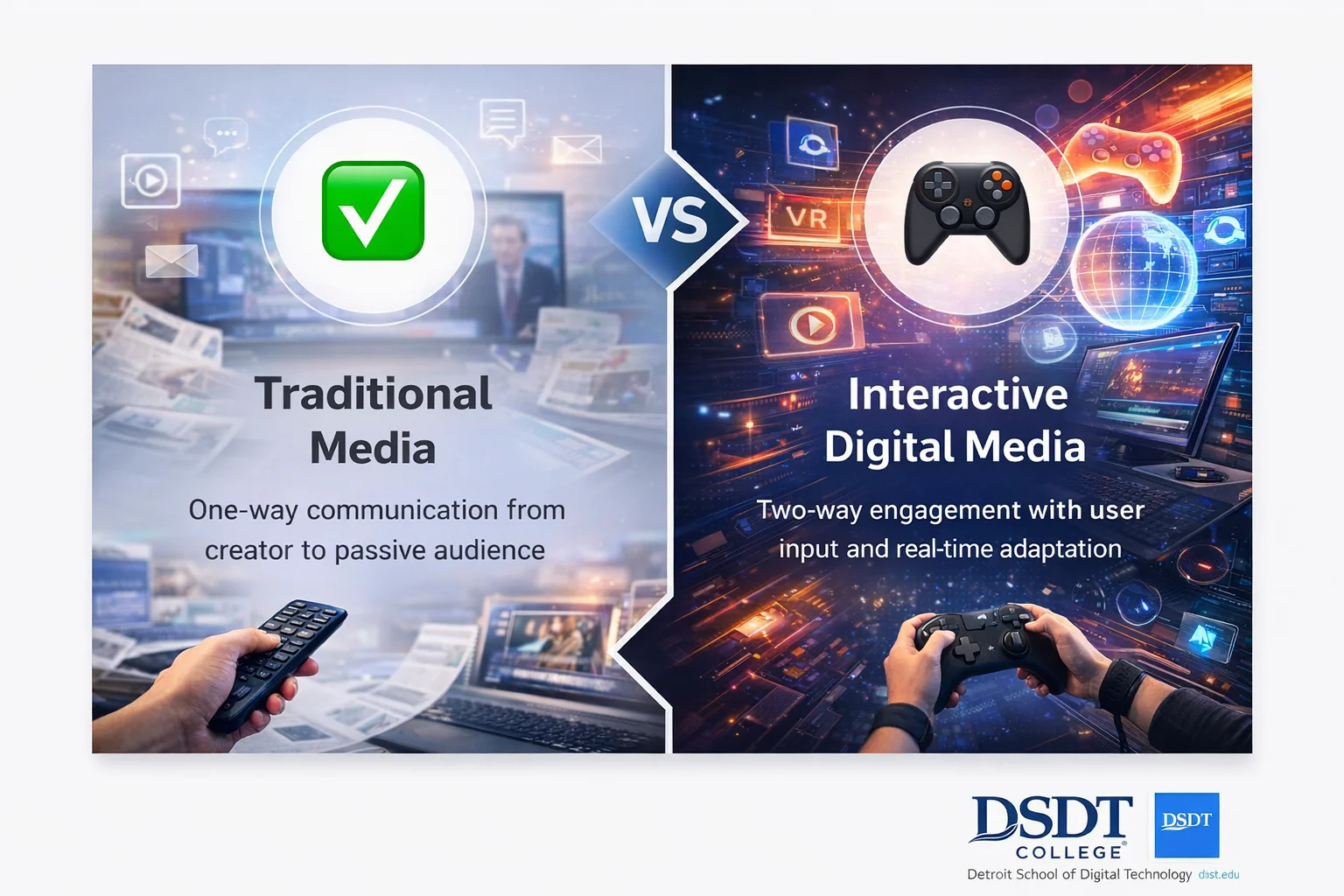
Interactive digital media is any digital content or system that responds to what a user does — in real time. Unlike a newspaper or a TV broadcast, it doesn’t just talk at you. It reacts, adapts, and changes based on your input.
Here’s a quick breakdown:
| Feature | Traditional Media | Interactive Digital Media |
|---|---|---|
| Information flow | One-way (creator → audience) | Two-way (creator ↔ user) |
| User role | Passive viewer | Active participant |
| Personalization | None | High |
| Examples | TV, print, radio | Apps, games, VR, social media |
The category is broad. It includes:
- Games — console, web, or mobile, with rules, progression, and rewards
- Immersive experiences — VR, AR, and mixed reality environments
- Websites and apps — interactive, data-driven content delivered in real time
- Software tools — creation and editing platforms used across creative industries
It’s not a niche hobby field anymore. In British Columbia alone, interactive digital media represents over 33% of the creative sector’s GDP — and that’s just one region. Globally, demand for people who can build these experiences is accelerating fast.
Whether you want to design user interfaces, develop games, create digital content, or build web applications, this field sits at the crossroads of creativity and technology. That’s a powerful place to be.
We are DSDT College — a nationally accredited institution that trains career changers and veterans in future-focused fields, including digital media production and content creation for the modern interactive digital media landscape. In the sections ahead, we’ll break down exactly how this world works and how you can build a career in it.
The Evolution of Media: From Laser Discs to the Metaverse
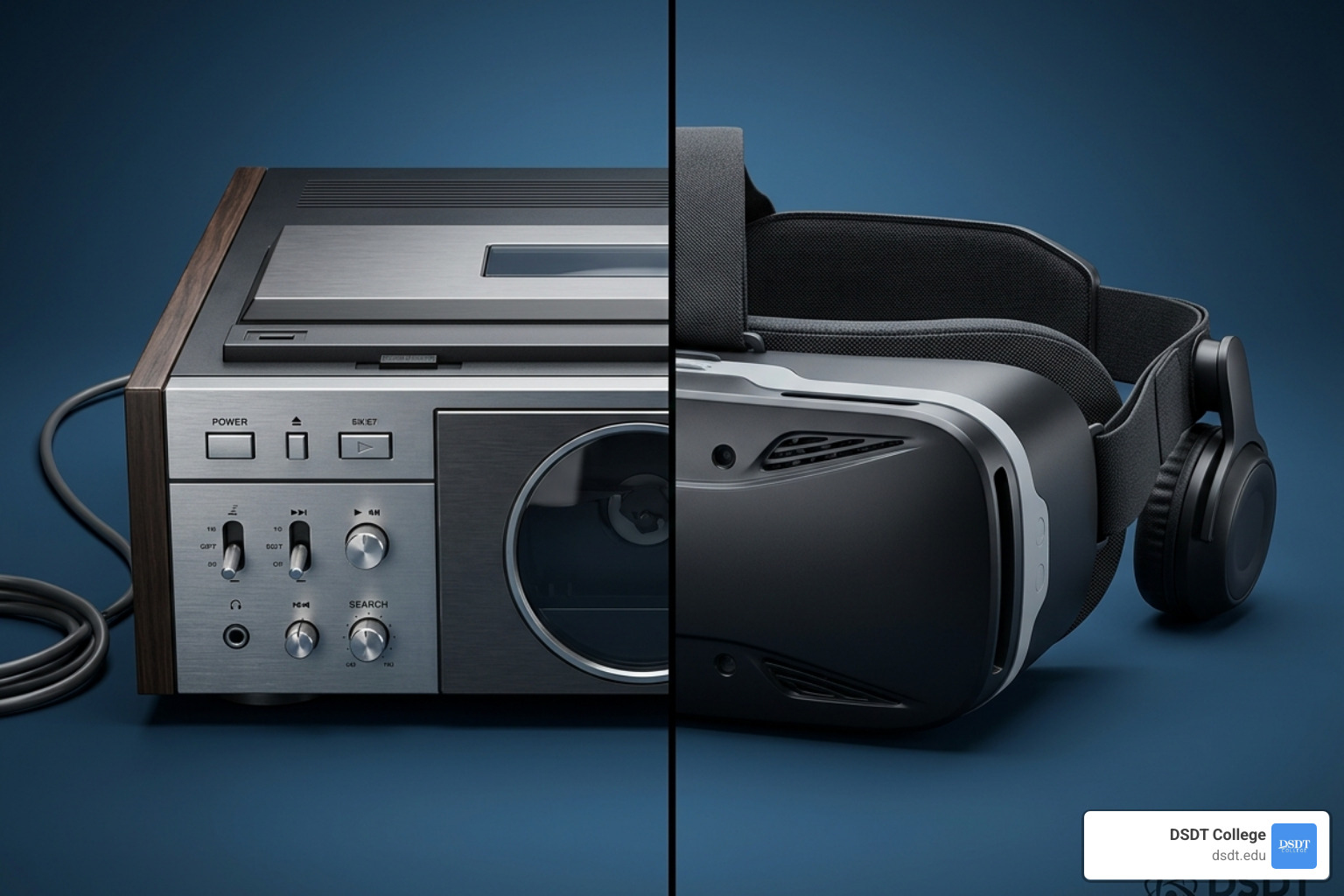
To understand where we are going, we have to look at how we got here. The journey of interactive media didn’t start with the iPhone; it began decades ago with bold experiments in hardware and user control.
The timeline of interactivity is a fascinating climb:
- 1958: The invention of laser disc technology. This allowed for high-quality analogue images that could be accessed non-linearly, a massive leap from tape-based media.
- 1970s: The birth of the Graphical User Interface (GUI). Before this, computers were walls of text. The GUI introduced icons and pointers, making interaction intuitive.
- 1990: Windows 3.0 hit the market. This accelerated the acceptance of GUIs as the standard for personal computing.
- The CD-ROM Era: Suddenly, PCs could handle digital sound and video, leading to the rise of electronic encyclopedias and complex “point-and-click” adventures.
- The Smartphone Revolution: Interactivity moved from the desk to the pocket. Touch screens changed our relationship with data from “clicking” to “feeling.”
- Modern Era: The rise of immersive technology, where digital and physical worlds begin to merge through advanced sensory interfaces.
The Shift Toward User Agency
The transition to interactive media represents a fundamental shift in how we consume information. Modern systems prioritize the user’s input—whether it’s a click, a voice command, or a physical movement—to trigger dynamic responses. This allows for hyper-personalization, where two people can use the same application but navigate completely different paths based on their specific choices.
The Role of Hardware and Software in Modern Interactivity
You can’t have the “magic” without the machinery. Modern interactivity is powered by a sophisticated stack of tools:
- Programming Languages: HTML, CSS, and JavaScript form the backbone of the web. For more complex systems, languages like C# or C++ power the engines.
- Engines: Unity and Unreal Engine are the heavy hitters used to build everything from mobile games to high-end VR simulations.
- Design Suites: Tools like the Adobe Creative Cloud allow creators to produce the visual and auditory assets that make digital worlds feel “real.”
- Sensory Hardware: We are seeing an explosion in haptic feedback (devices that vibrate or resist touch) and Internet of Things (IoT) integration, where your digital media can interact with your physical light bulbs or thermostat.
Core Components: Content Types and Delivery Methods
Not all interactive digital media is created equal. We categorize these experiences based on how they behave and how they reach the user.
| Category | Key Characteristics | Examples |
|---|---|---|
| Games | Rules, progression, rewards, high interaction | Console games, mobile apps, “Casual” games |
| Immersive Experiences | Focus on presence and atmosphere, often non-linear | VR tours, AR filters, digital exhibits |
| Software/Tools | Functional, utility-focused, service-oriented | Editing suites, CMS, communication platforms |
Presentation Types in Interactive Digital Media
When we build these experiences, we have to choose how they are presented to the user:
- Classic Immersion (CI): Traditional screen-based interaction that draws the user in through story and sound.
- Virtual Reality (VR): The user is fully immersed in a 100% digital environment, usually via a head-mounted display.
- Augmented Reality (AR): Digital elements are overlaid onto the real world (think Pokémon GO or furniture placement apps).
- Mixed Reality (MR): A blend where physical and digital objects co-exist and interact in real time.
- Non-Immersive: Standard interactive content that doesn’t require “diving in,” such as a basic website or a digital slideshow.
- Remote Control: Interactivity that extends to physical devices, such as controlling a drone through a tablet interface.
Global Delivery and Accessibility
How does the media get to you? We use several delivery methods:
- Web-Based: Content delivered through a browser. This is the most accessible form, working across almost any device.
- Native Apps: Software installed directly on a phone or computer, allowing for faster performance and better use of the device’s hardware.
- Cloud Communication: Platforms that use SMS and messenger apps to reach billions of people instantly. High-end platforms boast 99.99% uptime, ensuring that critical business messages always get through.
Why It Matters: The Pros and Cons of an Interactive World
Interactivity isn’t just “fun”—it’s functional. In education, interactive digital media allows for adaptive learning, where the curriculum changes based on a student’s performance. It builds stronger relationships between businesses and customers by allowing for two-way communication and instant problem-solving.
However, it isn’t without its challenges. The constant “ping” of interactive notifications can lead to major distractions and even sleep issues. There are also significant privacy concerns; when a system responds to you, it usually has to collect data about you. This makes regulations like GDPR (General Data Protection Regulation) essential for any modern digital wizard to understand. Finally, accessibility remains a hurdle—designers must ensure that people with different physical or cognitive abilities can still participate in the digital world.
Building Your Career in Interactive Digital Media
The path to becoming a professional in this field involves mastering both the “how” and the “why.” It’s not just about making things look pretty; it’s about making them work for the person on the other side of the screen.
Key skills you’ll develop include:
- User Research: Understanding what the audience actually needs before you start building.
- UI/UX Design: Creating interfaces that are intuitive and experiences that are enjoyable.
- Full Stack Development: Learning to handle both the visual “front end” and the data-driven “back end.” Explore our full stack developer programs to see how these skills come together.
- Testing and Analytics: Using A/B testing and data to see if your design actually works, then refining it until it’s perfect.
Essential Courses for the Digital Wizard
If you were to enroll in a high-level digital media program, you’d likely encounter courses like:
- Media Production: The nuts and bolts of creating video, audio, and graphics.
- Social Media Strategy: Understanding how to engage audiences across distributed networks.
- Game Art and Sound: Focusing on the aesthetics and audio that make games immersive.
- Human Factors Engineering: Studying how humans physically interact with machines to prevent errors and fatigue.
- Capstone Projects: Real-world assignments where you build a complete interactive product from scratch.
The Future of Interactive Digital Media: AI and XR
We are currently standing on the edge of the next big leap. Artificial Intelligence is no longer a sci-fi concept; it is a daily tool for digital creators. AI specialist programs are now teaching students how to use “prompt engineering” to generate assets, code, and even entire virtual environments in a fraction of the time it used to take.
The future also holds:
- Hyper-Personalization: Content that adapts not just to your clicks, but to your mood or the time of day.
- Blockchain and NFTs: New ways to verify ownership of digital assets within the “Metaverse.”
- Wearable Tech: Moving interaction away from screens and onto glasses, rings, or even clothing.
Frequently Asked Questions about Interactive Media
What skills do I need for a career in interactive media?
You need a mix of creative skills (visual design, storytelling) and technical skills (basic coding, software proficiency). Most importantly, you need “creative problem-solving”—the ability to figure out why a user is getting stuck and how to fix it.
How is AI changing interactive digital media?
AI streamlines production by automating repetitive tasks like asset generation and code debugging. It also enables more sophisticated user experiences, such as “smart” non-player characters that can engage in natural language conversations.
Conclusion
Interactive digital media has transformed from a niche technological experiment into the backbone of modern communication and entertainment. It is a field that rewards curiosity and those willing to “make stuff, publish, and repeat.”
At DSDT College, we specialize in helping people make the jump into these high-growth careers. Whether you are a veteran looking to transition into a new field or a career changer interested in our 100% online programs like Digital Media Production or AI Prompt Engineering, we provide an accelerated, military-friendly path to success. With no SAT/ACT requirements and a focus on real-world certifications, we make it easier to become the digital wizard you were meant to be.
Ready to start your journey? Explore our accredited programs and see how we can help you reach your goals.