The Fast Lane Into Tech: What You Need to Know About Entry Level IT Jobs
Entry level IT jobs are one of the most accessible ways to start a well-paying, future-proof career — even if you have zero tech experience today.
Here are the most common roles and what they pay:
| Job Title | Median US Pay |
|---|---|
| Help Desk Technician | $64,000 |
| IT Support Specialist | $71,000 |
| Technical Support Specialist | $72,000 |
| Desktop Support Specialist | $74,000 |
| Junior Network Technician | $79,000 |
And the demand is only growing. IT occupations are projected to grow much faster than average over the next decade — meaning companies are actively looking for people just like you.
The best part? Many of these roles require only a high school diploma and some basic training to get started.
I’m Jamie Kothe, an academic leader and workforce development professional at DSDT College, where I help students launch careers in high-demand fields like information technology — including guiding people into their first entry level IT jobs. Through years of connecting learners with employer partners and career-focused training programs, I’ve seen what it actually takes to go from no experience to employed in tech.
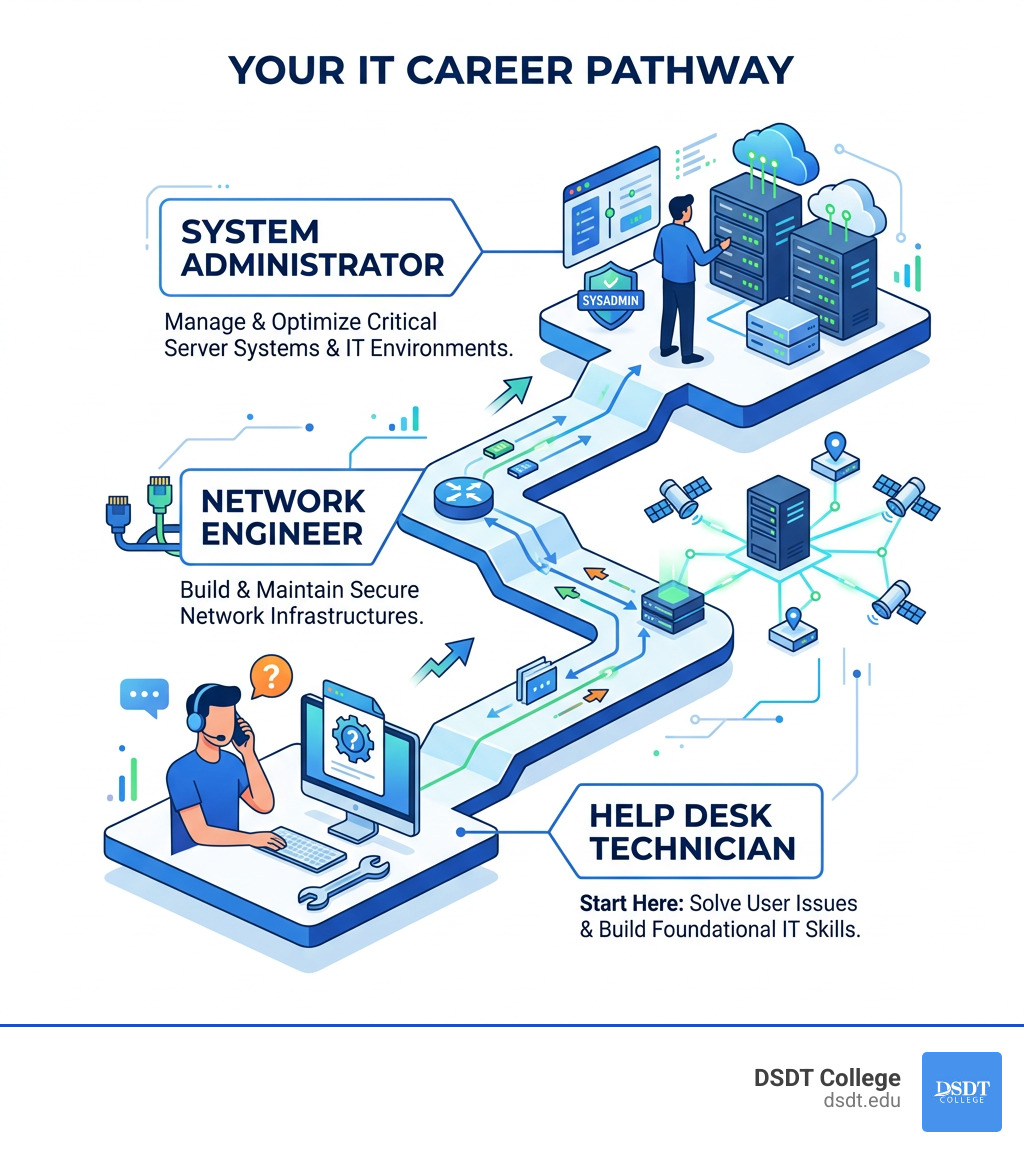
Top 5 Roles and Salaries in the Tech Industry
When we talk about entry level IT jobs, we aren’t just talking about one single position. The tech world is vast, but most “heroes” start their journey in one of five core roles. These positions serve as the front line of any organization, ensuring that the digital wheels keep turning.
According to the Bureau of Labor Statistics, jobs in IT are projected to grow at a much faster rate than other occupations over the next decade. This growth is driven by our global dependence on technology, cloud computing, and the ever-increasing need for robust cybersecurity.
1. Help Desk Technician
This is often the first “rank” in the IT world. As a Help Desk Technician, your day-to-day involves responding to user requests via phone, email, or chat. You’ll be the one solving password resets, fixing printer jams, and walking users through basic software glitches. With a median pay of $64,000, it’s a fantastic way to learn the ropes.
2. IT Support Specialist
Think of this as the “Swiss Army Knife” of the office. These specialists provide technical assistance and support for computer systems, hardware, and software. They don’t just fix things; they often train users on how to use new tools. The median pay here sits comfortably around $71,000.
3. Technical Support Specialist
While similar to help desk roles, technical support often dives deeper into specific products or services. You might work for a software company helping their clients integrate a platform. Because of the specialized knowledge required, the median pay is approximately $72,000.
4. Desktop Support Specialist
If you enjoy being hands-on, this is for you. These pros are the ones physically walking to a workstation to swap out a hard drive or set up a new dual-monitor configuration. They handle the “tangible” side of tech, earning a median pay of $74,000.
5. Junior Network Technician
For those fascinated by how the internet actually works, this role focuses on the cables, routers, and switches that connect us. You’ll assist in maintaining network integrity and troubleshooting connectivity issues. This is one of the highest-paying entry level IT jobs, with a median pay of $79,000.
Essential Skills and Certifications for Success
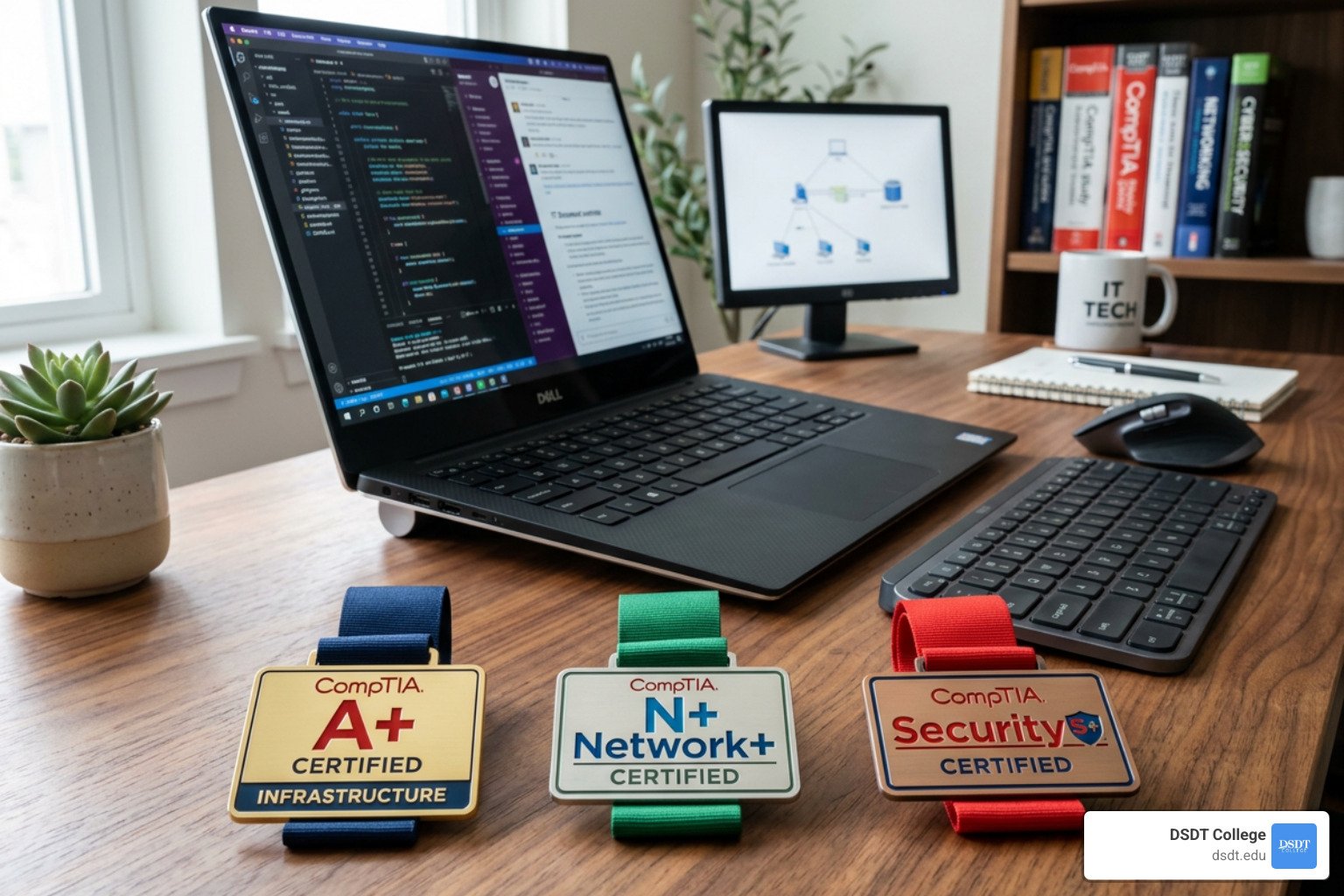
You don’t need to be a math genius or a master coder to land entry level IT jobs. However, you do need a specific blend of “hard” technical skills and “soft” people skills. In our experience at DSDT College, the most successful candidates are those who can explain a complex technical solution to someone who has never opened a Command Prompt.
The “Big Three” Certifications
In the IT industry, certifications are often more valuable than a four-year degree because they prove you have the specific skills needed right now.
- CompTIA A+: This is the industry standard for establishing a career in tech. It covers everything from hardware and networking to operating systems and security.
- CompTIA Network+: This certification proves you understand the infrastructure that keeps the world connected. It’s essential for anyone looking at Junior Network Technician roles.
- CompTIA Security+: With cyber threats on the rise, even entry-level roles require a baseline understanding of security. This cert is your ticket to higher-paying roles down the line.
Key Technical and Soft Skills
Beyond the badges, you’ll need to master:
- Troubleshooting: The ability to logically find the “why” behind a “how.”
- Operating Systems: A deep comfort level with Windows, macOS, and increasingly, Linux.
- Customer Service: You aren’t just fixing computers; you’re helping people.
- Analytical Thinking: Breaking down a large problem into small, manageable steps.
If you’re looking for a comprehensive way to gain these skills, our Information Technology Associate Degree is designed to take you from the basics to job-ready in a structured, supportive environment.
How to Break Into the Field with No Experience
We hear it all the time: “How do I get experience if every job requires experience?” It’s the classic catch-22. But in IT, there are several “side doors” you can use to break into entry level IT jobs.
Hands-On Training and Technical Schools
Traditional universities are great, but they can take a long time. Technical schools like DSDT College focus on “skill-stacking.” We prioritize hands-on learning—actually taking apart servers and configuring real networks—so that when you walk into an interview, you can say, “I’ve done this,” not just “I’ve read about this.”
Apprenticeships and Internships
Many companies, including giants like Cisco, view entry-level talent as “rising stars.” They offer programs for interns, co-ops, and apprentices that provide a foundation for career exploration and continuous learning. These roles often lead directly to full-time offers.
Self-Study and Networking
Don’t underestimate the power of a home lab. Setting up your own server or building a PC shows initiative. Additionally, staying current is vital. We recommend subscribing to resources like the Career Chat Newsletter to keep up with industry trends and new skills.
For those who want a focused path into the corporate world, our Business IT Specialist Program combines technical prowess with the business communication skills that modern employers crave.
Where to Find Entry Level IT Jobs: Top Locations and Platforms
Geography plays a big role in your job search. While remote work is available, many entry level IT jobs—especially those in data centers or desktop support—require you to be on-site.
Top Hiring Locations
Based on our research, several cities are currently hotspots for entry-level talent:
- Baltimore, MD: There are dozens of entry-level IT roles in the Baltimore area, often clustered around government contractors and healthcare hubs.
- Detroit, MI: As a major hub for DSDT College, we see a massive demand for IT professionals in the automotive and manufacturing sectors as they undergo digital transformations.
- New York City, NY: The fintech and AI sectors in NYC are constantly hiring for roles like backend software engineers and IT support associates, with salaries often exceeding the national average.
Data Centers: The Hidden Gem
Data centers are the physical backbone of the internet. Companies like Expedient often hire IT Support Associates for their facilities in places like Baltimore. These roles are fantastic because they often offer “fast-track” training, fully paid industry certifications, and shift premiums.
Job Search Platforms
- LinkedIn: Still the king of job boards. Use the “Entry Level” filter and set up alerts for your specific city.
- WayUp: A great platform specifically designed for students and recent grads to find internships and first-time jobs.
- Company Career Pages: Don’t just wait for a job board. Check the career pages of major employers in your area.
Frequently Asked Questions about Starting in Tech
Do entry level IT jobs require a degree?
Not necessarily! While an Associate or Bachelor’s degree can certainly help, many employers have moved toward “skills-based hiring.” This means if you have a high school diploma and the right certifications (like CompTIA A+), you are a viable candidate. Practical experience—even from a hands-on technical program—is often weighted just as heavily as a degree.
What is the average salary for entry level IT jobs?
As we noted earlier, the range typically falls between $64,000 and $79,000 annually. However, this can vary based on your location. In high-cost areas like New York City, entry-level software roles can even reach into the $90,000+ range. Additionally, many roles offer great benefits, 401(k) matching, and even “paid-to-learn” opportunities where the company pays for your future certifications.
Can I work remotely in an entry level IT role?
Yes, but it depends on the role. Help Desk and Technical Support roles are frequently remote or hybrid. However, roles like Desktop Support or Data Center Associate are almost always on-site because you need to physically touch the hardware. Many companies now offer a hybrid model, giving you the best of both worlds.
Conclusion
Starting a career in IT is one of the smartest moves you can make in today’s economy. Whether you start as a Help Desk Technician or a Junior Network Technician, the path upward is clear. From these entry level IT jobs, you can quickly advance to become a System Administrator, a Cybersecurity Analyst, or a Network Engineer.
At DSDT College, we are committed to helping you make that transition. Our programs are designed for high school graduates, career changers, and veterans who want a practical, accredited education that leads directly to a paycheck.
Ready to stop dreaming and start doing? Start your journey with the Technology Professional program today and turn your interest in computers into a lifelong career. We’ll provide the training, the certifications, and the support you need to become a true tech hero.