Why IT Certification Training Is Your Fastest Path Into Tech
IT certification training is a structured way to learn and prove technical skills that employers actively look for when hiring.
Here’s a quick overview of what you need to know:
| What You Want | Best Starting Point |
|---|---|
| Entry-level IT job | Google IT Support or CompTIA A+ |
| Networking career | Cisco CCNA |
| Cybersecurity focus | CompTIA Security+ or Fortinet NSE |
| Cloud computing | AWS Cloud Practitioner or Azure Fundamentals |
| Free options | Fortinet NSE, Cisco Networking Academy, Microsoft Learn |
| Advanced credentials | CISSP, CCNP, ITIL |
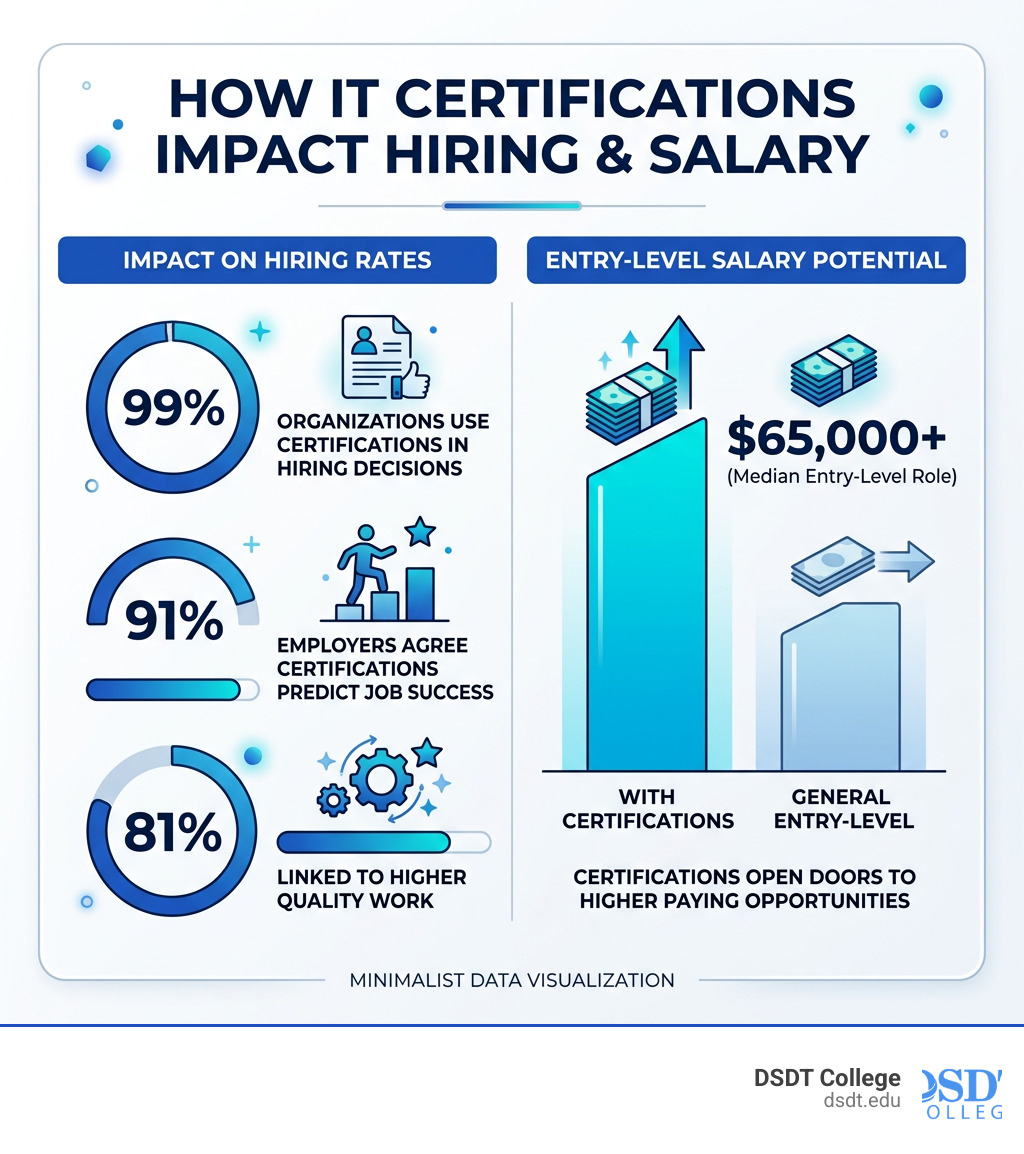
The numbers behind certifications are hard to ignore. According to Cisco, 99% of organizations use technical certifications when making hiring decisions. Another 91% of employers say certifications reliably predict whether a new hire will succeed. And 81% link certified professionals to higher quality work.
Whether you’re fresh out of high school, switching careers, or transitioning from the military, IT certifications give you a concrete, recognized credential to show employers you’re ready.
The field is also well-paying. Entry-level IT support roles carry a median salary of $65,000 — and certifications are often the key that unlocks those opportunities.
Top Entry-Level IT Certification Training Paths

When we talk about getting a foot in the door, we are usually looking at roles like help desk technician, technical support specialist, or junior systems administrator. These roles are the “boots on the ground” of the tech world. You’ll be the person fixing hardware issues, troubleshooting why a laptop won’t connect to the Wi-Fi, and managing operating systems for an entire office.
For those of us in cities like Detroit or Chicago, these roles are plentiful because every major industry—from healthcare to automotive—needs a reliable IT team to keep the lights on. But you can’t just walk in and say you’re “good with computers.” You need a way to prove it. That’s where IT Certification Training comes into play.
Explore DSDT College’s IT programs to find your path.
Starting Your Career with Google IT Certification Training
One of the most talked-about entry points lately is the Google IT Support Professional Certificate. We like this one because it’s designed specifically for beginners. You don’t need a four-year degree or even prior experience to start.
This program covers the essentials: troubleshooting, customer service, networking, operating systems, and security. It also introduces you to Python and Linux, which are vital skills if you want to move beyond the help desk later. According to recent 2024 job posting data, this certificate prepares you for jobs with a median entry-level salary of $65,000.
For about $50 a month on Coursera, it’s an affordable way to test the waters. Many people use this as a “pre-game” before tackling more intensive certifications. We’ve seen success stories where people used this cert to land a Junior Systems Admin role or a government help desk position. It’s practical, hands-on, and gives you a taste of what the daily grind of an IT pro looks like.
CompTIA A+ and Foundational IT Certification Training
If the Google cert is the “new kid on the block,” CompTIA A+ is the “tried and true” veteran. For decades, the A+ has been the industry standard for entry-level IT Certification Training.
Unlike vendor-specific certs (which focus on just one brand like Microsoft or Cisco), CompTIA is vendor-neutral. This means you learn how to fix any computer, regardless of the brand. The A+ is actually a two-part exam that covers:
- Hardware: Identifying, using, and connecting hardware components.
- Operating Systems: Installing and supporting Windows, iOS, Android, Apple OSX, and Linux.
- Software Troubleshooting: Solving problems with PC and mobile devices.
- Networking and Security: The basics of how data moves and how to keep it safe.
After A+, most professionals move on to CompTIA Network+ and Security+. This trio is often called the “Trifecta,” and having all three on your resume in a market like Dallas or Phoenix makes you a very attractive candidate for cybersecurity and infrastructure roles.
Learn more about CompTIA certifications
Comparing the Value of Popular IT Certifications
Choosing the right path can feel like looking at a menu with too many options. Do you go for the quick, cheap option, or the deep-dive professional credential? To help you decide, we’ve put together a comparison of the heavy hitters in the entry-level space.
| Feature | Google IT Support | CompTIA A+ | Cisco CCNA |
|---|---|---|---|
| Primary Focus | General IT Support | Hardware & OS | Networking & Routing |
| Difficulty | Beginner | Beginner/Intermediate | Intermediate |
| Cost | ~$50/mo (Subscription) | ~$450 (Exams only) | ~$300 (Exam only) |
| Industry Standing | Growing / Practical | Gold Standard for Entry | Gold Standard for Networking |
| Job Roles | Help Desk, Support | Tech Support, Field Tech | Network Engineer, Admin |
While the Google cert is great for building confidence, CompTIA A+ often carries more weight with HR departments who use automated resume filters. However, if you know for a fact you want to work on routers and switches all day, jumping straight into Cisco might be your move.
Cisco CCNA and Networking Essentials
The Cisco Certified Network Associate (CCNA) is legendary. Cisco has issued more than 4 million certifications, and for good reason. If the internet is a highway, Cisco built the road and the traffic lights.
The CCNA isn’t just about plugging things in; it’s about understanding IP connectivity, security fundamentals, and even automation. In today’s world, a network engineer needs to know a bit of Python to automate repetitive tasks. The CCNA training now includes these modern skills.
For our students in high-demand hubs like Houston or Jacksonville, the CCNA is often the difference between a $45k job and a $70k job. It shows you can handle the complex “plumbing” of a corporate network.
Discover DSDT College’s networking courses
Vendor-Specific Training: AWS, Azure, and Fortinet
Once you have your foundations, you might want to specialize. This is where vendor-specific IT Certification Training comes in. If a company uses Amazon Web Services (AWS) for their cloud, they want someone with an AWS Cloud Practitioner or Solutions Architect cert.
- AWS Foundational: Great for understanding how the cloud works.
- Microsoft Azure Fundamentals (AZ-900): Essential if you’re working in a “Microsoft shop” (which is most big corporations).
- Fortinet NSE: Fortinet has made many of its cybersecurity training modules free. This is a “no-brainer” for adding specialized security knowledge to your resume without breaking the bank.
These certifications are “low-hanging fruit.” They often take less time to study for than a CCNA but add immediate “buzzwords” to your resume that recruiters love to see.
Free and Low-Cost Resources for IT Certification Training
You don’t always need a massive budget to start your IT Certification Training. In fact, some of the best training comes directly from the companies that make the software.
Leveraging Community and Vendor Platforms
We always tell our learners to check out these “hidden gems” for free training:
- Microsoft Learn: They offer completely free paths for Azure, Microsoft 365, and Security. If you attend their “Virtual Training Days,” you can sometimes even snag a free exam voucher.
- Cisco Networking Academy: This is a fantastic resource for self-paced courses in networking, cybersecurity, and even Python. It’s a great way to “try before you buy” a CCNA exam.
- Fortinet Training Institute: They offer free access to their NSE 1 and 2 certifications, which give you a solid baseline in the cybersecurity threat landscape.
- AWS Training and Certification: They have hundreds of free digital courses to get you started with cloud basics.
Explore DSDT College’s resources
Enhancing Your Resume with Micro-Credentials
In the IT world, we talk about “stackable” certifications. This means you don’t just get one and stop; you layer them. For example, if you already have your CompTIA Security+, adding a free Fortinet NSE cert or a cheap $15 Microsoft Power BI certificate shows you are constantly learning.
Communities like Reddit’s r/ITCareerQuestions are great places to find updated lists of free courses. We’ve seen users switch into IT Support Specialist II roles simply because they took the time to complete free ServiceNow Fundamentals training when their company announced they were switching platforms.
Advance your skills with DSDT College
Advanced Specializations: Cybersecurity, Cloud, and AI
Once you’ve mastered the basics and have a few years of experience under your belt, the real money is in specializations. Cybersecurity, Cloud Architecture, and Artificial Intelligence are the three pillars of the modern tech economy.
The Role of AI and Automation in Modern IT
Artificial Intelligence isn’t just for sci-fi movies anymore; it’s part of IT Certification Training. Cisco recently introduced the AI Technical Practitioner (AITECH) path. This is designed for IT pros who want to move from traditional “maintenance” roles to innovation roles.
You’ll learn about:
- AI-powered code generation.
- Data analysis for network health.
- Automating workflows so you don’t have to manually reset passwords all day.
If you’re in a tech-forward city like Seattle or Boston, knowing how to integrate AI into your IT workflows is going to be a requirement, not an option, within the next few years.
Moving Toward Expert-Level Credentials
For those aiming for the top of the mountain, there are “Gold Standard” certifications that require years of experience:
- CISSP (Certified Information Systems Security Professional): This is the heavy hitter for cybersecurity. You usually need five years of experience just to qualify for the full certificate. It covers everything from risk management to software development security.
- ITIL (Information Technology Infrastructure Library): This isn’t about how to fix a computer; it’s about how to manage an entire IT department as a service. It’s the industry standard for project and portfolio management.
- CCNP and CCIE: These are the professional and expert levels of Cisco’s path. A CCIE is often considered the “PhD” of networking.
Prepare for advanced certifications at DSDT College
Frequently Asked Questions about IT Certification Training
Do free or low-cost certifications carry real weight with employers?
Yes, but with a caveat. A free cert from a reputable vendor like Fortinet or Microsoft carries weight because it proves you have specific, up-to-date knowledge. However, they usually won’t replace a “heavyweight” like the CompTIA A+ or CCNA for your first job. Think of free certs as the “garnish” that makes your resume look professional and well-rounded.
How do I choose between vendor-neutral and vendor-specific certifications?
If you are just starting and don’t know where you’ll be working, go vendor-neutral (CompTIA). It gives you the broadest range of skills. If you already have a job or are targeting a specific company that uses Cisco or AWS, go vendor-specific.
What are the best steps for a beginner to start IT training today?
- Audit a course: Go to Coursera or Microsoft Learn and try a free module to see if you actually enjoy the work.
- Pick a path: Decide between general support (A+) or networking (CCNA).
- Get hands-on: Use virtual labs (like CompTIA CertMaster Labs) to practice fixing things, not just reading about them.
- Join a community: Find a local meetup in Detroit or join an online forum to hear what’s actually happening in the job market.
Conclusion
At DSDT College, we believe that education should lead directly to a paycheck. Whether you are a high school graduate in Michigan looking for a practical career, a veteran transitioning to civilian life in Killeen, Texas, or an adult learner in Tampa looking for a fresh start, IT Certification Training is the key.
Our programs are designed to be hands-on and career-focused. We don’t just want you to pass a test; we want you to be the “linchpin” of your future organization. From CompTIA A+ to Security+, we provide the training that aligns with what employers in the Midwest and across the nation are actually looking for.
The tech world moves fast, but with the right certifications, you won’t just keep up—you’ll lead.