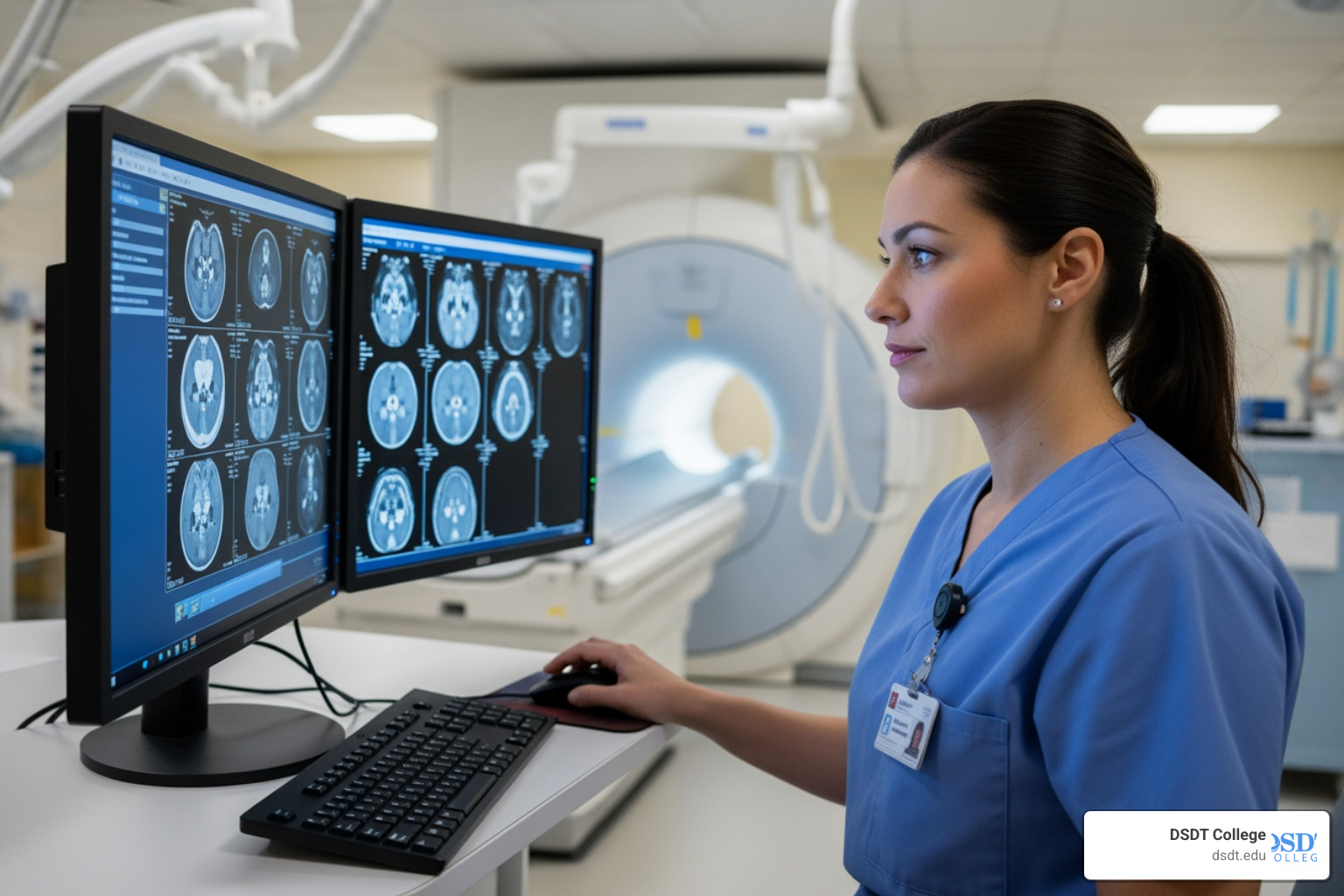
When we talk about an MRI Associate Degree, we are looking at a specialized educational path that blends sophisticated technology with essential patient care. As an MRI Technologist, you aren’t just pushing buttons; you are operating powerful magnets and radio waves to create detailed, 3D cross-sectional images of the human body. These non-invasive diagnostics are crucial for identifying everything from strokes and tumors to sports injuries.
The programs we provide and support follow rigorous industry standards. This includes parameters suggested by the Joint Review Commission on Education in Radiologic Technology (JRCERT) and the Association of Educators in Imaging and Radiologic Sciences (AEIRS). These guidelines ensure that your education isn’t just a collection of lectures, but a comprehensive training module that covers safety protocols, physics, and the ethical responsibilities of a healthcare professional.
One of the most critical aspects of this pathway is learning “MRI Safety.” Because the scanners use incredibly strong magnetic fields, you must become an expert at screening patients for contraindications like pacemakers, metal implants, or even certain tattoos. We take this responsibility seriously because your knowledge directly ensures the safety of every person who enters the scan room.
Core Courses in an MRI Associate Degree
What exactly goes into the “didactic” or classroom portion of your degree? It is a mix of high-level science and practical communication. You will start with the basics and move into the highly technical physics that makes imaging possible.
Key courses typically include:
- MRI Physics: Understanding how magnetic fields and radio frequency pulses interact with atoms in the body.
- Sectional Anatomy: Learning to identify organs and tissues from a cross-sectional perspective (top-down, side-view, etc.).
- Medical Terminology: The universal language of healthcare.
- Patient Care & Safety: How to move patients safely, monitor vitals, and alleviate claustrophobia.
- Ethics and Law: Navigating HIPAA, patient privacy, and professional conduct.
- Pulse Sequences & Image Analysis: The “art” of adjusting scanner settings to get the clearest possible picture for the radiologist.
For those interested in the specific breakdown of these modules, you can find more info about the MRI Technology Associate Degree on our program page. You will also learn about contrast administration, where you may assist in injecting non-radioactive dyes to help certain tissues “light up” on the scan.
Clinical Externship and Hands-on Training
You can’t learn to be an MRI tech solely from a textbook. That is why the MRI Associate Degree requires a massive commitment to hands-on training, often called a clinical externship. Most reputable programs require between 960 and 1,020 supervised clinical hours.
During this time, we place you in real-world environments like general hospitals, specialized imaging centers, or orthopedic clinics. You will work under the wings of experienced technologists, moving from observation to actually positioning patients and running the console.
| Training Component | Typical Clock Hours | Purpose |
|---|---|---|
| Didactic (Classroom/Online) | 600 – 1,500 Hours | Theory, Physics, and Anatomy |
| Lab / Simulation | 100 – 120 Hours | Practicing without live patients |
| Clinical Externship | 960 – 1,020 Hours | Real-world experience with patients |
| General Education | 240 – 300 Hours | Math, English, and Humanities |
This balance ensures that by the time you graduate, you aren’t just “book smart”—you are “job ready.” You will have experience with different machine manufacturers (like GE, Siemens, or Philips) and various patient pathologies.
Certification and Professional Registry Eligibility
Graduating with your degree is a huge milestone, but the final step to employment is “The Registry.” Most employers—especially in major hubs like Detroit, Chicago, or Phoenix—require you to be certified by either the American Registry of Radiologic Technologists (ARRT) or the American Registry of Magnetic Resonance Imaging Technologists (ARMRIT).
The MRI Associate Degree at DSDT College is specifically designed to follow the ARRT Primary Pathway. This is a big deal because it means you don’t need to be an X-ray tech first. You can go straight into MRI as your primary specialty. Once you complete your educational and clinical requirements, you become eligible to sit for the national board exams.
You can check the ARRT website for exam eligibility to see the latest standards for ethics and competency. Achieving these professional credentials proves to hospitals and clinics that you have met the highest national standards for safety and skill.
Meeting ARRT MRI Certification Requirements
To earn that “R.T. (MR)” credential after your name, you have to satisfy three main “pillars”:
- Education: Completing an accredited MRI Associate Degree program.
- Ethics: Passing a background review to ensure you meet professional standards.
- Examination: Passing the actual registry exam.
We help our students prepare for this through rigorous mock exams and registry prep courses. We know the stakes are high, so we focus on clinical competency verification throughout your final semesters. If you are looking for more info about healthcare career training and how we support certification, our admissions team is always available to walk you through the process.
Benefits of a Hybrid MRI Associate Degree
We understand that our students lead busy lives. Many are adult learners with families, or veterans transitioning from bases like Fort Hood or Fort Campbell. That is why a hybrid model is often the best fit.
In a hybrid MRI Associate Degree program, you get the best of both worlds:
- Online Didactic: You can study physics and anatomy from home, fitting your lectures around your work or family schedule.
- Virtual Simulations: Some programs use advanced simulators (like Corsmed) to let you practice “scanning” on a computer before you ever touch a million-dollar machine.
- Local Clinical Sites: We work to place you in a clinical rotation near your home within our service areas, from Jacksonville to Seattle.
This flexibility is a game-changer for veteran career programs, allowing those ending their service to begin training for a high-demand civilian role while still finishing their duties.
Career Outlook and Salary Expectations for Technologists
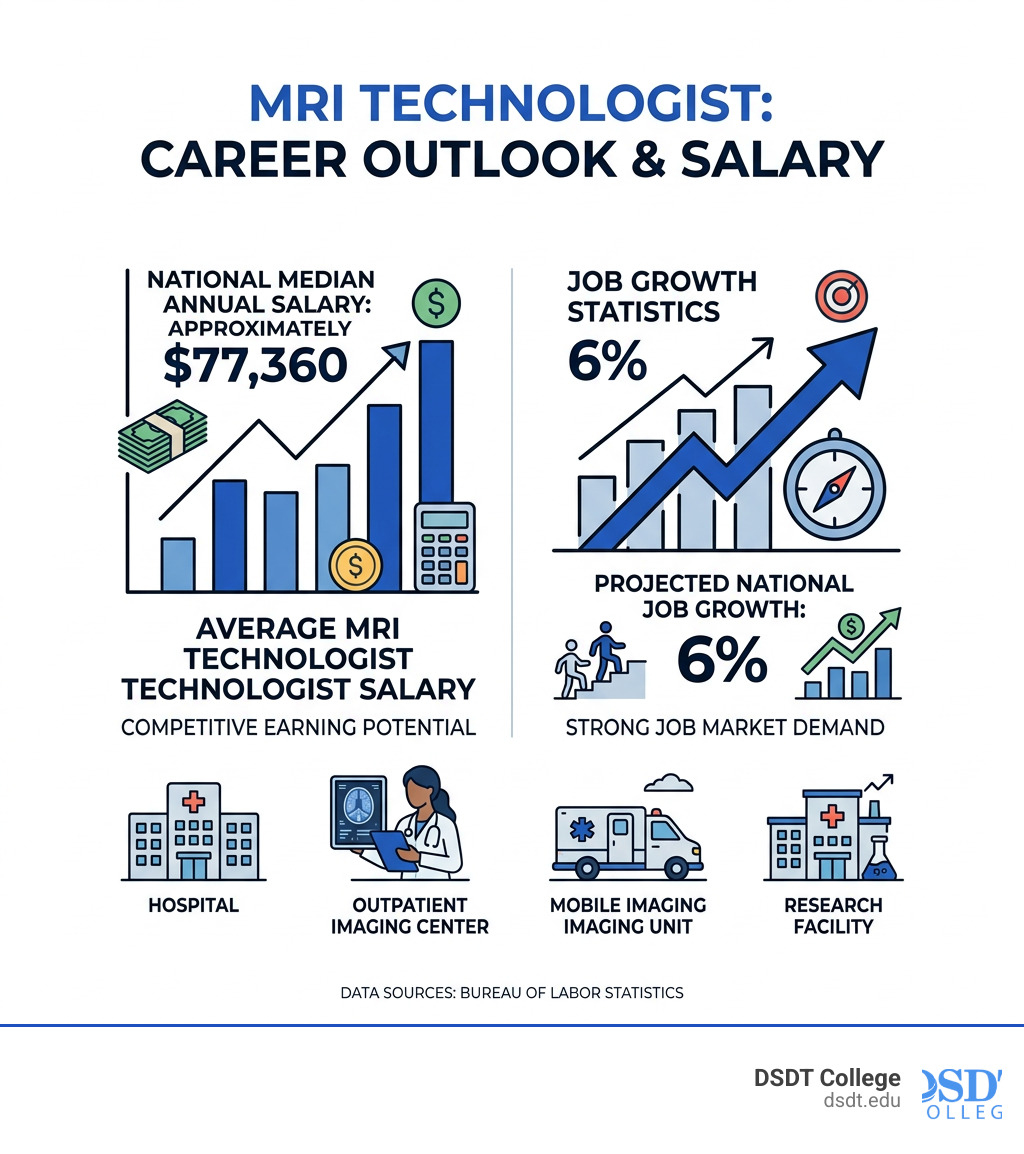
Is the investment in an MRI Associate Degree worth it? The data says yes. According to the Bureau of Labor Statistics, the national median annual salary for MRI technologists is approximately $77,360. In high-demand areas or for those with years of experience, that number can climb well over $100,000.
The BLS job outlook for MRI Technologists projects a 6% growth nationally, but certain regions are seeing much faster spikes. For example, Arizona has seen projected growth as high as 39% in recent years, and California remains a powerhouse for medical imaging employment.
As a graduate, you aren’t limited to just hospitals. You can find rewarding paths in:
- Outpatient Imaging Centers: Usually offering more “9-to-5” style schedules.
- Mobile Imaging Units: Traveling to different facilities to provide scans.
- Research Facilities: Helping develop new medical breakthroughs.
- Physician Offices: Working closely with specialists like neurologists or orthopedists.
Admission Requirements and Program Costs
Getting started is simpler than you might think. Most MRI Associate Degree programs require a High School Diploma or GED. While a 2.5 GPA is a standard benchmark, what we really look for is a commitment to the field and a “scientific” mindset.
Because you will be working in a healthcare environment, there are a few “non-academic” requirements:
- Background Checks & Drug Screening: Standard for anyone working with patients.
- Immunizations: You must be up to date on shots (like Flu, Hep B, and TB) to enter clinical sites.
- CPR Certification: Usually required before you start your externship.
Regarding costs, we encourage every student to use a Net Price Calculator to see what their actual tuition might look like. Financial aid is available for those who qualify, including Federal Pell Grants and specialized GI Bill® information for our veteran community. We are committed to making this career path accessible to everyone, whether you are in Detroit, Columbus, or San Antonio.
Frequently Asked Questions about MRI Degrees
How long does it take to complete an MRI Associate Degree?
Most students complete the program in 18 to 24 months. This typically includes about 72 to 115 weeks of total instruction. It is a full-time commitment, especially once you begin your clinical rotations, which may require you to be at a hospital 2 to 4 days a week.
Do I need prior healthcare experience to enroll?
No! One of the best things about the MRI Associate Degree is that it is designed for beginners. We teach you everything from the ground up—from how to talk to a patient to the complex physics of magnetism. Whether you were a retail manager, a stay-at-home parent, or in the infantry, you can succeed in this program if you are detail-oriented and enjoy technology.
Where do MRI Technologists typically work?
While over half of all MRI techs work in general hospitals, there is a massive shift toward diagnostic laboratories and outpatient clinics. These settings often offer more predictable hours. You might also find yourself in an urgent care center or even a mobile unit that brings imaging services to rural areas.
Conclusion
The journey to becoming an MRI Technologist is one of the most rewarding paths in the modern workforce. It combines the stability of healthcare with the excitement of cutting-edge technology. At DSDT College, we don’t just provide an education; we provide a bridge to your next career. From our hands-on labs to our dedicated career placement services, we are here to ensure you don’t just earn a degree—you earn a future.
If you are ready to take that next step, we are ready to help. Whether you are in Michigan, Texas, Florida, or any of our other locations, your new career is closer than you think. Start your career with an MRI Technology Associate Degree and join a community of professionals dedicated to changing lives through diagnostic excellence.