How Long Does the MRI Certification Timeline Pathway Actually Take?
The MRI certification timeline pathway you choose will determine whether you’re working as a credentialed MRI technologist in 12 months or 6 years — and the difference comes down to one thing: your starting point.
Here is a quick breakdown before we dive deeper:
| Pathway | Who It’s For | Estimated Timeline | Estimated Total Cost |
|---|---|---|---|
| ARRT Primary | Career changers, new entrants | 2-4 years | $20,000 – $55,000+ |
| ARRT Postprimary | Existing ARRT-certified RTs | 6-12 months | Varies |
| ARMRIT | Career changers, no prior radiology required | 12-18 months | $8,500 – $15,000 |
The right path depends on your background, your budget, and how fast you need to start earning. If you already hold a radiologic technology credential, you can add MRI in under a year. If you are starting from scratch — as many veterans and career changers do — you have two main options: the longer ARRT primary route built on an associate’s degree, or a faster ARMRIT-approved program focused exclusively on MRI.
Both pathways lead to the same outcome: a nationally recognized credential that qualifies you to work as an MRI technologist. But the road looks very different depending on which one you take.
There is real demand on the other side of that road. The Bureau of Labor Statistics projects more than 15,000 MRI technologist job openings annually through the next decade, driven by an aging population and growing reliance on MRI for diagnosis. That is not a slow-moving field — it is one actively looking for trained professionals.
I’m Jamie Kothe, and at DSDT College I work directly with career changers, veterans, and military families navigating the MRI certification timeline pathway from day one to national registry. In the sections below, I’ll walk you through each route clearly so you can make a confident, informed decision.
Understanding the Main MRI Certification Pathways
When you begin your research, you will encounter two primary credentialing bodies: the American Registry of Radiologic Technologists (ARRT) and the American Registry of Magnetic Resonance Imaging Technologists (ARMRIT). Both are national organizations, but they approach the MRI certification timeline pathway from different educational philosophies.
The Magnetic Resonance Imaging – ARRT pathway is often considered the traditional route. It offers two ways to get certified: the Primary pathway and the Postprimary pathway. The Primary pathway is designed for students who are entering the field for the first time and involves completing an associate degree or higher.
Alternatively, ARMRIT offers a specialized, MRI-only credential. This is frequently a top choice for career changers because it does not require a prior degree in general radiography (X-ray). Instead, students attend an approved MRI-specific program that focuses on MRI physics and clinical hours from day one.
Choosing Between ARRT and ARMRIT
Deciding between these two registries often comes down to where you want to work. ARRT is the “gold standard” for large hospital systems and university medical centers. Because ARRT technologists often start with a broader background in radiologic science, hospitals value their versatility.
ARMRIT, however, is highly respected in private imaging centers, orthopedic clinics, and specialized neurology practices. In 2026, the landscape of state acceptance is shifting. ARMRIT is currently accepted in over 40 states, including major markets like California, Florida, and Texas. If you know you want to specialize exclusively in MRI and want to enter the workforce quickly, the ARMRIT pathway is a legitimate and efficient route.
The Postprimary Route for Existing Technologists
If you are already a Registered Technologist (R.T.) in Radiography, Sonography, or Nuclear Medicine, you don’t need to go back to school for another degree. You can use the ARRT Postprimary pathway. This allows you to “cross-train” into MRI. You will need to complete 16 hours of structured education and document specific clinical competencies (usually around 125 procedures) to sit for the MRI registry exam.
Comparing the MRI Certification Timeline Pathway
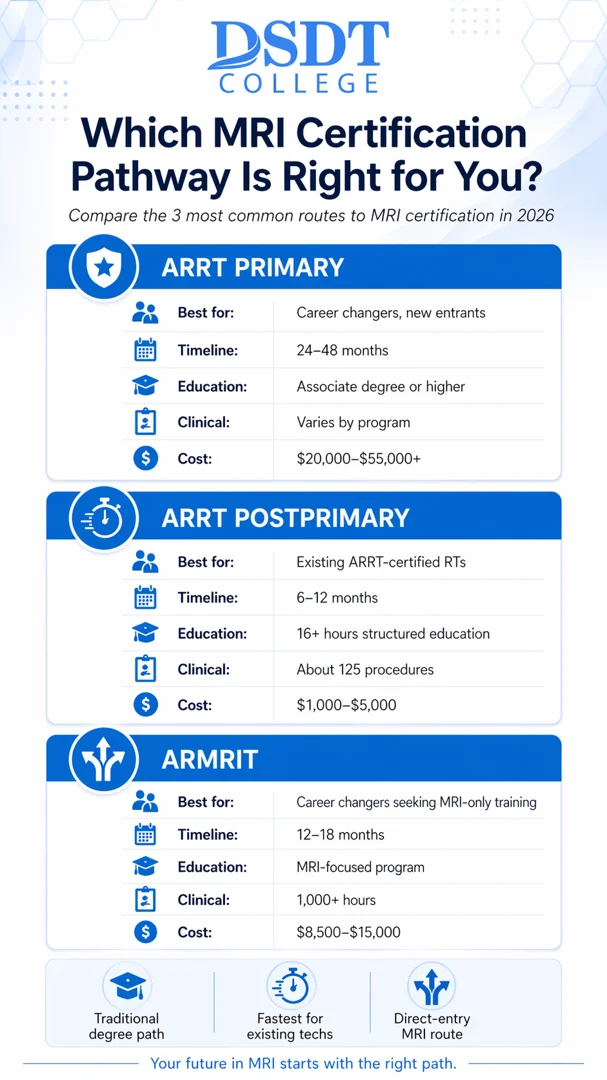
To help you visualize the time and financial commitment, we’ve broken down the three most common routes below.
| Feature | ARRT Primary | ARRT Postprimary | ARMRIT |
|---|---|---|---|
| Prerequisites | High School Diploma | Existing RT Credential | High School Diploma |
| Education | 2-4 Year Degree | 16+ Hours Structured Ed | 12-18 Month Program |
| Clinical Hours | Varies by Program | 125 Procedures | 1,000+ Hours |
| Total Duration | 24 – 48 Months | 6 – 12 Months | 12 – 18 Months |
| Cost Range | $20,000 – $55,000 | $1,000 – $5,000 | $8,500 – $15,000 |
Accelerated vs. Traditional Academic Routes
A traditional associate degree at a community college or university usually takes about two years of full-time study, plus any time spent on general education prerequisites. For many adult learners, this “slow burn” approach can be difficult to balance with family or work obligations.
Accelerated certificate or Associate of Applied Science in MRI Technology (AAS) programs are designed to be more intensive. These programs often combine online didactic learning with local clinical externships, allowing you to finish in as little as 17 to 18 months.
Impact of Clinical Placement on Graduation Speed
The biggest “bottleneck” in any MRI certification timeline pathway is clinical placement. You cannot become a technologist just by reading a book; you must spend hundreds of hours behind the console of a real MRI scanner.
Some programs require you to find your own clinical site, which can cause months of delays. We recommend looking for programs that have established partnerships with hospitals and imaging centers. Consistency is key—students who can commit to 16-24 hours of clinical training per week finish much faster than those who have gaps in their schedule.

Educational Prerequisites and Clinical Requirements
Before you can touch a scanner, you must meet certain educational standards. For beginners, the baseline is a high school diploma or GED. From there, your coursework will dive deep into the science of imaging.
Didactic Coursework and Physics Mastery
MRI is widely considered the most difficult imaging modality to learn because it relies on complex physics rather than simple X-ray transmission. You will study:
- Sectional Anatomy: Learning to identify organs and tissues in cross-section (axial, sagittal, and coronal planes).
- MRI Physics: Understanding magnetic fields, radiofrequency pulses, and spatial encoding.
- Patient Care: Screening for metal implants, managing claustrophobia, and administering contrast media.
- Safety Protocols: Understanding the four “Zones” of an MRI suite and how to prevent accidents in a 24/7 magnetic environment.
Documenting Clinical Competency
To qualify for the ARRT or ARMRIT exams, you must prove you can actually perform the job. This involves a “competency checklist.” You will be required to perform a certain number of mandatory procedures (like brain, spine, and knee scans) and a selection of elective procedures (like MRA or cardiac scans) under the direct supervision of a certified technologist. For ARMRIT, this typically requires 1,000 total clinical hours, while ARRT focuses on a specific count of 125 successfully completed procedures.
Navigating the Career Changer’s Journey
Many of our students are veterans or military spouses looking for a stable, high-demand career after service. One of the best things about the MRI field is that you do not need prior healthcare experience to start. Your ability to follow strict safety protocols and communicate clearly with patients—skills often honed in the military—makes you an excellent candidate for MRI training.
Step-by-Step MRI Certification Timeline Pathway for Beginners
If you are starting today with zero experience, here is what your next 17 months will likely look like:
- Enrollment and Foundation (Months 1-3): You’ll start with medical terminology, basic anatomy, and an introduction to the healthcare environment.
- Advanced Physics and Procedures (Months 4-8): This is the “heavy lifting” phase where you learn how the MRI machine actually works and how to set up different types of scans.
- Clinical Immersion and Externship (Months 9-15): You will begin working at a clinical site. You’ll start by observing, then move to “hands-on” scanning under supervision. This is where you build the 1,000 hours or 125 procedures required for your registry.
- Registry Preparation and Exam (Months 16-17): After completing your hours, you’ll focus on intensive exam prep, taking practice tests and reviewing physics before sitting for the national ARRT or ARMRIT exam.
Costs, State Licensing, and Job Prospects in 2026
The financial investment in your education is significant, but the return on investment (ROI) is often rapid. Tuition for MRI-specific programs typically ranges from $11,000 to $20,000. It is important to also budget for “hidden costs” such as background checks, immunizations, scrubs, and the fee for the registry exam (usually around $225–$300).
Understanding State-Specific Licensing Rules
National certification is only half the battle. You must also check your state’s licensing requirements.
- ARRT States: Some states, like Florida or New York, have specific licensing boards that heavily favor ARRT credentials.
- ARMRIT States: Over 40 states currently allow ARMRIT-certified technologists to practice.
- No License States: A handful of states do not require a separate state license if you hold a national certification.
Always check with your state’s Department of Health or Radiologic Technology Board before choosing your MRI certification timeline pathway.
Salary Expectations and Employer Preferences
In 2026, the demand for MRI technologists remains high. According to the Bureau of Labor Statistics, the median annual wage for MRI technologists is approximately $88,180.
- Entry-Level: $60,000 – $70,000
- Experienced (5+ years): $90,000 – $110,000+
- Travel MRI: Many technologists with 2+ years of experience take “travel” assignments, which can pay $2,500 to $4,000 per week.
While some hospitals still prefer ARRT, many outpatient centers are eager to hire ARMRIT-certified techs to fill immediate vacancies.
Avoiding Pitfalls in Your Professional Development
The road to certification is challenging, and many students fall off track due to avoidable mistakes.
Common Mistakes in Your MRI Certification Timeline Pathway
- Underestimating Physics: Many students breeze through anatomy but hit a wall with MRI physics. Start studying physics on day one; don’t leave it for the end of the program.
- Inconsistent Clinical Hours: If you only go to your clinical site once a week, it will take you years to finish. Treat your clinical externship like a job. Consistency helps you build “muscle memory” on the scanner.
- Ignoring State Rules: Don’t assume that a national certification is enough to work in your specific city. Research the licensing rules for your target location early.
- Delaying the Registry Exam: The best time to take your exam is within 30 days of finishing your clinical hours while the information is still fresh in your mind.
Frequently Asked Questions about MRI Certification
Can I become an MRI technologist with no prior healthcare experience?
Yes! You do not need to be a nurse or an X-ray tech first. Many career changers successfully complete direct-entry MRI programs in 12-18 months. These programs are designed to teach you everything from medical terminology to advanced physics from the ground up.
What is the difference between ARRT and ARMRIT certification?
ARRT is a multi-modality registry that often requires an associate degree and covers a broader range of radiologic sciences. ARMRIT is a specialized registry that focuses exclusively on MRI. ARRT is often preferred by large hospitals, while ARMRIT is widely accepted in private imaging centers.
How long does the ARRT postprimary pathway take for existing X-ray techs?
For those who are already ARRT-certified in another area (like X-ray), the process is much faster. You can typically complete the required 16 hours of structured education and the 125 clinical procedures in 6 to 12 months while continuing to work in your current role.
Conclusion
Choosing your MRI certification timeline pathway is a major life decision, but you don’t have to navigate it alone. Whether you are a veteran looking to utilize your GI Bill® benefits or a career changer seeking a stable future in healthcare, there is a path that fits your life.
At DSDT College, we specialize in helping students across the country—from Detroit to San Diego—reach their goals through our career-focused Healthcare and IT programs. Our Associate of Applied Science in MRI Technology is designed to prepare you for the ARRT Primary pathway, providing the degree and the clinical foundation you need to succeed in any imaging environment.
Ready to take the first step toward your new career? We are here to help you find the right clinical site and guide you through the enrollment process. For More info about MRI Technology Associate Degree, visit our program page today and let’s get you started on your 2026 career journey.