A clinical externship is a specialized course that takes place in a real-world healthcare environment. Unlike a laboratory setting on a college campus, an externship places you in the heart of a diagnostic imaging department. Here, you transition from a student to a trainee technologist, working under the supervision of experienced professionals to provide actual patient care.
In medical imaging, theory is only half the battle. You can memorize the physics of magnetic resonance and the anatomy of the brain, but the true skill lies in positioning a nervous patient, selecting the right pulse sequences, and troubleshooting artifacts in real-time. This is why MRI externship hospital partners are indispensable; they provide the “clinical immersion” necessary to turn academic knowledge into professional competence.
Bridging Theory and Practice
Before you step into a hospital, we ensure you have a solid foundation through rigorous didactic coursework and laboratory training. However, the hospital environment introduces variables that a classroom simply cannot replicate.
When you are at a clinical site, you apply your knowledge of MRI safety, patient screening, and cross-sectional anatomy. You learn the nuances of high-field magnets and how to handle the physical demands of the job—such as standing for long periods or assisting patients with limited mobility. Mentorship is a cornerstone of this experience. Having a seasoned technologist provide real-time feedback on your scanning technique is the most effective way to sharpen your MRI technologist training skills.
Preparing for the Workforce
Beyond the technical “knob-turning,” an externship is a months-long job interview. It allows you to build a professional network and a competitive resume before you even graduate. You learn the “soft skills” that employers crave: how to communicate with radiologists, how to manage a busy patient schedule, and how to maintain professional composure in a high-pressure Level I trauma center.
By the time you complete your rotations with our MRI externship hospital partners, you won’t just be ready for a test; you’ll be ready for a career. You will have the confidence to walk into any imaging suite and contribute to the team on day one.
Types of Healthcare Systems Serving as MRI Externship Hospital Partners
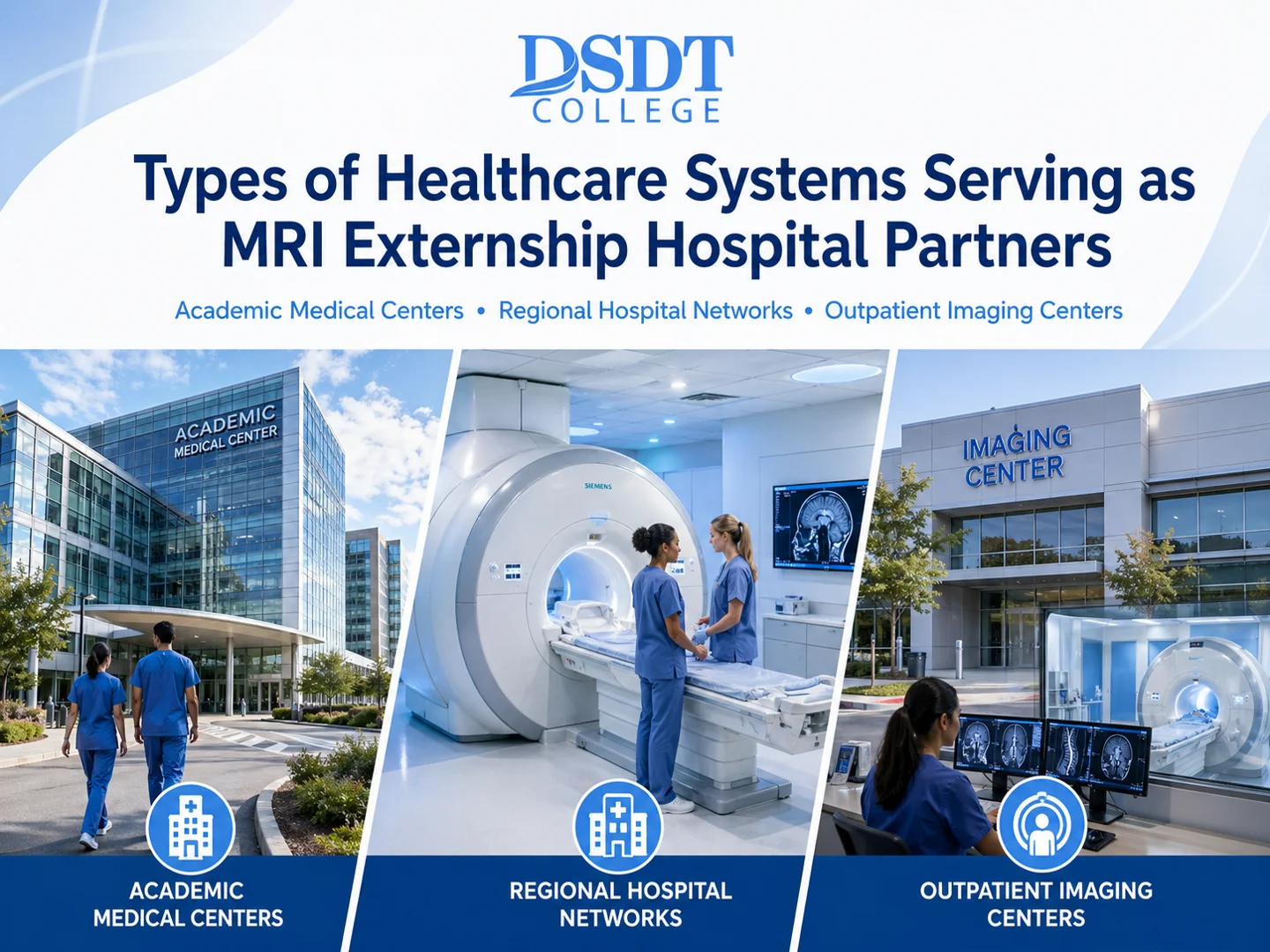
Not all clinical sites are created equal. Depending on your career goals, you might find yourself in a massive academic medical center or a specialized private clinic. We work with a diverse array of partners to ensure our students get exposure to the widest possible range of imaging scenarios.
Leading Academic Medical Centers
Many of our students rotate through large academic health centers and Level I trauma facilities. These sites are often the “gold standard” for clinical training. For example, some major teaching hospitals perform approximately 300 MRI procedures each week.
In these environments, you aren’t just doing routine knee and spine scans. You are exposed to complex cases involving oncology, pediatrics, and emergency trauma. These high-volume sites often utilize the latest research-driven protocols and state-of-the-art equipment, including 3.0 Tesla magnets and specialized coils. Training in this type of environment prepares you for the most demanding roles in the industry.
Regional Hospital Networks and Outpatient Centers
While large hospitals offer volume, regional networks and outpatient diagnostic centers offer a different kind of value. These sites often focus on community health and provide a more personalized patient interaction experience.
Regional partners, such as major healthcare systems in Ohio or Florida, allow students to rotate through various medical centers within a single network. This variety helps you understand how different facilities operate and which environment best suits your personality. From focused orthopedic clinics to general community hospitals, these sites are vital for building a well-rounded skill set. If you’re ready to see which locations are available near you, check out our DSDT Admissions Information.
Key Requirements and Structure for MRI Externship Hospital Partners
Entering a clinical environment requires more than just good grades. Because you will be handling patients and working with expensive, sensitive equipment, there is a standard set of “onboarding” requirements that all MRI externship hospital partners expect.
| Requirement | Description |
|---|---|
| BLS Certification | Basic Life Support for Healthcare Providers, often obtained through the American Red Cross, is mandatory. |
| Background Check | A clean criminal background check is required by all clinical sites. |
| Drug Screening | Standard 10-panel drug screens are typically performed before entry. |
| Immunizations | Proof of TB testing, MMR, Hep B, and other standard vaccines. |
| Liability Insurance | Students must often carry professional liability insurance (HPSO). |
| MRI Safety | A thorough screening to ensure the student has no metallic implants. |
How to Evaluate MRI Externship Hospital Partners
When we look for new industry partnerships, we evaluate them based on the quality of the student experience. You should do the same. A great partner site should offer a variety of equipment—ideally both 1.5T and 3.0T scanners—to ensure you are versatile.
Diversity in the patient population is also key. You want a site that challenges you with different body parts, ages, and medical conditions. Most importantly, the quality of mentorship is paramount. A site where the lead technologists are invested in teaching will always produce a better graduate than one where students are treated as “extra hands.”
Duration and Scheduling
MRI externships are a significant time commitment. Most programs require clinical experience to meet ARRT requirements. At DSDT, we understand that many of our students are veterans or adult learners with families. While clinical rotations typically follow a standard Monday-through-Friday daytime schedule, some of our partners offer evening or weekend shifts to help students balance their education with personal responsibilities.
How Clinical Rotations Prepare You for ARRT Certification
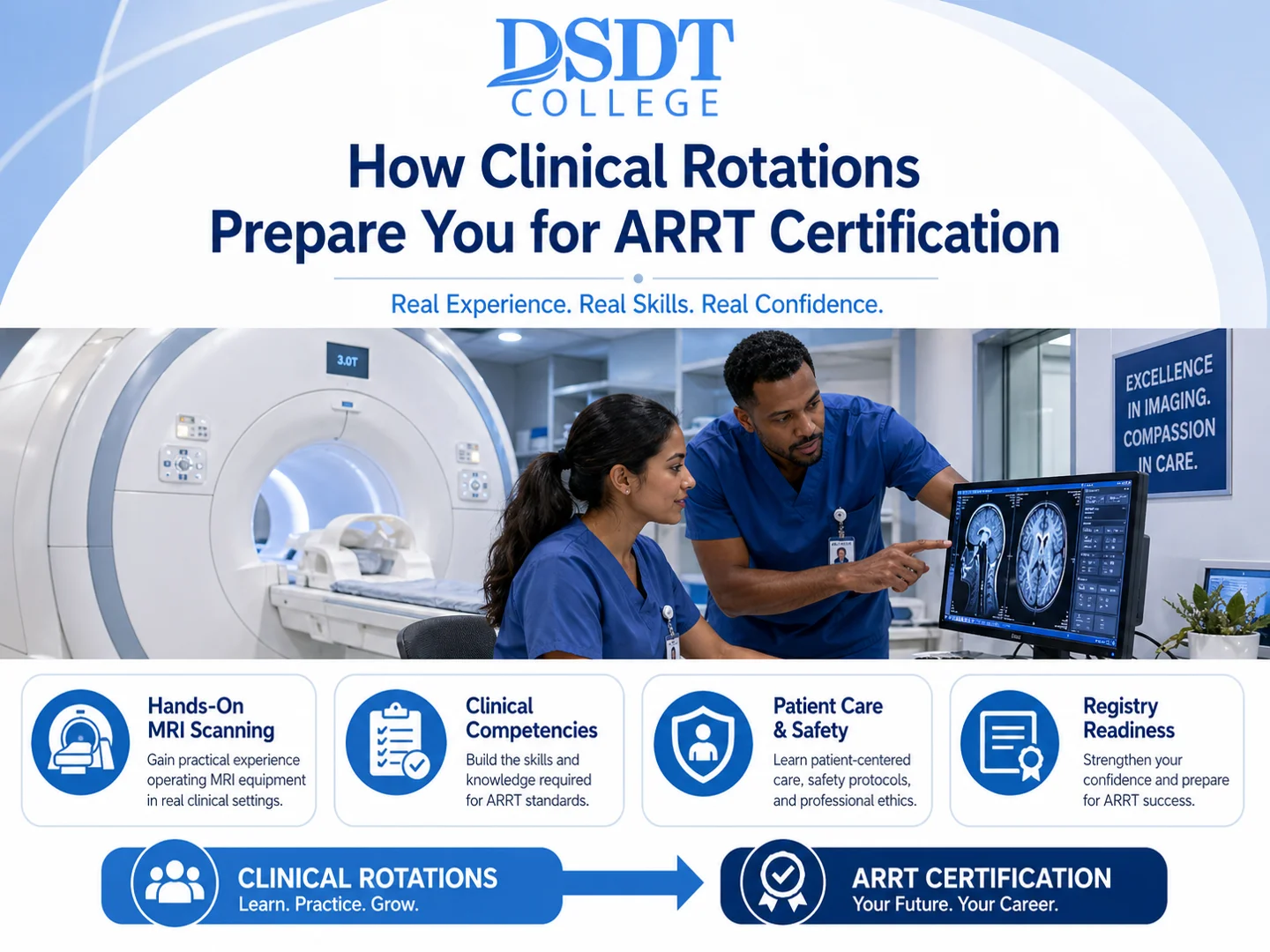
The ultimate goal of your time with our MRI externship hospital partners is to achieve “Registry Readiness.” To earn your credentials through the American Registry of Radiologic Technologists (ARRT) Primary Pathway, you must document a specific list of clinical competencies. This means you must prove you can perform a variety of scans—from routine brains to complex abdominal studies—independently and accurately.
Achieving Registry Readiness
Clinical rotations are where you master the clinical competency requirements set by the ARRT. You will track your progress, having a licensed technologist “sign off” on your ability to perform specific exams. This hands-on proficiency is paired with your MRI Technology Associate Degree coursework, which provides the structured education hours required for the exam.
By the time you finish your rotations, you should have a deep understanding of:
- Anatomy Mastery: Identifying structures in multiple planes.
- Physics Application: Understanding how to adjust parameters to improve image quality.
- Safety Protocols: Managing the powerful magnetic field and preventing accidents.
The Role of MRI Externship Hospital Partners in Career Placement
One of the best-kept secrets in healthcare is that externships are essentially a long-term talent pipeline. Hospitals love to hire their own externs. Why? Because you’ve already been “pre-vetted.” They know your work ethic, your technical skills, and how well you fit into their team culture.
Many of our partners, like those in the Mayo Clinic or OhioHealth systems, use their internship and externship programs to build a “bench” of qualified professionals. Even if a site isn’t hiring immediately, the networking you do during your rotations can lead to professional references and job leads across the healthcare community.
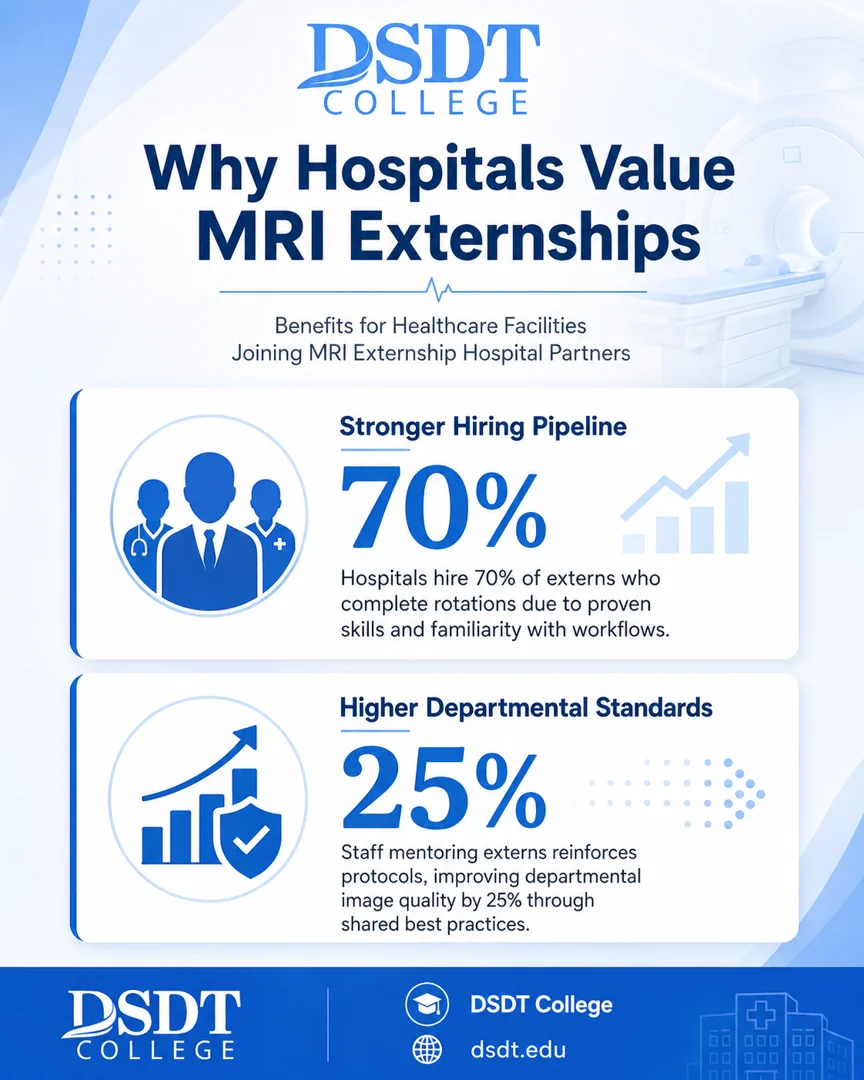
Benefits for Healthcare Facilities Joining MRI Externship Hospital Partners
The relationship between a college and a hospital is a two-way street. While students gain experience, healthcare facilities gain a wealth of benefits by becoming MRI externship hospital partners.
Streamlining Recruitment and Onboarding
Hosting students allows facilities to integrate potential future employees into their specific workflows early on. This familiarity reduces the time and resources typically spent on orientation for new hires. Facilities interested in this collaborative model can explore partnering with DSDT to connect with emerging professionals who are already trained on modern protocols.
Enhancing Departmental Standards
Teaching others actually helps current staff sharpen their own skills. When a technologist has to explain the “why” behind a specific protocol to a student, it reinforces best practices and keeps the department aligned with the latest academic standards. It fosters a culture of collaborative learning and clinical excellence that benefits the entire hospital.
Frequently Asked Questions about MRI Externships
How do I find a hospital partner for my clinical rotations?
If you are a student at DSDT College, we do the heavy lifting for you. We have a dedicated clinical coordination team that works with nearly 150 different externship partners across the country. We match you with a site based on your location, your skill level, and the site’s specific needs.
What are the typical requirements to start an MRI externship?
Students must complete all prerequisite didactic and laboratory training before entering a clinical site. Onboarding typically involves standard healthcare clearances and safety screenings to ensure a secure environment for both the trainee and the patients.
Can I complete my clinical rotations while managing other responsibilities?
Yes, but it requires careful planning. Clinical rotations are typically full-time commitments. However, we work with a variety of sites, and some may offer flexible scheduling. We encourage students with diverse backgrounds and responsibilities to speak with our advisors to create a schedule that works for their life.
Start Your Career in Medical Imaging
The path to becoming an MRI technologist is challenging, but with the right MRI externship hospital partners, it is incredibly rewarding. At DSDT College, we provide a clear, supported path from the classroom to the clinical site.
Our nationwide clinical network is designed to help you launch your career with confidence. Whether you are a career changer or entering the medical field for the first time, we offer the support and professional network needed to succeed in this high-tech profession.
Are you ready to stop dreaming and start scanning? Begin your journey in MRI Technology with DSDT College today.