What Is an Online Digital Marketer — and Is It the Right Career for You?
An online digital marketer is a professional who uses internet-based channels — like search engines, social media, email, and paid ads — to help businesses attract customers, build brand awareness, and grow revenue.
| Area | What It Means |
|---|---|
| What they do | Plan and run marketing campaigns across digital channels |
| Where they work | Remotely, in-house, at agencies, or freelance |
| Key skills | SEO, content, paid ads, email, analytics, AI tools |
| Who hires them | Businesses of every size, in every industry |
| Job growth | 10% projected over the next decade — above average |
| Entry barrier | Accessible through accelerated certification programs |
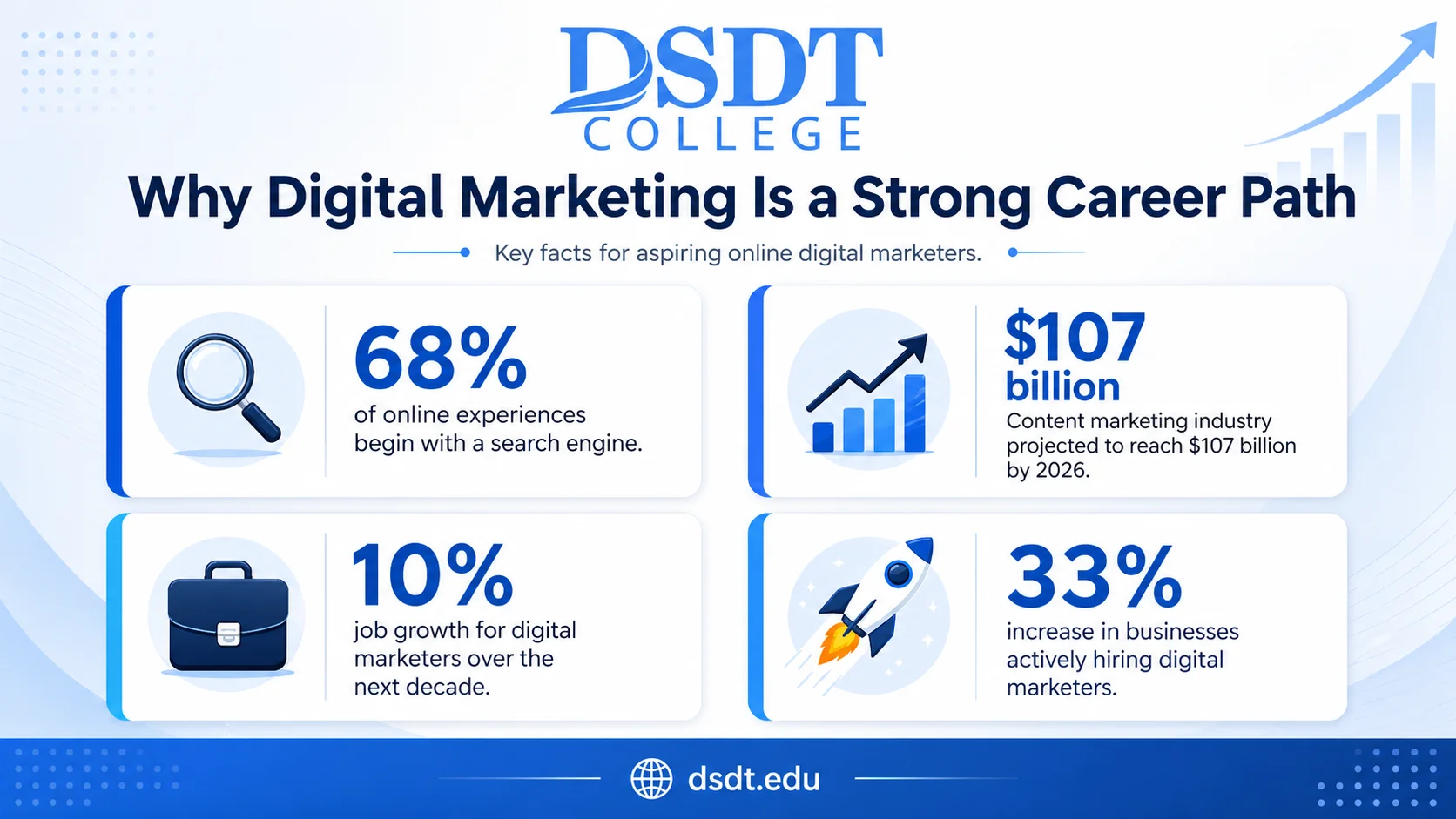
Digital marketing is no longer optional. Today, 68% of online experiences begin with a search, and the content marketing industry alone is projected to be worth $107 billion by 2026.
Whether you’re a veteran transitioning to civilian work, a career changer, or someone just starting out — the path to becoming a skilled online digital marketer is more accessible than ever.
I’m writing on behalf of DSDT College — a nationally accredited institution that trains career changers, veterans, and military families for high-demand roles. As a Military-Friendly School with expertise in accelerated, accessible career training, DSDT is well-positioned to help you launch a career in this space.
The Evolving Role of the Online Digital Marketer in 2026
In 2026, the role has evolved into that of a strategic architect of the human experience. We analyze complex consumer behavior data to understand the “why” behind every click, focusing on the customer journey—the path from initial awareness to brand advocacy. Whether in B2B or B2C, the objective is data-driven growth that feels personal rather than clinical.
B2B vs. B2C: Different Strategic Approaches
While the tools remain similar, the strategies differ significantly based on the target audience. B2B marketing focuses on relationship building and nurturing leads over long decision cycles, whereas B2C marketing relies on emotional triggers to drive immediate brand awareness and sales.
| Feature | B2B Digital Marketing | B2C Digital Marketing |
|---|---|---|
| Primary Goal | Lead generation & long-term relationships | Brand awareness & immediate sales |
| Decision Cycle | Long (months to years) | Short (minutes to days) |
| Content Tone | Educational, professional, data-heavy | Emotional, entertaining, urgent |
| Main Channels | LinkedIn, Email, Webinars, Whitepapers | TikTok, Instagram, Facebook, Search Ads |
Mastering Search and Omni-channel Consistency
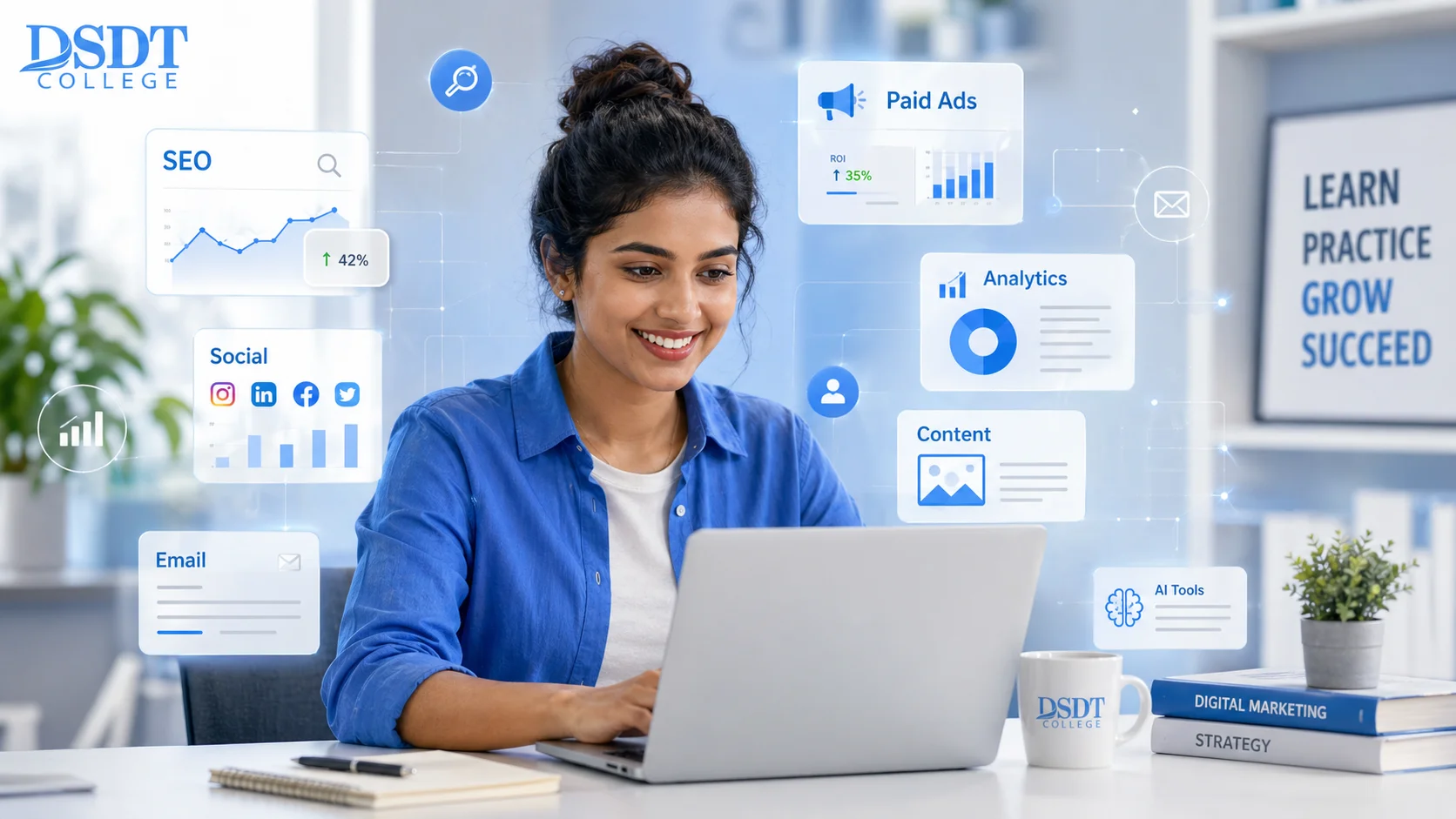
Search remains the backbone of the digital world. Success requires mastering both organic search (SEO) and paid search (PPC). Tools like GA4 (Google Analytics 4) and GTM (Google Tag Manager) allow us to track user interaction and improve the experience.
In 2026, maintaining brand professionalism and cohesive messaging across the entire customer lifecycle is essential. By using multi-touch attribution, we ensure a consistent voice everywhere the customer is, guiding them toward a conversion.
Core Channels and Strategies for Business Growth
To drive real growth, an online digital marketer must be a “full-stack” strategist. We don’t just pick one channel; we build an integrated ecosystem.
- Content Marketing: This is the fuel for your engine. By creating valuable, educational content, we establish businesses as thought leaders. In fact, 80% of marketers in recent years reported that their content strategy was the primary driver of their success.
- Email Marketing: Despite being one of the oldest digital tools, email remains a powerhouse for lead generation and nurturing. With the end of third-party cookies, owning your audience via an email list is more critical than ever.
- Social Media & Influencers: Platforms like TikTok have seen engagement rates as high as 16% for influencer collaborations. We use these channels to build community and trust.
- Video Sales Letters (VSLs): Combining classic copywriting with modern video, VSLs are essential for converting cold leads into buyers by explaining complex value propositions quickly.
High-Impact Advertising and PPC
Paid advertising is where we scale. Whether it’s Google Ads for intent-based searches or Facebook and TikTok ads for discovery, we focus on ROAS (Return on Ad Spend).
A key part of our job is conducting ad account audits to find “leaking” funnels—places where money is being spent but users aren’t converting. By optimizing the “Quality Score” of ads and ensuring landing pages are perfectly aligned with the ad copy, we lower the CPC (Cost Per Click) and maximize the budget.
Content Strategy and Authority
To build lasting authority, we use “content clusters.” Instead of random blog posts, we create a “pillar post”—a comprehensive guide on a major topic—and surround it with smaller, related articles that link back to it. This signals to search engines that we are experts in that field.
For those looking to master these frameworks, the Digital Marketing Professional program at DSDT College provides the hands-on training needed to build these strategies from scratch. We emphasize ethical marketing and building brand trust, ensuring that your growth is sustainable and your reputation remains untarnished.
The AI Revolution: Enhancing Strategy with Automation
If 2024 was the year of AI curiosity, 2026 is the year of AI execution. For an online digital marketer, AI is not a replacement; it is an “execution engine.”
We use AI to handle the heavy lifting:
- Content Personalization: AI can swap out images or text in an email to match a specific user’s interests instantly.
- Workflow Automation: Smart tools can trigger specific ads or emails based on a user’s behavior without us lifting a finger.
- Predictive Analytics: Machine learning helps us guess what a customer will want next, allowing us to be proactive rather than reactive.
The secret to winning with AI lies in “prompt engineering.” This is the art of giving an AI the right instructions to get high-quality results. At DSDT, our AI Prompt Specialist program is designed to turn you into a power user who can leverage these tools to work faster and smarter than the competition.
Career Outlook and Opportunities in the Digital Space
The job market for an online digital marketer is incredibly healthy. The Bureau of Labor Statistics projects a 10% growth in marketing roles over the next decade, and the number of companies hiring for these positions has surged by 33%.
Career paths are diverse:
- Marketing Manager: Overseeing the big picture and managing teams.
- Digital Strategist: Focusing on data and high-level campaign planning.
- Content Creator: Building the stories that capture attention.
- Freelance Consultant: Offering specialized services like SEO or PPC audits to multiple clients.
One of the greatest perks of this career is remote work flexibility. For our military community, this is a game-changer—your career can move with you from base to base.
How to Become a Certified Online Digital Marketer
- Get Certified: Start with foundational courses like HubSpot Academy or Google Analytics.
- Build a Portfolio: Create “mock” campaigns to show you can do the work.
- Optimize Your Presence: Your LinkedIn profile is your digital resume. Use it to network and showcase your certifications.
- Hands-on Training: Structured, accelerated paths are available through specialized programs, including guidance on tuition and financial aid to make the transition as smooth as possible.
Frequently Asked Questions about Digital Marketing Careers
What is the typical cost of digital marketing certifications?
Costs vary widely. Many foundational certifications (like those from HubSpot or Google) are free. However, comprehensive, career-focused programs that include mentorship and job placement support typically range from $2,000 to $3,000. These are often eligible for military benefits like the Post-9/11 GI Bill® or MyCAA.
How long does it take to see results from a digital marketing strategy?
It depends on the channel. Paid ads (PPC) can show results in hours. SEO and content marketing are long-term plays that usually take 3 to 6 months to gain significant traction. A balanced strategy uses both for short-term wins and long-term stability.
Do I need a college degree to become a digital marketer?
No. While some corporate roles may still list a degree as a preference, the industry is overwhelmingly moving toward “skills-based hiring.” If you can prove you can rank a website or run a profitable ad campaign, you are hirable.
Conclusion
The journey to becoming a successful online digital marketer is one of constant learning and exciting challenges. It is a career that rewards creativity, analytical thinking, and a genuine desire to connect people with the products and services they need.
Ready to take the first step toward your new career? Explore our Digital Marketing Professional program today and join the ranks of professionals shaping the future of the digital world. We have no waitlists and no SAT/ACT requirements—just a direct path to the skills you need to succeed.
External Resources for Further Growth:
- Mark Ligon | Digital Marketer – Ecommerce & SEO Expert
- Nancy C Weaver – Digital Strategist & Email Expert
- Chay Kelly | Digital Marketing Consultant
- Alizah Thornton | Data-Driven Digital Strategist
- Thatcher Olson — Digital Marketing Expert
- Hazem Maraqa | Digital Marketer Expert
- National Marketing Services – Zilker Partners
- NYC Digital Marketing Agency | Thrive
- Los Angeles Digital Marketing Agency | Thrive
- Digital Marketers Chicago
- Forthea: Houston Digital Marketing Agency
- Miami Digital Marketing Agency | Thrive
- Dallas Digital Marketing Agency | Thrive
- Phoenix Online Media