Advertising Is Growing Fast — Here’s What You Need to Know
Advertising certificate programs are short, focused training programs that teach you the skills to plan, create, and manage advertising campaigns — without the time or cost of a full degree.
Quick answer: What are advertising certificate programs?
| Feature | Details |
|---|---|
| What they are | Short credential programs focused on advertising and marketing skills |
| Who they’re for | Career starters, career changers, and degree holders adding skills |
| How long they take | A few months to 3 semesters, depending on the program |
| What you learn | Media planning, digital ads, copywriting, analytics, campaign strategy |
| Where you can study | Online, in-person, or hybrid |
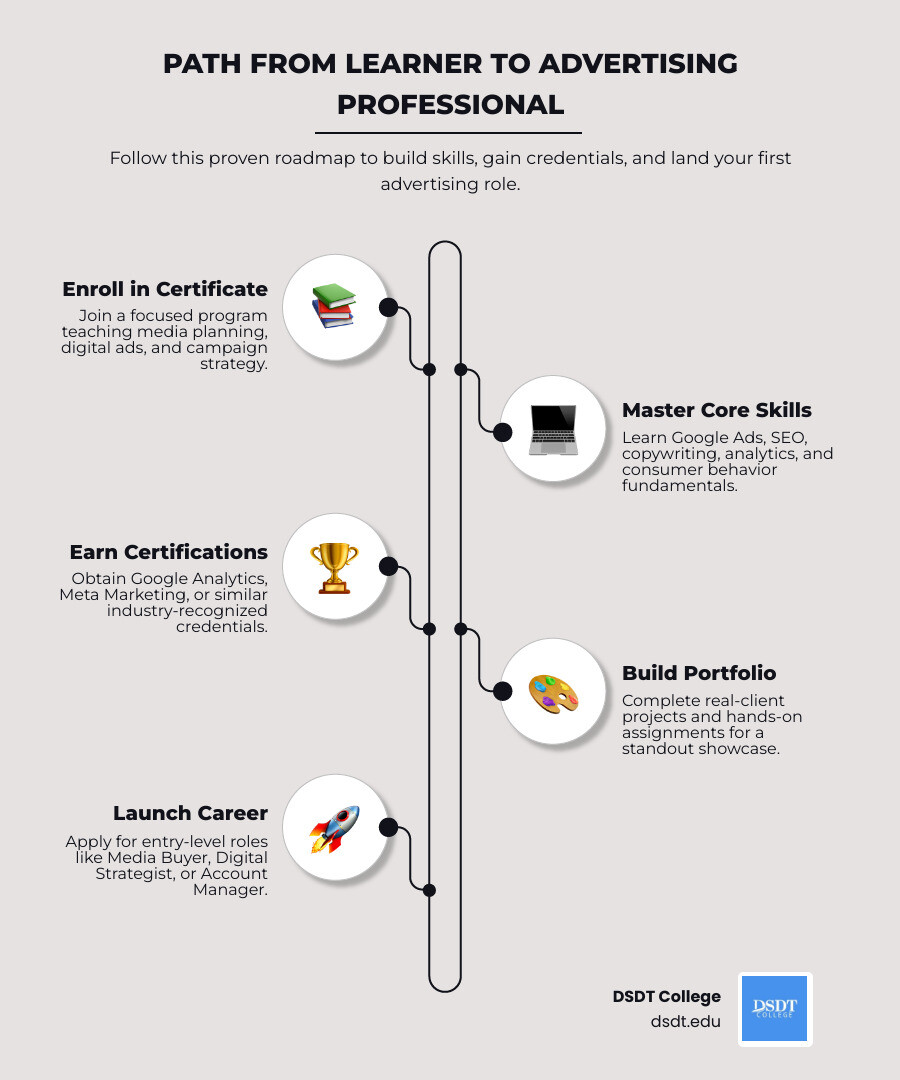
| What they lead to | Roles like Media Buyer, Digital Strategist, and Account Manager |
The advertising industry is expanding. The U.S. Bureau of Labor Statistics projects 10% job growth in advertising between 2021 and 2031. That means more demand for skilled, job-ready professionals — and employers are hiring.
A certificate can get you there faster than a degree. Programs range from a few hours of on-demand coursework to structured multi-semester credentials. Some are standalone. Others add on to an existing degree. Either way, you gain real, usable skills that employers are actively looking for.
Whether you’re fresh out of high school, switching careers, or building on a degree you already have — there’s a path into advertising that fits your situation.
I’m Jamie Kothe, an academic leader at DSDT College with experience developing career-focused programs — including in digital marketing — that align with what today’s employers actually need. I’ve worked closely with industry partners to make sure advertising certificate programs like the ones covered here lead to real career outcomes, not just credentials. Let’s break down your options so you can find the right fit.
Why Choose Advertising Certificate Programs Over a Degree?
When we talk to students about their career goals, the first question is often: “Do I really need a four-year degree?” In the fast-moving world of media and promotion, the answer is increasingly shifting toward specialized certification. Advertising certificate programs offer a streamlined, high-impact alternative to traditional academic paths.
While a degree provides a broad theoretical foundation, a certificate is designed for immediate application. These programs focus on the “how-to” rather than just the “why.” For many, this means entering the workforce years earlier with the exact tools employers are currently using.
Comparing the Pathways
| Feature | Certificate Program | Traditional Degree (BA/BS) |
|---|---|---|
| Time Commitment | Under 6 months to 1.5 years | 4 years |
| Credit Hours | Typically 15 to 33 credit hours | 120+ credit hours |
| Focus | Technical skills & industry tools | General education & theory |
| Cost | Highly cost-effective | High tuition & long-term debt |
| Flexibility | Online, hybrid, and on-demand options | Often requires full-time on-campus presence |
Standalone Credentials vs. Add-on Certificates
Not all certificates are created equal. Depending on your current education level, we see two primary paths:
- Standalone Credentials: These are perfect for career changers or high school graduates. For example, a 33-credit hour program can provide enough depth in marketing principles and digital design to qualify you for entry-level roles.
- Add-on Certificates: Many universities offer 15-credit (roughly 5 course) certificates designed to supplement an existing degree. This is a popular choice for business or communications students who want to prove they have specific expertise in digital marketing or integrated communications.
For those looking for rapid entry into the field, flexible study options—such as less than 10 hours of study per week—allow you to keep your current job while you pivot into a new career. This cost-effectiveness and speed make advertising certificate programs a dominant choice for the modern learner.
Essential Skills Gained in advertising certificate programs
The “magic” of a certificate program lies in the curriculum. We don’t just want you to read about ads; we want you to build them. When you enroll in a high-quality program, you are essentially building a toolkit that you can carry into any agency or corporate marketing department.

The Digital Toolbox
In today’s landscape, digital skills are non-negotiable. You can expect to master:
- Google Ads & SEO: Understanding how to make a brand visible when someone searches for a product is the bread and butter of modern advertising.
- Social Media Advertising: Mastering platforms like Meta, Twitter, and LinkedIn to reach specific demographics.
- Marketing Analytics: Learning to read the data. If a campaign isn’t working, you need to know how to find the “leak” in the budget and fix it.
- E-commerce Tools: Many programs now include training in platforms like Shopify and Mailchimp, allowing you to manage the entire customer journey from the first ad to the final sale.
The Creative and Strategic Side
It’s not all about buttons and data; the “art” of the deal still matters. You will gain experience in:
- Copywriting: Writing persuasive text that drives action.
- Consumer Behavior: Understanding the psychology of why people buy.
- Media Planning and Budget Allocation: Deciding where to spend money (TV? Search? Social?) to get the best return on investment (ROI).
- Agency-Client Relationships: Learning the soft skills required to manage expectations and communicate effectively with corporate stakeholders.
By the time you finish, you’ll have the ability to develop a comprehensive marketing plan from scratch. For those interested in a structured path, you can find more info about digital marketing training that covers these essential pillars.
Top Institutions Offering Advertising Credentials
If you are looking for where to study, several types of institutions stand out for their specific approach to advertising and media. These programs are often distinguished by their connection to real-world industry standards.
Focus on Media Management
Some specialized programs focus heavily on the business side of the industry. These are often post-graduate certificates that require a prior degree. They excel at teaching both the “buyer” and “seller” perspectives. You learn how to negotiate for ad space and how to research media markets using professional tools like Comscore and Vividata.
Integrated Marketing Communication
Many institutions emphasize “Integrated Marketing Communication.” This approach ensures that a brand’s message is consistent across traditional media (like billboards and print) and the digital landscape. This is vital for corporations that need to communicate effectively with a global audience.
Community College Pathways
For those seeking a solid foundation, various community colleges offer certificate programs that blend marketing principles with digital design. These programs often focus on the free enterprise system and digital design principles, providing an accessible entry point into the field.
Hands-on Experience
The best advertising certificate programs include a “work-integrated learning” component. This might look like:
- Field Placements: A minimum of 160 hours working at an actual advertising firm.
- Real-Client Projects: Working with local businesses or non-profits to implement real marketing strategies.
- Simulated Campaigns: Using industry software to run “mock” ads and analyze the results.
Other notable options for those in major metropolitan areas are designed to be career-ready, often allowing you to finish in a year or less. These programs are structured to provide practical education aligned with workforce needs.
Career Opportunities and Industry Certifications
A certificate is more than just a piece of paper; it’s a signal to employers that you have verified skills. Many programs are built specifically to help you earn industry-recognized certifications while you study.
Industry-Recognized Credentials
While the college provides the certificate, third-party certifications are often the “gold standard” for specific tools. Top programs will prepare you for:
- Google Ads & Google Analytics: Essential for any digital role.
- Meta Social Media Marketing: A professional certificate that proves you can handle large-scale social campaigns.
- Shopify and Mailchimp: Proving you can manage e-commerce storefronts and email marketing funnels.
Job Roles for Graduates
Once you’ve completed your advertising certificate programs, a variety of entry-level and mid-level roles become available:
- Media Buyer/Planner: You decide where the ads go and negotiate the prices.
- Digital Strategist: You look at the big picture of how a brand exists online.
- Account Manager: You act as the bridge between the creative team and the client.
- Social Media Manager: You manage the “voice” of the brand on social platforms.
- Marketing Analyst: You dive deep into the data to see what’s working.
Portfolio Development
One of the biggest benefits of these programs is that you leave with a portfolio. Instead of just a resume, you have actual campaign plans, creative designs, and data reports to show potential employers. This is especially helpful for those transitioning from unrelated fields or veterans moving into civilian creative roles.
Frequently Asked Questions about Advertising Certificates
What are the typical admission requirements for advertising certificate programs?
Requirements vary based on the “level” of the certificate.
- Graduate Certificates: Usually require a Bachelor’s degree or equivalent. These are designed for people who already have a degree but want to specialize in media management.
- Undergraduate/Community College Certificates: Often only require a high school diploma or GED.
- Mature Students: Many schools offer pathways for adult learners who may not have traditional academic backgrounds but have relevant work experience.
- Language Proficiency: For international students, proof of English proficiency (like TOEFL or IELTS) is standard.
How long do advertising certificate programs take to complete?
The timeline is one of the biggest draws!
- Accelerated Online Options: Many industry-standard professional certificates can be completed in under six months with about 10 hours of study per week.
- Associate/Community College Certificates: These typically take 2 to 3 semesters (about one year) if you go full-time.
- Micro-credentials: Some professional associations offer “associate” certificates that can be completed in as little as 4 to 10 hours for specific, niche skills.
What is the average cost of these programs?
Cost depends on the institution and your residency status.
- Domestic Students: For a three-semester graduate program, fees can range around $6,000 to $7,000 total. Community college certificates are often even more affordable, charged by the credit hour.
- International Students: Tuition is typically higher, often ranging from $15,000 to $20,000 for a full program.
- Financial Aid: Many accredited programs are eligible for federal financial aid, scholarships, and bursaries. We always recommend speaking with a financial advisor at the school to explore your options.
Conclusion
The world of advertising is moving faster than ever, and the traditional four-year degree isn’t the only way to get your foot in the door. Advertising certificate programs offer a practical, hands-on, and cost-effective way to gain the skills that are in high demand right now. From mastering Google Ads to managing real-client projects, these programs are designed to turn you into a job-ready professional in a fraction of the time.
At DSDT College, we believe in education that leads directly to a paycheck. Whether you are in Detroit, Chicago, or Dallas, the need for skilled digital marketers is only growing. We focus on industry alignment and hands-on training to ensure our students aren’t just learning—they’re doing.
If you’re ready to stop “adding it up” and start your career, now is the time to explore your options. Start your digital marketing journey with us and see how a focused certificate can change your professional future.