Choosing the right ARRT approved MRI pathway is the most critical decision you will make at the start of your journey. The American Registry of Radiologic Technologists (ARRT) designed these two distinct routes to ensure that whether you are a high school graduate or an experienced X-ray tech, you have a structured way to prove your competency.
To be eligible for ARRT certification in MRI, you must meet three core requirements: education, ethics, and examination. While the ethics and exam components are largely the same for everyone, the education and clinical experience requirements differ significantly based on your chosen pathway.
The Primary Pathway for New Students: An ARRT Approved MRI Pathway
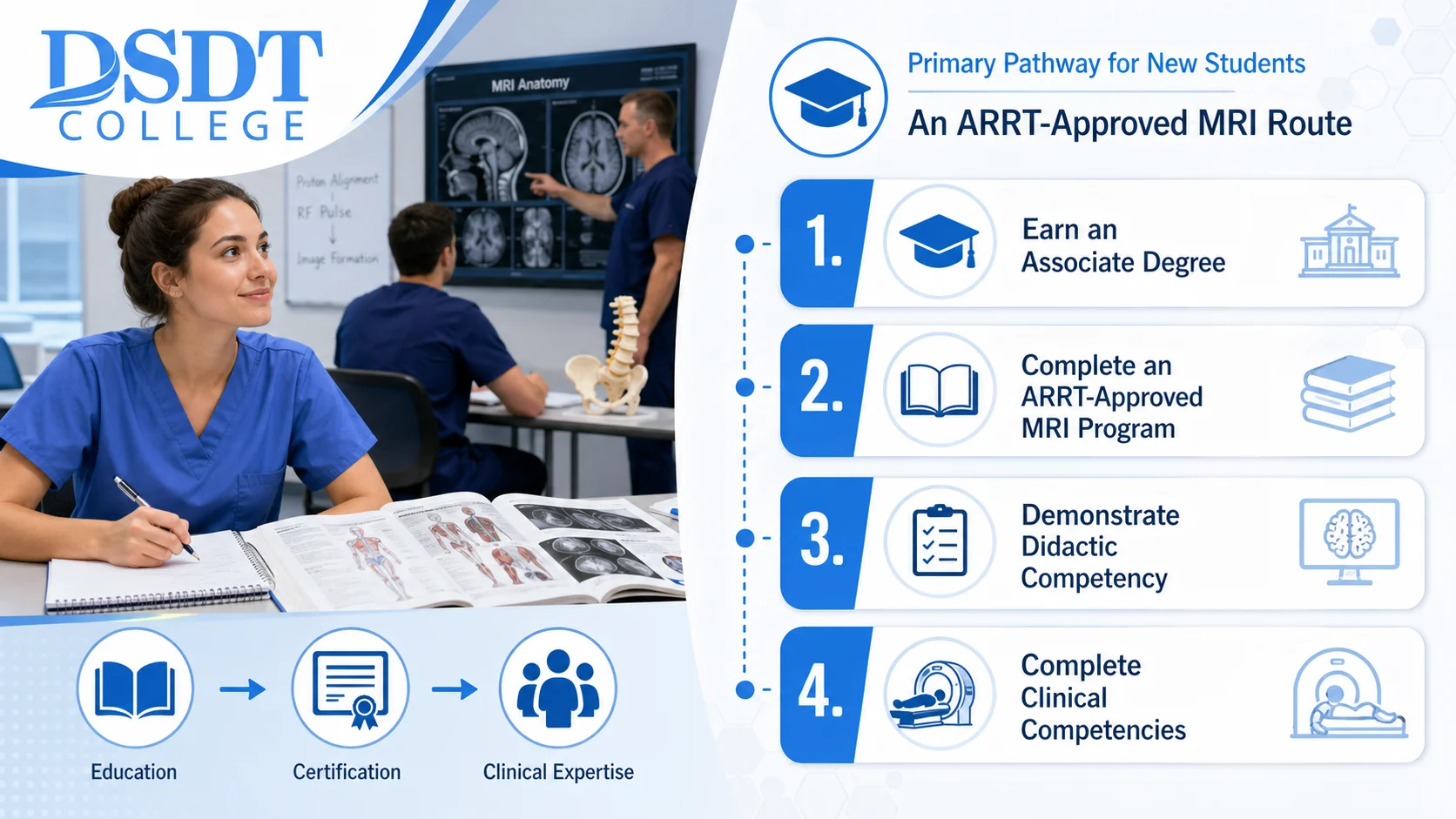
The Primary Pathway is the most common route for individuals who are not yet certified in any medical imaging discipline. If you are a high school graduate or a career changer, this is likely your path.
To succeed in the Primary Pathway, you must:
- Earn an Associate Degree or Higher: The ARRT requires that all primary candidates hold at least an associate degree. This degree does not necessarily have to be in radiologic sciences, but it must be from an institution accredited by an agency that ARRT recognizes.
- Complete an ARRT-Approved Educational Program: You must graduate from a program specifically designed for MRI technology that is recognized by the ARRT. At DSDT College, our Associate of Applied Science in MRI Technology is built to follow this exact pathway, combining rigorous online coursework with hands-on clinical training.
- Demonstrate Didactic Competency: You must complete coursework covering the ARRT Content Specifications, which include patient care, safety, image acquisition, and physics.
- Complete Clinical Competencies: You must perform a specific list of MR imaging procedures on actual patients under supervision to prove you can do the job safely and effectively.
The Postprimary Pathway: An ARRT Approved MRI Pathway for R.T.s
The Postprimary Pathway is designed for healthcare professionals who already hold a “supporting category” credential. This is a popular choice for Radiologic Technologists (R.T.s) who want to specialize and increase their earning potential.
To use this pathway, you must already be certified and registered with ARRT (or in some cases, NMTCB or ARDMS) in one of the following:
- Radiography (R)
- Nuclear Medicine Technology (N)
- Radiation Therapy (T)
- Sonography (S)
According to the ARRT Postprimary Eligibility Pathway Handbook, these candidates do not need a new degree. Instead, they must fulfill structured education (16 credit hours) and clinical experience requirements within the 24 months immediately preceding their application.
Education and Clinical Requirements for MRI Certification
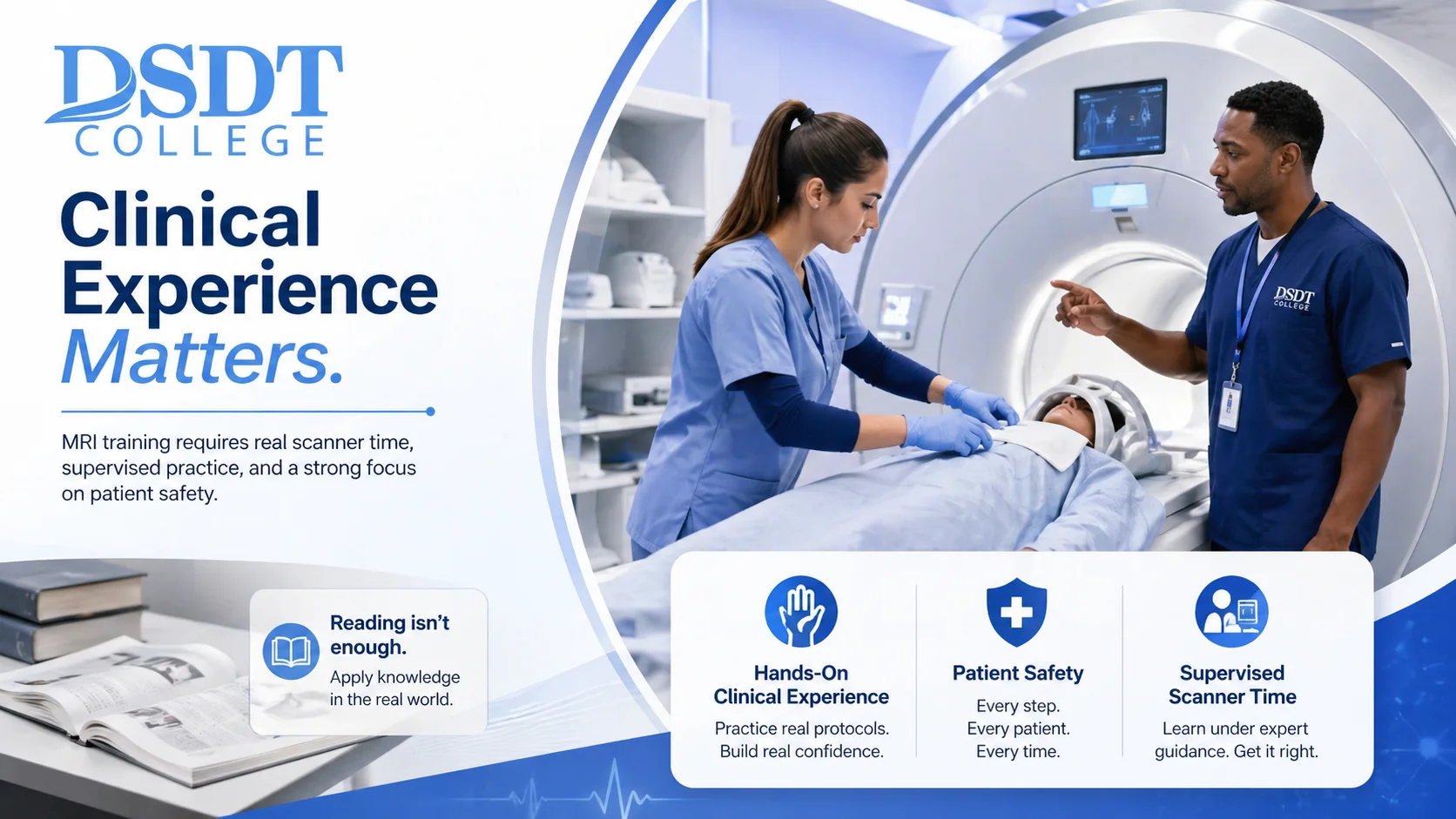
Regardless of the pathway, you cannot become an MRI technologist just by reading a book. You need “seat time” in front of the scanner. The ARRT sets high standards for clinical experience to ensure patient safety, especially given the powerful magnetic fields used in MRI suites.
Mandatory and Elective MR Imaging Procedures
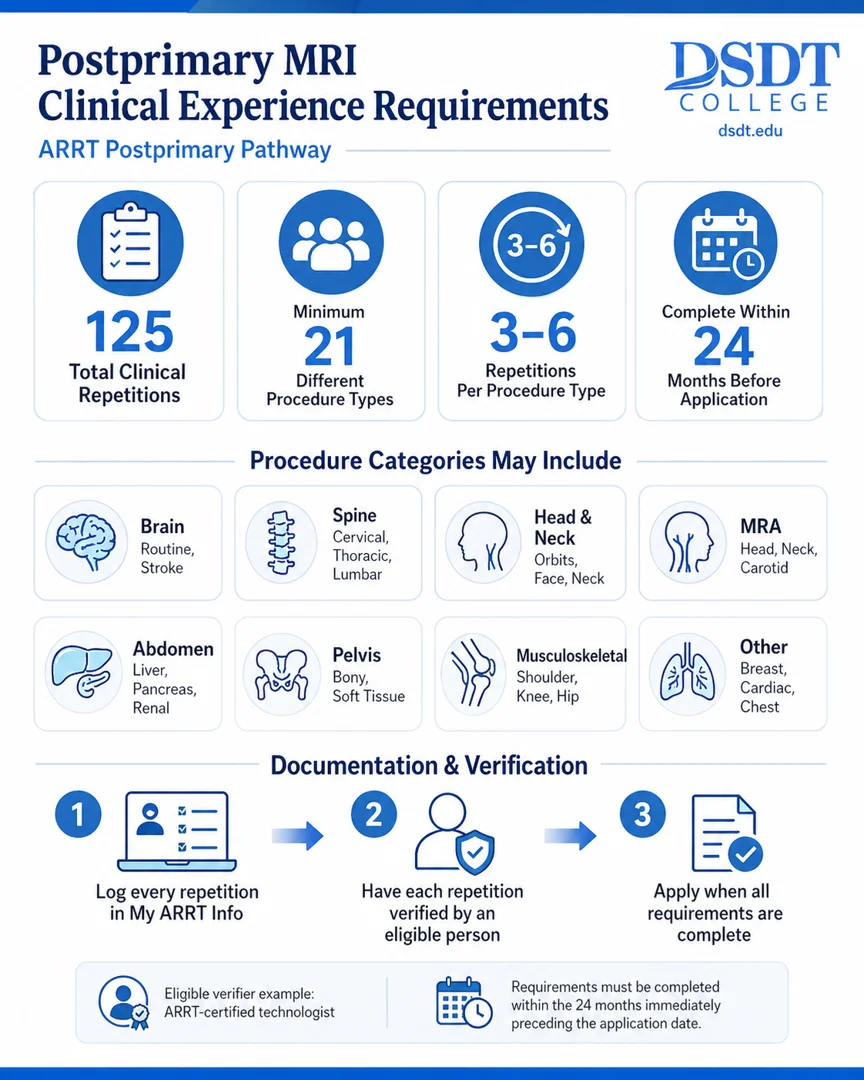
The ARRT requires candidates to prove they can handle a wide variety of scans. For the Postprimary Pathway, the MRI clinical experience requirements mandate a minimum of 125 repetitions of MRI procedures. These must cover at least 21 different types of procedures, with 3 to 6 repetitions required for each.
For Primary Pathway students, the requirements are slightly more prescriptive:
- 17 Mandatory Procedures: These are the “bread and butter” of MRI, including scans of the brain, cervical spine, lumbar spine, shoulder, and knee. You must perform these on actual patients; simulations are generally not allowed for these core tasks.
- 11 Elective Procedures: You can choose from a list of 30 options, such as MRA of the head, breast imaging, or specialized abdominal scans (like an MRCP).
- Quality Control (QC): You must demonstrate competence in 7 specific QC procedures, such as checking the Signal-to-Noise Ratio (SNR) and verifying center frequency.
Documenting and Verifying Clinical Competencies
In the old days, you might have carried around a paper logbook. Today, everything is handled through the My ARRT Info online logging tool.
Candidates must log each procedure as they complete it. Each entry must be verified by an eligible person, typically an ARRT-certified technologist, a medical physicist, or an interpreting physician (radiologist).
A few critical rules to remember:
- Physical Presence: The ARRT is very strict about this-remote scanning is not acceptable. The candidate must be physically present at the facility during the procedure.
- Verification: Your verifier does not necessarily need to be certified in MRI specifically, but they must hold an ARRT credential (or be a physicist/physician) and have witnessed your performance.
- Diversity: You are encouraged to perform procedures on a diverse patient population, including different ages, genders, and medical conditions (e.g., trauma vs. routine screening).
Navigating the ARRT MRI Examination and Ethics Standards
Once your education and clinical hours are in the system, you face the final hurdle: the registry exam. This is a comprehensive, computer-based test that evaluates your knowledge of everything from the physics of magnetism to how to handle a patient with claustrophobia.
MRI Safety Requirements for Certification
Safety is the single most important topic in MRI. Because the magnet is always on, mistakes can be fatal. The ARRT requires all candidates to demonstrate competence in 8 specific safety areas:
- Screening: Effectively screening patients, staff, and even equipment (like oxygen tanks) for MR-unsafe metallic objects.
- Safety Zones: Understanding the four zones of an MRI suite and who is allowed in each.
- Field Effects: Managing the biological effects of static magnetic fields, radiofrequency (RF) fields, and gradient fields.
- Contrast Media: Identifying risks like Nephrogenic Systemic Fibrosis (NSF) and handling allergic reactions to Gadolinium-based contrast agents.
The Ethics Review and Application Process
Before you can sit for the exam, you must prove you are of “good moral character.” This involves complying with the ARRT Standards of Ethics. If you have a prior criminal record (even a misdemeanor), we highly recommend requesting an Ethics Review Preapplication before you even start school. This allows the ARRT to determine your eligibility early, so you don’t spend time and money on a program only to be denied certification later.
The Exam Format:
- Total Questions: 220 (200 scored, 20 unscored “pilot” questions).
- Time Limit: 4 hours.
- Testing Center: Exams are administered via Pearson VUE.
- The Three-Attempt Rule: You have three attempts to pass the exam within a three-year window. If you don’t pass within three tries, you must start the eligibility process over.
Career Advancement and Maintaining Your MRI Credentials
Passing the exam is a huge achievement, but it’s just the beginning of your professional life. To keep your “R.T.(MR)” initials, you must stay current with the latest technology and safety standards.
Benefits of Earning an ARRT Credential
The ARRT approved MRI pathway is designed to produce experts. For you, that means:
- Higher Salary Potential: MRI technologists often earn significantly more than general radiographers or other entry-level healthcare roles.
- Job Security: With an aging population and the expansion of diagnostic technology, the demand for skilled MRI techs in cities like Detroit, Chicago, and Dallas remains high.
- Career Mobility: An ARRT credential is recognized nationwide, allowing you to work in hospitals, private imaging centers, or even as a traveling technologist.
Ongoing Requirements
To maintain your certification, you must:
- Renew Annually: Pay your dues and confirm your continued compliance with ethics standards.
- Continuing Education (CE): Complete 24 credits of approved CE every two years (biennium).
- Continuing Qualifications Requirements (CQR): Every 10 years, the ARRT requires a “check-up” to ensure your skills haven’t grown rusty. This involves a professional profile, a structured self-assessment (not a pass/fail test), and targeted CE based on your results.
Frequently Asked Questions about ARRT MRI Pathways
What is the difference between the Primary and Postprimary pathways?
The Primary Pathway is for those starting their medical imaging education from scratch and requires an associate degree and an ARRT-approved MRI program. The Postprimary Pathway is for those already certified in a discipline like Radiography or Sonography who want to add MRI as an additional credential.
How many clinical hours are required for the ARRT MRI exam?
The ARRT does not mandate a specific number of “hours,” but rather a specific number of competencies or repetitions. For the Primary Pathway, you must complete 17 mandatory and 11 elective procedures. For the Postprimary Pathway, you must document 125 repetitions across at least 21 different procedures.
Can I take the ARRT MRI exam without being a Radiologic Technologist?
Yes! Through the Primary Pathway, you can go straight into MRI technology without ever becoming an X-ray tech (Radiographer). You simply need to graduate from an ARRT-approved MRI program and hold an associate degree.
Conclusion
The path to becoming a certified MRI technologist is rigorous, but the rewards are well worth the effort. By following an ARRT approved MRI pathway, you are setting yourself up for a career at the forefront of medical technology, where your skills directly impact patient lives every day.
At DSDT College, we are committed to helping you navigate this journey. Whether you are a high school graduate in Detroit looking for a career with a future, or a professional looking to transition into a high-demand healthcare role, our programs are designed with your success in mind. We provide the flexible, hands-on training you need to meet ARRT standards and excel in the workforce.
Ready to take the first step toward your future in medical imaging? Start your journey in MRI Technology with DSDT College today and join the ranks of elite healthcare professionals.