An Associate Degree in AI Could Be Your Fastest Path Into One of the World’s Fastest-Growing Fields
An associate degree in AI is a two-year college program that teaches you the core skills behind artificial intelligence — including machine learning, data analysis, programming, and AI ethics — and prepares you for entry-level tech careers or transfer to a four-year university.
Here’s what you need to know at a glance:
| Topic | Quick Answer |
|---|---|
| Program length | 2 years full-time (3 years part-time) |
| Credit hours | Typically 60-76 credits |
| Degree type | Associate in Science (A.S.) or Associate in Applied Science (A.A.S.) |
| Core subjects | Python, Machine Learning, NLP, Computer Vision, AI Ethics |
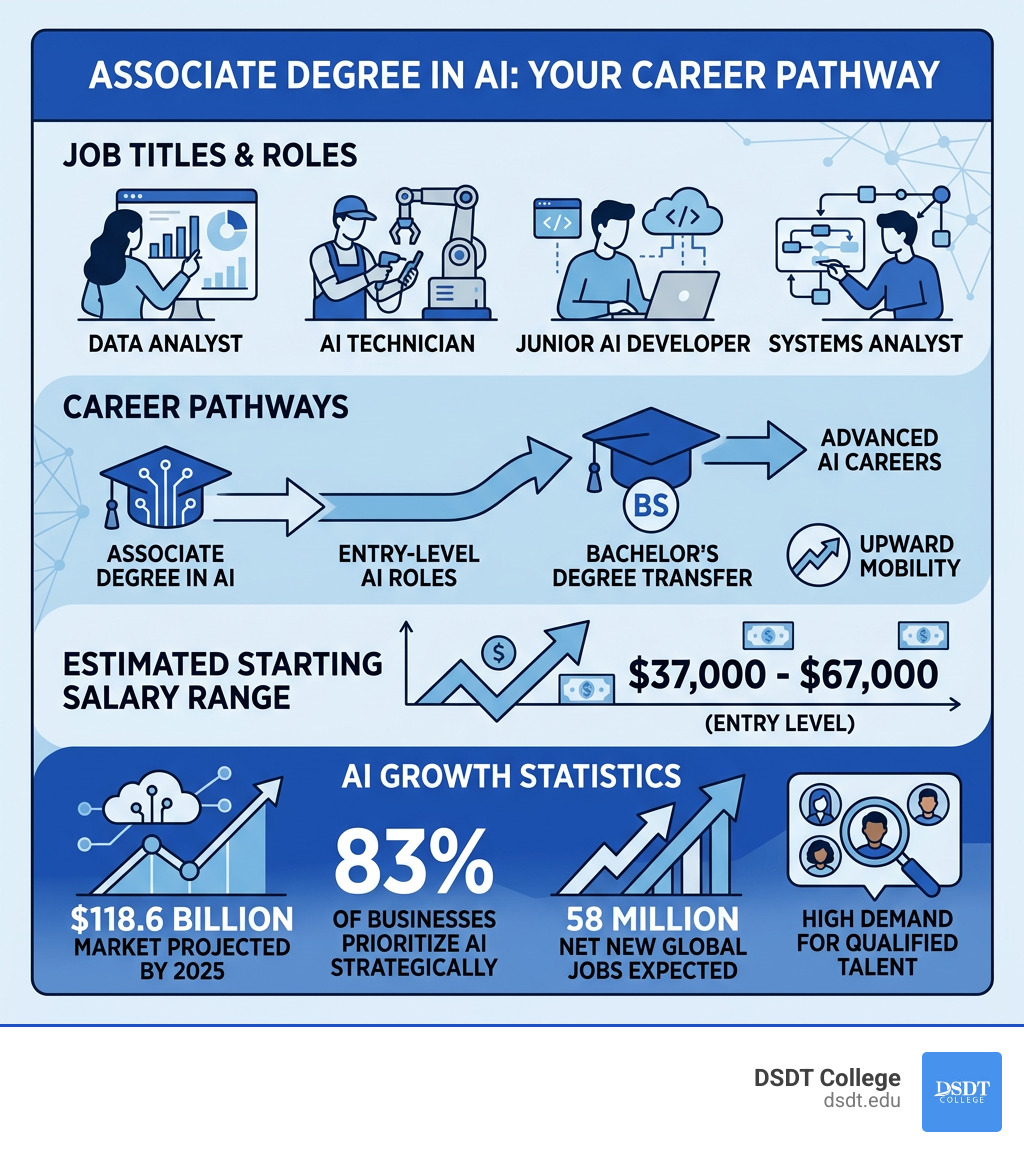
| Career options | Data Analyst, AI Technician, Junior Developer, Systems Analyst |
| Starting salary range | ~$37,000-$67,000 (entry level) |
| Can credits transfer? | Yes, to bachelor’s programs in IT, Computer Science, or related fields |
AI is no longer a niche technology. The World Economic Forum predicts it could create a net increase of 58 million jobs globally — and businesses are taking notice. In fact, 83% of businesses say AI is a strategic priority right now, and the industry is projected to grow into a $118.6 billion market by 2025.
The demand is real. The jobs are real. And the skills gap is real too — more than half of senior AI professionals report difficulty finding qualified new talent.
That’s exactly where an associate degree in AI comes in. It gives you a structured, affordable, and fast path into a field that is actively looking for trained workers.
I’m Jamie Kothe, an academic leader and workforce development professional at DSDT College, where I work to align career-focused programs — including technology and AI training — with what employers actually need. My work developing and delivering industry-aligned programs makes me well-positioned to help you evaluate your options for an associate degree in AI and find the path that fits your goals.
What is an Associate Degree in AI?
When we talk about an associate degree in AI, we are looking at a credential that bridges the gap between high school and a four-year university, specifically tailored for the “Fourth Industrial Revolution.” This degree typically consists of 60 to 70 credit hours and takes about two years of full-time study to complete.
Unlike a general computer science degree, an AI-focused associate degree is highly specialized. It is usually offered as an Associate in Science (A.S.) or an Associate in Applied Science (A.A.S.). The “Applied” part is key—it means the curriculum is designed to get you into the workforce quickly by focusing on hands-on technical training rather than just abstract theory. At DSDT College, we emphasize this practical approach because we know that 71% of executives view AI and machine learning as total game-changers for their business operations.
Admission Requirements for New Students
Getting started is simpler than most people think. We find that many students are intimidated by the “math” side of AI, but the entry requirements are designed to be accessible. Common requirements include:
- A standard high school diploma or a GED.
- Completion of an official application for admission.
- Basic math prerequisites (though many programs offer developmental courses to get you up to speed).
- A “can-do” attitude—research shows that breaking into AI requires initiative and “guts” just as much as a degree.
Delivery Formats: Online, Hybrid, and In-Person
We understand that our students lead busy lives. Whether you are a high school graduate in Detroit or a military veteran transitioning to a civilian career in Columbus or Dallas, flexibility is a must. Most modern AI programs offer three main formats:
- Online: 100% remote learning, perfect for those balancing work and family.
- Hybrid: A mix of online theory and in-person labs.
- In-Person: Traditional classroom settings at campus locations like Detroit or Chicago, offering direct interaction with instructors.
Regardless of the format, the goal remains the same: mastering the tools that allow 54% of executives to report a massive boost in their team’s productivity.
Core Curriculum: Skills You’ll Gain in an Associate Degree in AI

What exactly happens inside an AI classroom? It isn’t just staring at code all day. It’s about teaching machines how to “see,” “hear,” and “think.” The curriculum is built around the AI project lifecycle—from initial data collection to final deployment.
| Module | What You Learn |
|---|---|
| Machine Learning | Building models that predict outcomes and make decisions. |
| Natural Language Processing (NLP) | How machines interpret and generate human speech and text. |
| Computer Vision | Enabling machines to identify objects and faces in images/video. |
| Generative AI | Working with large language models and prompt engineering. |
| AI Ethics | Addressing bias, privacy, and the responsible use of technology. |
Technical Proficiency and Programming
To build these systems, you need a toolkit. Programming is the foundation of any associate degree in AI. You will dive deep into:
- Python: The “gold standard” for AI and data science.
- SQL: For managing the massive databases that feed AI models.
- Java and C++: Often used for more complex system-level AI applications.
Mathematics and Data Analysis
You don’t need to be a Fields Medal winner, but you do need to be comfortable with numbers. The “secret sauce” of AI is math. Your coursework will likely include:
- Statistics and Probability: To understand how AI makes “guesses.”
- Linear Algebra: The math behind how neural networks process information.
- Calculus: Used for optimizing how AI models learn over time.
Career Outlook and Salary Potential for AI Graduates
One of the most common questions we hear is: “What can I actually do with this degree?” The answer is: plenty. AI is being implemented by 78% of brands, meaning your skills will be in demand across healthcare, finance, manufacturing, and even retail.
According to the Occupational Outlook Handbook, the tech sector offers some of the most competitive salaries in the country. While an associate degree in AI typically leads to entry-level or “junior” roles, the ceiling is incredibly high.
- Computer and Information Research Scientists: $148,090 (Average)
- Computer Systems Analysts: $98,470 (Average)
- Computer Programmers: $79,350 (Average)
Is an associate degree in AI enough for a high-paying job?
Yes, but it’s often about the “foot in the door.” An associate degree prepares you for roles like AI Technician, Data Annotator, or Junior Developer. Because 83% of businesses see AI as a strategic priority, they are often willing to hire associate degree holders who have the right technical certifications and hands-on experience.
Industry Certifications and Stackable Credentials
At DSDT College, we strongly believe in the power of certifications. Many employers view industry-standard certs as being just as important as the degree itself. Many associate programs are designed to prepare you for:
- Amazon AWS Cloud Practitioner
- Microsoft Azure Fundamentals
- Google Cloud Foundations
- CompTIA A+, Network+, and Security+
These are “stackable,” meaning you can earn them while you’re still in school, making your resume stand out before you even graduate.
Academic Pathways and Future Growth
The beauty of an associate degree in AI is that it is not a dead end—it’s a launchpad. Whether you are a high school graduate looking for a fast start or a military veteran using your benefits to pivot into tech, this degree grows with you.
Transferring your associate degree in AI to a four-year university
Many students choose to start at a career college like DSDT and then transfer to a four-year university. This is a smart financial move. You can complete your foundational 60 credits at a lower cost and then move into a Bachelor of Science program in Information Management, Data Analytics, or Computer Science. Most programs have transfer agreements that ensure your hard-earned credits don’t go to waste.
The Role of AI Ethics and Responsible Development
As AI becomes more powerful, the “human” side becomes more important. We don’t just teach you how to build models; we teach you how to build them fairly. A core part of any reputable program is studying AI ethics. This includes learning how to:
- Identify and mitigate data bias.
- Ensure data privacy and security.
- Understand the social impact of automation.
- Develop “Responsible AI” that helps people rather than harming them.
Frequently Asked Questions about AI Associate Degrees
How long does it take to complete the program?
Most students finish in two years (four semesters) if they go full-time. If you’re working while studying, a part-time track usually takes about three years.
What kind of jobs can I get with an associate degree?
You’ll be qualified for roles such as AI Specialist, Data Analyst, Support Technician, Junior AI Developer, or Prompt Engineer. These roles focus on maintaining and implementing AI systems rather than just researching new theories.
Can I complete an AI degree entirely online?
Absolutely. Many institutions now offer 100% online formats. These programs use virtual labs and cloud-based software to give you the same hands-on experience you’d get on a physical campus.
Conclusion
The tech world is moving fast, and an associate degree in AI is the ultimate “hack” to keep up. It’s a focused, affordable, and practical way to enter a field where 75% of businesses are already planning new ventures based on AI capabilities.
At DSDT College, we are committed to providing the Detroit community and our nationwide students with the tools they need to succeed. From our roots in Michigan to our presence in tech hubs like Dallas and Chicago, we focus on education that leads directly to a paycheck.
If you’re ready to stop watching the AI revolution from the sidelines and start being a part of it, now is the time to act. Your future in the $118 billion AI industry starts with those first 60 credits. Let’s get to work.