How Long MRI Technologist Training Really Takes (Quick Answer)
How long MRI technologist training takes depends mostly on where you’re starting from. Here’s the short version:
| Starting Point | Typical Duration |
|---|---|
| No prior healthcare experience (Primary Pathway) | 18-24 months |
| Existing radiologic technologist (Post-Primary) | 6-12 months |
| Career changer via Associate Degree program | 18 months |
| Certificate program for credentialed techs | 6 months full-time |
Most people land somewhere between 12 and 24 months from start to job-ready. After training, add a few weeks to schedule and pass your ARRT or ARMRIT certification exam.
So you want to become an MRI technologist – but you’re not sure how long it will take or where to even start. That’s a fair question, and the answer isn’t one-size-fits-all. The path looks very different depending on whether you’re a veteran transitioning out of service, a high school grad skipping the four-year university route, or someone already working in healthcare who wants to specialize. The Bureau of Labor Statistics projects 7% job growth for MRI technologists through 2034, with a median salary of $88,180 – making this one of the more accessible, high-reward careers in healthcare. But first, you need to understand exactly what the training commitment looks like for your situation.
I’m writing on behalf of DSDT College, a nationally accredited institution specializing in MRI Technology training through the ARRT Primary Pathway – the direct route that answers how long MRI technologist training takes for career changers and veterans with no prior X-ray license. In the sections below, I’ll walk you through every timeline, pathway, and factor that affects how fast you can get credentialed and working.
Understanding the Timeline for How Long MRI Technologist Training Lasts
When we look at the total time spent in school, we have to consider two main components: didactic learning (the “book work”) and clinical rotations (the “hands-on work”).
The American Registry of Radiologic Technologists (ARRT) and the American Registry of Magnetic Resonance Imaging Technologists (ARMRIT) set the standards for what you need to learn. According to the Radiologic and MRI Technologists Occupational Outlook, most professionals in this field enter with an Associate degree.
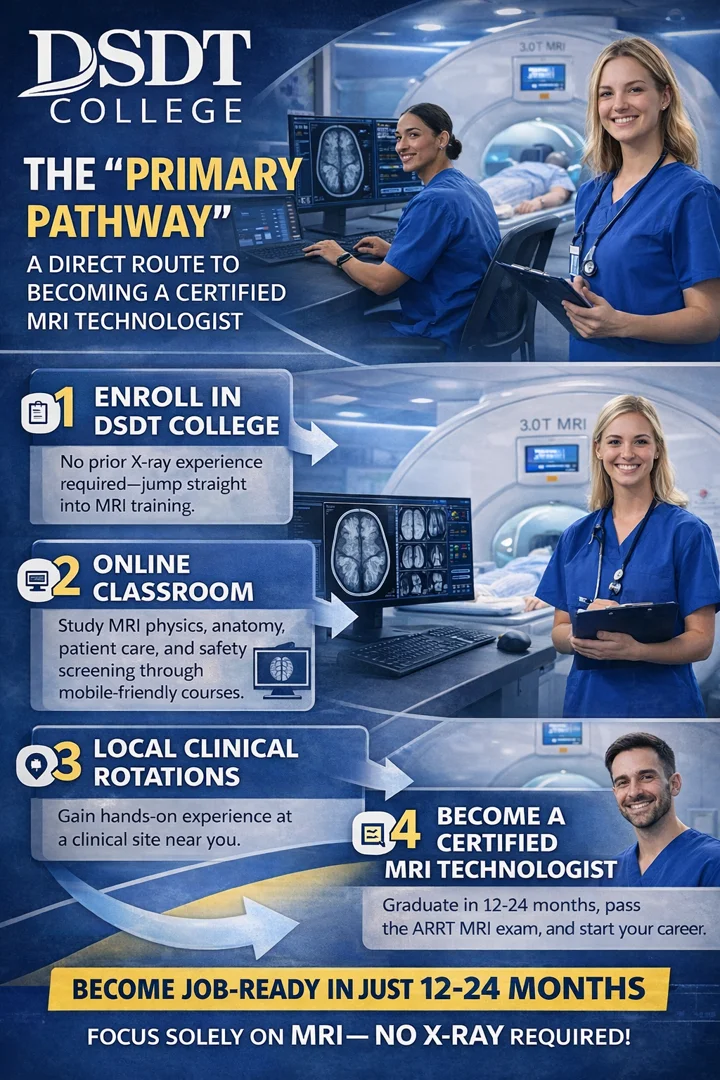
At DSDT College, we focus on the Primary Pathway. This is a major distinction in the industry. Historically, many people became X-ray techs first and then spent additional time learning MRI. By choosing a Primary Pathway program, you skip the X-ray requirement entirely, focusing solely on Magnetic Resonance Imaging from day one. This effectively streamlines your total time compared to the traditional “stacking” method.
Accelerated vs. Traditional Program Lengths
We know that life doesn’t stop just because you’re in school. That’s why program format matters:
- Full-Time Enrollment: Usually involves a full-time commitment between classes and clinics. This is the fastest route, often finishing in 18 months.
- Part-Time/Flexible: Some programs extend the timeline to allow students to work while they learn.
- Online Didactic Models: DSDT College utilizes a mobile-friendly, online didactic approach. This allows you to study the complex physics of MRI from home, while your clinical rotations happen at a physical imaging center or hospital near you. This hybrid model is often the most efficient for adult learners.
Primary vs. Post-Primary: Choosing Your Educational Path
Choosing between a certificate and a degree is a key decision. For those without a prior imaging credential, the Associate degree is the standard requirement for eligibility.
For a deeper dive into these steps, check out this Step-by-Step Guide to Becoming an MRI Tech.
The Associate Degree Advantage for New Professionals
The AAS in MRI Technology is the “gold standard” for those entering the field fresh. You’ll cover:
- Anatomy & Physiology: Learning the body in “slices” (sectional anatomy).
- MRI Physics: Understanding how magnets and radiofrequency pulses create images.
- Patient Care: Safety screening, contrast media administration, and emergency procedures.
- Clinical Externships: Real-world experience in a hospital or imaging clinic.
Certificate Programs for Existing Imaging Professionals
If you are already a certified radiologic technologist, you don’t need another degree. You just need the specialized MRI knowledge. These programs focus on meeting the ARRT’s clinical competency requirements and the structured education required to sit for the post-primary exam.
Factors Influencing the Duration of Your MRI Education
Even the best-laid plans can face delays. Several external factors can influence the timeline:
- Waitlists: Many community colleges have 1-2 year waitlists just to get into the program. We pride ourselves on having no waitlists, letting you start your career sooner.
- Clinical Site Availability: You can’t graduate without finishing your clinical hours. Programs with a large nationwide network of clinical partners (like ours) can often place students faster than local-only schools.
- Prerequisites: Some schools require you to take a year of “pre-med” classes before you even apply to the MRI program. Primary pathway programs often integrate these into the core curriculum.
For more details on how we structure our 18-month path, visit our MRI Associate Degree services page.
Clinical Requirements and Field Experience
The “clinical” portion of your training is where you go into a real medical facility and work with actual patients under supervision. You will need to demonstrate competency in various types of scans—brain, spine, abdomen, and musculoskeletal.
The duration of this phase depends on your weekly commitment. Students who dedicate more time to their clinical site each week will complete their competencies faster. This phase is crucial because it transforms “book knowledge” into “job readiness.” You’ll learn the nuances of safety—like screening for pacemakers or metal fragments—that you simply can’t learn from a textbook.
Military and Veteran Benefits in Training Speed
For our veterans and military spouses, the timeline can be even more streamlined. Using the Post-9/11 GI Bill® or MyCAA for spouses can cover the costs of these accelerated programs.
We understand the military lifestyle. If you are an active-duty spouse and your family gets PCS orders halfway through your program, our 100% online didactic courses move with you. We then work to secure a new clinical site at your new duty station, ensuring your training timeline stays on track despite the move.
Certification and Job Readiness: The Final Stretch
Once you finish your classes and clinicals, you aren’t quite a technologist yet. You must pass a national registry exam.
Timeline for Post-Graduation Certification
- Application (1–2 weeks): After graduation, you apply to the ARRT or ARMRIT.
- Scheduling (2–4 weeks): You’ll receive an “Authorization to Test” and schedule your exam at a Pearson VUE center.
- The Exam: A comprehensive test covering MRI physics, safety, and procedures.
- Results: You typically get a preliminary score immediately, with official credentials arriving in the mail a few weeks later.
Most students are job-hunting during their final months of clinicals. Because of the high demand (over 85% of facilities report difficulty filling these roles), many of our students have job offers before they even sit for their exam.
Long-Term Maintenance and Career Advancement
Becoming an MRI tech isn’t a “one and done” deal. To keep your license, you must complete continuing education (CE) credits every two years.
Every ten years, the ARRT also requires Continuing Qualifications Requirements (CQR), which is a structured self-assessment to ensure you are staying current with new technology. As you gain experience, you can move into roles like Lead Technologist, MRI Supervisor, or even specialize in advanced areas like Cardiac MRI or Research, which often come with significant pay increases.
Frequently Asked Questions about MRI Training Length
Can I become an MRI tech without being an X-ray tech first?
Yes! As discussed in the pathways above, you can enroll directly in an MRI Associate degree program without a prior X-ray license. This direct route is the most efficient path for those new to medical imaging.
Is there a 6-month MRI program for beginners?
Generally, no. A 6-month program is almost always a “Post-Primary” certificate intended for people who are already X-ray or Ultrasound techs. For a beginner, you need the foundational science and anatomy that requires a longer commitment to be safe and competent.
How long does it take to get MRI certified online?
While the didactic (classroom) portion can be done 100% online, you cannot become certified without in-person clinical hours. An online-hybrid program still follows the standard timeline because the clinical requirements are the same as a traditional campus-based program.
Conclusion
The journey to becoming an MRI technologist is a marathon, not a sprint—but it’s a marathon that leads to a rewarding, high-paying career in a growing field. Whether you are a veteran looking for a mission-focused career or a career changer seeking stability, the 18 to 24-month timeline is a small investment for a lifetime of professional growth.
At DSDT College, we are dedicated to helping you navigate this timeline with flexibility and speed. With our nationwide clinical partnerships and military-friendly online programs, we remove the barriers like waitlists and rigid schedules. Are you ready to start your clock?
Explore our Healthcare and IT Programs today and take the first step toward your new career in medical imaging.