IT Jobs and Salaries in 2026: What You Need to Know Before You Start
If you’re researching the it jobs list and salary landscape, here’s a quick snapshot of what top roles pay right now:
| IT Job Title | Median Annual Salary | Education Needed |
|---|---|---|
| Software Developer | $131,450 | Bachelor’s degree |
| Information Security Analyst | $124,910 | Bachelor’s degree |
| Data Scientist | $183,000+ | Master’s degree |
| Cloud Architect | $160,000 – $252,000 | Bachelor’s degree |
| AI/ML Engineer | $140,000 – $190,000 | Bachelor’s degree |
| Cybersecurity Engineer | $140,000 – $225,000 | Bachelor’s degree |
| IT Support Specialist | ~$50,000 – $75,000 | Certificate or Associate’s |
| Software Engineering Manager | $187,500 – $287,000 | Bachelor’s degree |
Sources: Bureau of Labor Statistics, Glassdoor (2026)
The demand for IT professionals is growing much faster than the average for all careers. The U.S. Bureau of Labor Statistics projects around 317,700 IT job openings every year through 2034. The median salary for IT workers — $105,990 — is more than double the national median of $49,500.
Whether you’re a recent high school graduate, a career changer, or a veteran exploring new paths, tech offers real opportunity at every level. From entry-level help desk roles to six-figure engineering and C-suite positions, the career ladder in IT is one of the most accessible and rewarding in today’s job market.
I’m Jamie Kothe, an academic leader and workforce development professional at DSDT College, where I help students build practical skills for careers in high-demand fields like information technology and cybersecurity. My work connecting students with employer partners gives me a front-row view of exactly what the it jobs list and salary landscape looks like for people entering or advancing in tech today.
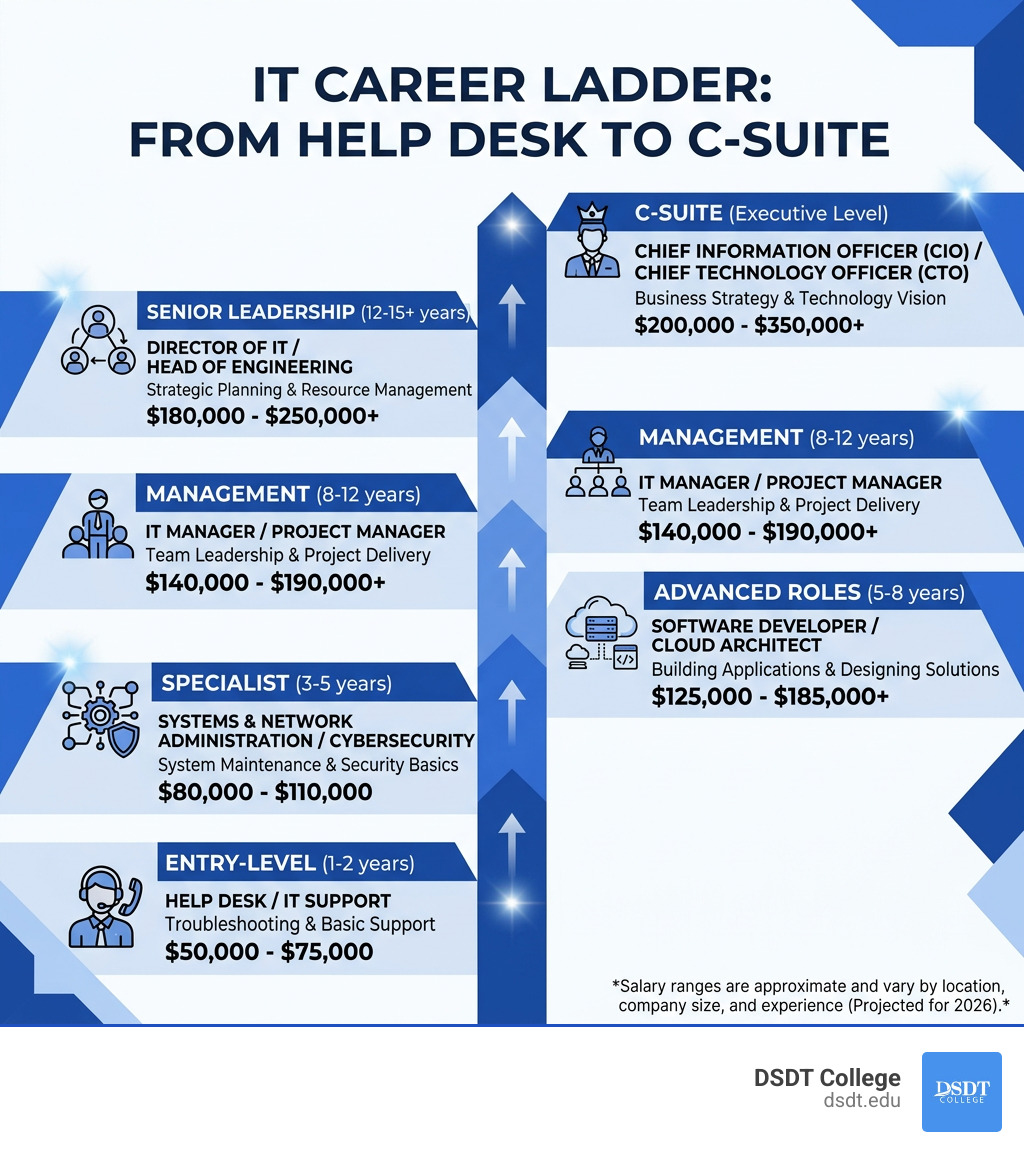
The Ultimate IT Jobs List and Salary Guide for 2026
When we look at the tech landscape for 2026, the data tells a very clear story: the “tech recession” headlines of previous years haven’t stopped the long-term need for skilled professionals. According to the Bureau of Labor Statistics, employment in computer and information technology is projected to grow much faster than the average for all occupations.
But what does that actually mean for your wallet? Let’s break down the heavy hitters on the it jobs list and salary rankings.
Software Developers and Engineers
Software developers are the architects of the digital world. Whether they are building mobile apps or complex enterprise systems, their median pay currently sits at $131,450. If you move into a specialized role like a Principal Software Engineer, salaries can soar to $244,500 or more. These roles usually require a Bachelor’s degree, but your portfolio and coding skills often speak louder than your diploma.
Information Security Analysts
With cyber threats becoming more sophisticated, companies are desperate for people who can protect their data. Information Security Analysts earn a median of $124,910. This is one of the fastest-growing sectors in the entire economy, with demand driven by the constant need to stay one step ahead of hackers.
Contract vs. Permanent Roles
In our experience at DSDT College, we see many students weighing the pros and cons of contract work versus permanent positions.
- Permanent Roles: Offer stability, health insurance, and 401(k) matching. Salaries are consistent, and you get “buy-in” with the company culture.
- Contract Roles: Often pay a higher hourly rate to compensate for the lack of benefits. For a seasoned pro, contracting can lead to a much higher annual “take-home” pay, though it requires more personal financial management.
With over 317,700 annual openings projected, there is plenty of room for both types of employment.
Entry-Level IT Jobs List and Salary Expectations
We often hear from high school graduates and career changers in Detroit or Chicago who worry that they can’t get into tech without a four-year degree. That simply isn’t true. Entry-level roles are the foundation of the industry.
- Helpdesk Technician: This is the classic “foot in the door.” You’ll help users solve hardware and software issues. Average starting salaries range from $45,000 to $55,000.
- IT Support Specialist: A step up from the helpdesk, these pros manage more complex troubleshooting. In areas like Lansing or Cleveland, you can expect to earn between $50,000 and $75,000.
If you are looking for a structured way to start, you might consider IT associate degree programs. These programs provide the hands-on training needed to pass critical certifications like CompTIA A+, which many employers view as the “gold standard” for entry-level hiring.
For career changers, the salary progression is often rapid. We’ve seen professionals start at $45k and, by stacking certifications and moving jobs every two years, reach $80k or $100k within just a few years.
Comparing the IT Jobs List and Salary by Specialization

As you move past the entry-level stage, specializing is the key to maximizing your income. Here are the high-growth specializations for 2026:
- Cloud Architect: As businesses move away from physical servers, Cloud Architects design the virtual infrastructure. In the New England and Midwest markets, these roles pay between $160,000 and $252,000.
- Cybersecurity Engineer: This role focuses on building secure systems from the ground up. Salaries often range from $140,000 to $225,000.
- AI/ML Engineer: With the explosion of generative AI, these engineers are in high demand. Expect a salary range of $140,000 to $190,000. If you’re interested in this path, check out our AI prompt specialist program to get a head start on these emerging technologies.
- Full-Stack Developer: These “jacks of all trades” can handle both the front-end (what users see) and back-end (the server side) of applications. They typically earn between $127,000 and $185,000. For those in Detroit or Columbus looking to break into this, we offer a dedicated full-stack developer training program.
- Data Scientist: Companies have more data than they know what to do with. Data scientists help them make sense of it, earning a median of $183,000 (though many top-tier roles in major hubs like New York or Dallas pay over $211,000).
Management and C-suite Tech Salaries
For those who enjoy leading people as much as they enjoy coding, the management track offers the highest compensation on our it jobs list and salary guide.
- Chief Technology Officer (CTO): The CTO oversees the entire technological physical of a company. Salaries start around $120,000 at small startups but can exceed $201,500 at established firms.
- Chief Information Officer (CIO): While the CTO looks at external technology, the CIO focuses on internal systems. Starting salaries are often around $108,000, reaching $200,000+ for experienced leaders.
- Chief Information Security Officer (CISO): This is one of the most critical roles in 2026. Protecting a company’s reputation and data pays well, with ranges from $96,000 to $220,000.
- Software Engineering Manager: If you want to stay close to the code while managing a team, this role pays between $187,500 and $287,000 in competitive markets.
While some C-suite roles benefit from an MBA, many tech leaders reach these heights through years of technical excellence and “soft skills” like communication and strategic planning.
Factors Influencing IT Salaries: Location, Education, and AI
It isn’t just what you do, but where you do it and how you use new tools like AI.
AI Adoption and Your Paycheck
We are seeing an AI adoption rate of up to 40% in the workplace. While some fear AI will replace jobs, the reality is that it is changing the nature of the work. AI is automating routine tasks, which actually increases the value of human professionals who can oversee these systems.
Regional Salary Variations
Location still matters, though remote work has leveled the playing field a bit.
- High-Cost Hubs: Cities like San Jose, New York, and Boston offer the highest raw numbers. For example, the median annual IT pay in San Jose is a staggering $206,540.
- The Midwest Advantage: In cities like Detroit, Chicago, and Cleveland, the salaries are still very high (often $90,000 to $140,000 for mid-level roles), but the cost of living is much lower. Your “real” wealth—what you have left after paying rent or a mortgage—is often higher in Detroit than in San Francisco.
- Remote Trends: Many companies now use “localized” pay scales for remote workers, but top-tier talent can still command “Silicon Valley” wages while living in Florida or Texas.
The Value of IT Degrees vs. Certifications
This is the age-old question: do you need the degree?
The research shows that while degrees are linked to higher lifetime earnings (the BLS found bachelor’s degree holders make about $1,608 a week compared to $917 for high school grads), IT is unique. In this field, certifications are often faster and more direct paths to a raise.
- CompTIA Security+: A must-have for cybersecurity.
- AWS Certified Solutions Architect: Can lead to an average salary of $155,597.
- Google Cloud Professional Cloud Architect: Linked to salaries around $190,204.
About 20% of IT professionals who receive certification training report receiving an immediate raise. For veterans transitioning to civilian life or adult learners, this “stackable” approach to education—starting with a diploma and adding certifications—offers the best ROI.
How to Maximize Your Earning Potential in Tech
If you want to climb the it jobs list and salary ladder quickly, you can’t just sit still.
- Job-Hopping (Strategically): In the US IT market, staying at one company for 10 years often leads to “salary stagnation.” Internal raises usually hover around 3%, while switching jobs every 2-3 years can result in 20-30% salary jumps.
- Continuous Upskilling: The tech you use today will be obsolete in five years. Whether it’s learning system design or mastering a new AI tool, the highest earners are perpetual students.
- Network on LinkedIn: Don’t just post your resume. Engage with industry leaders in your city—whether that’s Seattle, Dallas, or Tampa.
- Soft Skills: The “lonely coder in a basement” stereotype is dead. To earn the big bucks, you need to be able to explain technical decisions to non-technical stakeholders.
Frequently Asked Questions about IT Careers
Which IT role has the highest salary ceiling in 2026?
The highest salary ceilings are typically found in Principal Software Engineering and Cybersecurity Architecture. These “Individual Contributor” (IC) roles allow you to earn as much as a Vice President without having to manage a large team. In major tech hubs, these roles can reach total compensation packages (including stocks) well over $300,000.
Is a degree necessary for high-paying IT jobs?
No, but it helps. A degree is often a requirement for HR filters at large corporations. However, a strong portfolio, relevant certifications (like those offered at DSDT College), and 5+ years of experience can often override the lack of a degree. For many, starting with an associate degree or a specialized diploma is the most cost-effective way to get that first $60k job.
How is AI affecting entry-level IT job demand?
AI is automating “Tier 1” tasks like basic password resets or simple code debugging. This means entry-level workers need to be more skilled than they used to be. Instead of just knowing how to follow a script, you need to know how to use AI tools to solve problems faster. The “human-in-the-loop” is more important than ever.
Conclusion
The world of IT is fast, exciting, and incredibly lucrative for those willing to put in the work. Whether you are looking at the it jobs list and salary for a role in Detroit, Chicago, or anywhere across the country, the opportunities are there.
At DSDT College, we specialize in providing that hands-on, career-focused education that bridges the gap between “I want a job” and “I have a career.” From CompTIA certifications to full-stack development and AI training, we help high school graduates, career changers, and veterans gain the skills they need to thrive.
Ready to see where you fit on the list? Start your IT career training today and take the first step toward a high-paying future in tech.