Why MRI for Career Changers is a Top Healthcare Move
When we talk about MRI for career changers, we aren’t just talking about a job title; we are talking about a fundamental shift in how you interact with medicine. Magnetic Resonance Imaging (MRI) is a sophisticated diagnostic tool that uses powerful magnetic fields and radiofrequency pulses to create detailed images of the organs and tissues within the body. Unlike X-rays or CT scans, MRI does not use ionizing radiation, making it a safer environment for both the patient and the technologist.
For those of us looking for a career with a strong “why,” MRI offers a front-row seat to life-saving diagnostics. Research published in Magnetic resonance imaging of brain anomalies highlights how critical this technology is for identifying everything from adult brain anomalies to complex liver cancers. As an MRI technologist, your daily life involves more than just pushing buttons. You are a patient advocate, a safety officer, and a technical expert.
Daily responsibilities include:
- Patient Screening: Ensuring patients don’t have metal implants or pacemakers that could be dangerous in the magnetic field.
- Image Acquisition: Operating the scanner to capture high-quality images for radiologist interpretation.
- Patient Care: Managing patient anxiety (especially for those with claustrophobia) and explaining the procedure clearly.
- Protocoling: Selecting the right sequences to help the doctor see exactly what they need to diagnose the patient.
The work-life balance is another major draw. While hospitals operate 24/7, many MRI technologists work in outpatient centers with standard business hours. Even in hospital settings, the 4-day work week (10-hour shifts) is common, providing a level of flexibility that bedside nursing often lacks. If you are interested in exploring how our healthcare programs can fit your lifestyle, the transition is more seamless than you might imagine.
The ARRT Primary Pathway: Becoming an MRI Tech Without X-Ray Experience
One of the biggest myths we hear is that you must become an X-ray technician before you can touch an MRI machine. While that was the traditional route (the “Post-Primary” path), it is no longer the only way. At DSDT College, we focus on the ARRT Primary Pathway.
This pathway allows MRI for career changers to enter the field directly. Instead of spending two years learning X-ray and then another year specializing in MRI, you earn an Associate of Applied Science in MRI Technology. This degree qualifies you to sit for the American Registry of Radiologic Technologists (ARRT) MRI examination immediately upon graduation.
Why is this a game-changer?
- Speed to Career: You skip the “middleman” of X-ray school, saving years of tuition and time.
- No Waitlists: Many community college radiology programs have 2-3 year waitlists. Our accredited programs are designed for rapid entry.
- No SAT/ACT: We believe your potential isn’t defined by a standardized test you took years ago. We look for motivation and a high school diploma or GED.
- Clinical Rotations: You don’t just read about magnets; you work with them. We help facilitate clinical rotations so you gain hands-on experience in real medical environments, which is essential for landing MRI Radiologic Technology Per Diem Jobs in New York and other major metros.
Education Pathways: MRI for Career Changers with No Experience
If you are coming from a field like retail, hospitality, or even stay-at-home parenting, you already possess “soft skills” that are hard to teach. Communication, multitasking, and empathy are the backbone of a great technologist.
Our curriculum bridges the gap between your current skills and the technical requirements of the job. You will dive into:
- Cross-Sectional Anatomy: Learning to see the body in “slices.”
- MRI Physics: Understanding how protons and magnets interact (it’s basically magic, but with math).
- Patient Safety: Mastering the “Zones” of the MRI suite to keep everyone safe.
The hybrid learning model is perfect for working adults. You can complete your didactic (classroom) work online from the comfort of your home, allowing you to keep your current job while you study. When it’s time for clinicals, you transition to a local imaging site to put that knowledge into practice. To see the full course breakdown, check out our MRI Technology Associate Degree page.
Salary, Job Outlook, and the Future of Medical Imaging
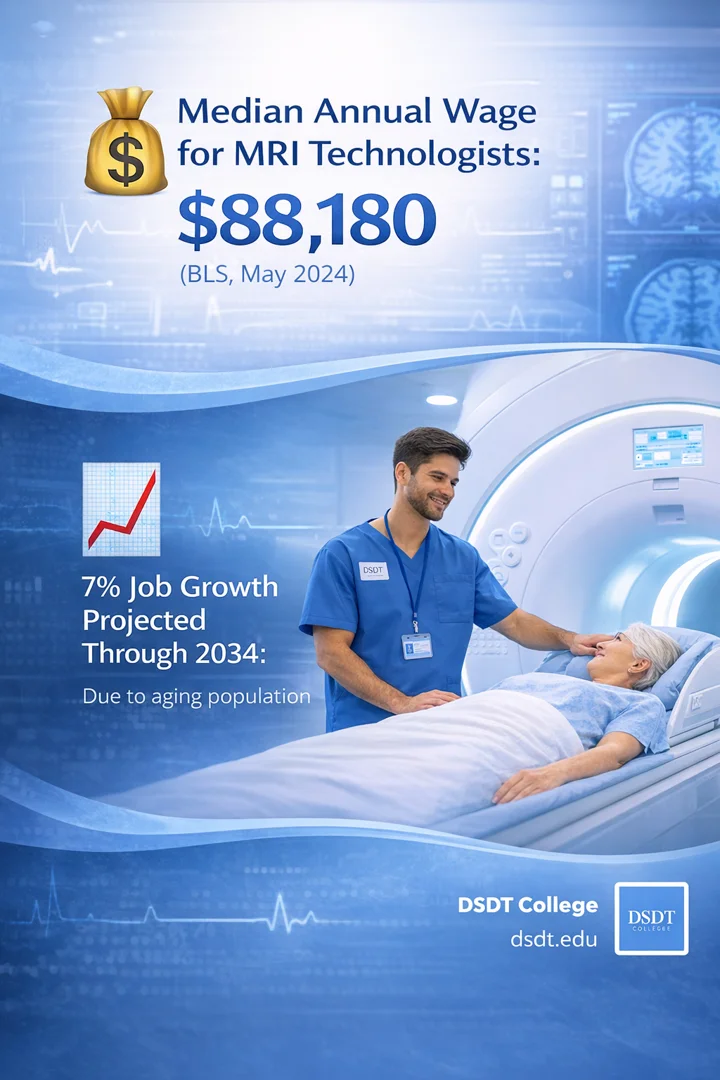
The financial incentive for MRI for career changers is compelling. According to the Bureau of Labor Statistics (May 2024), the median annual wage for MRI technologists is $88,180. To put that in perspective, many career changers from retail or administrative roles see their income double within 18 months of starting their program.
The job outlook is equally bright. The field is projected to grow 7% through 2034. As the “Baby Boomer” generation ages, the need for diagnostic imaging to manage chronic conditions and age-related illnesses is skyrocketing. Furthermore, as more surgical procedures move to outpatient settings, the demand for technologists in diagnostic labs and private clinics is increasing.
While healthcare is our focus, many students find that the technical nature of MRI sparks an interest in broader technology. For those who enjoy the “tech” side of the job more than the “patient” side, our Information Technology degrees offer a different path into high-growth sectors like cybersecurity or networking.
Salary and Growth: MRI for Career Changers in Today’s Market
Your first job as an MRI tech is just the starting line. The career path is not linear; it branches out into several high-paying directions:
- Lead Technologist: Managing a team of techs and overseeing department workflows ($90k – $110k+).
- Department Management: Moving into hospital administration or clinic ownership ($120k+).
- Travel MRI Tech: Taking 8-13 week assignments across the country. Travel techs can earn between $2,500 and $4,000 per week, often totaling over $150,000 annually.
- Vendor Applications Specialist: Working for companies like Siemens, GE, or Philips to train hospital staff on how to use new MRI scanners ($95k – $140k).
Geographic location also plays a role. In markets like New York, NY, or Los Angeles, CA, salaries often trend higher to match the cost of living, with some experienced techs clearing $115,000 in base pay alone.
Military and Veteran Benefits for MRI Students
At DSDT College, we take immense pride in being a military-friendly school. We understand that transitioning from active duty to civilian life can be daunting. MRI for career changers is an excellent fit for veterans because it rewards the discipline, attention to detail, and procedural mindset developed in the military.
We offer several ways to fund your education:
- Post-9/11 GI Bill®: Many veterans can complete their MRI degree with zero out-of-pocket tuition costs.
- MyCAA: This program provides up to $4,000 in tuition assistance for eligible military spouses pursuing licenses or associate degrees.
- Tuition Assistance (TA): Active-duty soldiers can utilize TA to begin their studies while still serving.
For those stationed at or near Fort Hood seeking IT careers, we offer a specialized, in-person Cybersecurity CSP/SkillBridge program. The Fort Hood CSP is a dedicated path for those entering the technology sector. Our MRI program is a separate academic track available online with nationwide clinical sites.
Our goal is to ensure that military families have a “portable” career. Because MRI technologists are needed in every state, your credentials move with you, whether you are in Killeen, Texas, or Virginia Beach, Virginia.
Frequently Asked Questions about MRI Career Transitions
How long is the training period?
Most students complete the curriculum and clinical requirements in 12 to 18 months, providing a streamlined path to a new career compared to traditional four-year programs.
Is the ARRT or ARMRIT certification better?
While both are recognized, the ARRT is often considered the “gold standard” by large hospital systems. Choosing this pathway ensures the broadest range of employment opportunities across the United States.
Conclusion
The path of MRI for career changers is paved with opportunity. Whether you are looking for better pay, a more meaningful mission, or a stable environment to support your family, MRI technology offers it all. You don’t need to spend four years in a classroom or wait on a list for half a decade.
With DSDT College, you get an accredited, career-focused education that respects your time and your background. From our military-friendly support to our nationwide clinical partnerships, we are here to help you bridge the gap from where you are to where you want to be.
Are you ready to stop wondering “what if” and start your new career? Start your journey with the MRI Technology Associate Degree today and join the next generation of healthcare imaging professionals.