Your Fast Track to a Healthcare Career: The MRI Technology Associate Degree
An MRI Technology Associate degree is a two-year college program that trains you to operate MRI scanners, care for patients, and produce diagnostic images used by doctors — no medical school required.
Here is what you need to know at a glance:
| Question | Quick Answer |
|---|---|
| How long does it take? | 18 to 24 months |
| What credential do you earn? | Associate of Applied Science (AAS) or Associate of Science (AS) |
| What certifications can you pursue? | ARRT (MR) or ARMRIT after graduation |
| Median annual salary? | $77,360 (top 10% earn over $100,870) |
| Job growth outlook? | 6% nationally through 2031; up to 39% in some states |
| Where do graduates work? | Hospitals, outpatient clinics, diagnostic labs, physician offices |
The demand for MRI technologists is growing fast. Over 42,000 MRI technologists were employed across the U.S. as of May 2020, and the field continues to expand as the population ages and the need for non-invasive diagnostics rises.
Whether you are a recent high school graduate, a career changer, or a veteran exploring healthcare careers, an MRI Technology Associate degree offers a clear, affordable, and relatively quick path into a stable, well-paying profession.
I’m Jamie Kothe, a workforce development specialist and veteran training program developer with experience guiding students into high-demand technical careers — including allied health fields like the MRI Technology Associate degree. In this guide, I’ll walk you through everything you need to make a confident, informed decision about this career path.
What is an MRI Technologist and Why Pursue an MRI Technology Associate Degree?
At its core, an MRI Technologist is a highly skilled medical professional who uses specialized equipment to create detailed, 3D images of the human body. Unlike X-rays or CT scans, which use ionizing radiation, Magnetic Resonance Imaging (MRI) utilizes powerful magnets and radio waves. This makes it a vital, non-invasive diagnostic tool for identifying everything from sports injuries to complex neurological conditions.
When we look at the daily life of an MRI tech, it isn’t just about pushing buttons on a multi-million dollar machine. It’s about patient-centered care. You are the person who calms a nervous patient, ensures they aren’t wearing any metal that could interfere with the magnet, and positions them precisely to get the clearest possible image for the radiologist to interpret.
Why the Associate Degree is the “Sweet Spot”
Pursuing an MRI Technology Associate degree is often considered the most efficient route into the field. While some choose a four-year bachelor’s degree, the Associate of Applied Science (AAS) allows you to enter the workforce in roughly half the time while still qualifying for the same high-paying roles.
The financial upside is significant. According to BLS data, MRI technologists earned a median annual salary of $77,360 as of May 2021. For those in the top 10%, earnings exceeded $100,870. This is a notable jump compared to general radiologic technologists, making the specialized training well worth the effort.
| Feature | General Radiologic Tech | MRI Technologist |
|---|---|---|
| Median Salary | ~$61,370 | ~$77,360 |
| Primary Tool | X-Ray / Ionizing Radiation | Magnets / Radio Waves |
| Specialization | General Imaging | Advanced Soft Tissue Imaging |
| Job Growth | Steady | High (especially in AZ and MI) |
Educational Paths: The MRI Technology Associate Degree Program
When you decide to pursue this career, you’ll find that the MRI Technology Associate degree typically follows one of two main educational tracks.
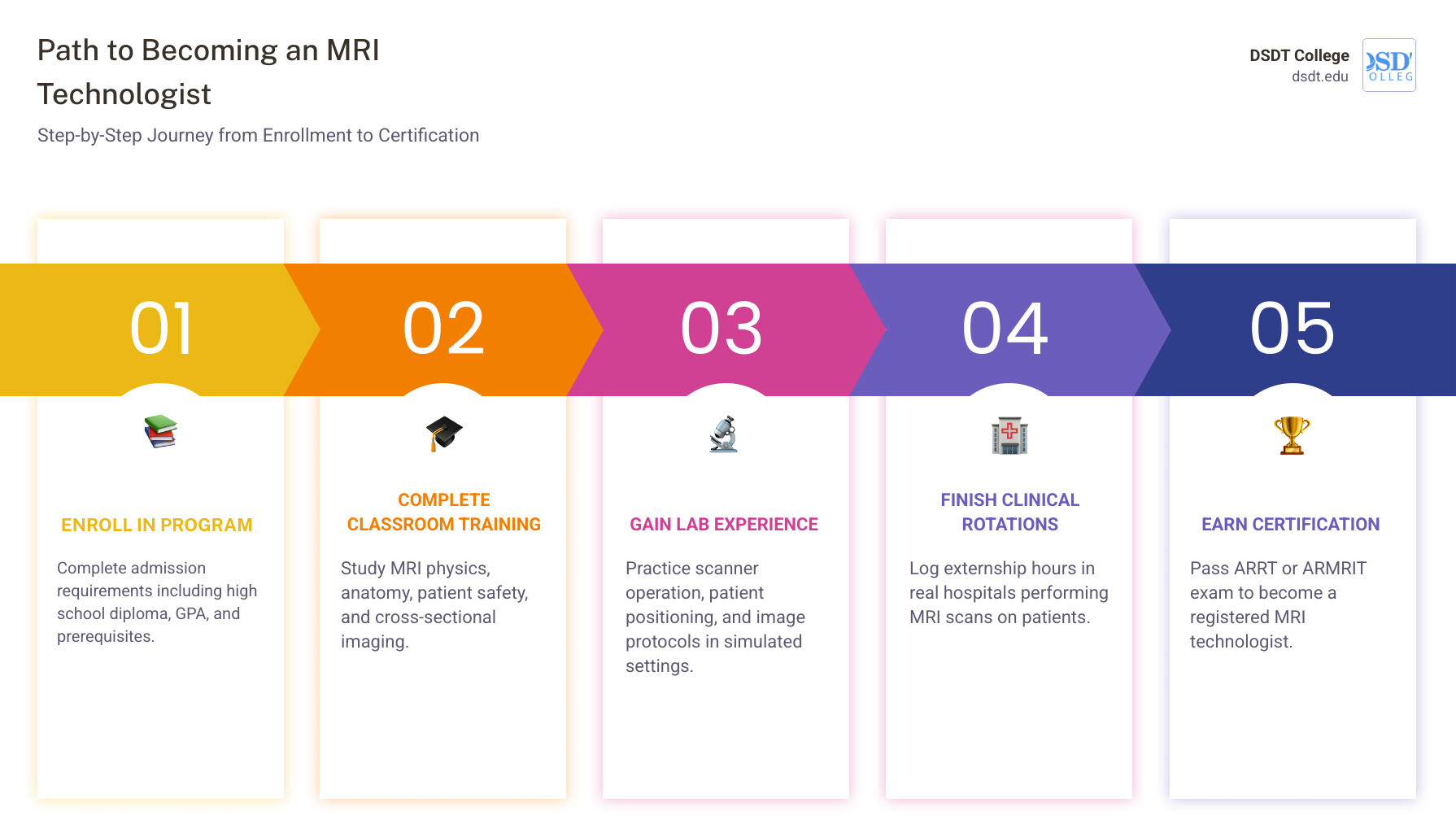
- The Primary Pathway: This is designed for students who do not have a prior degree in imaging. You go straight into MRI-specific training. At DSDT College, we focus on this ARRT Primary Pathway, ensuring you have all the foundational knowledge needed to sit for your boards immediately upon graduation.
- The Post-Primary Pathway: This is for professionals who are already certified in Radiography or Sonography and want to add MRI as a sub-specialty.
Learning Models and Accreditation
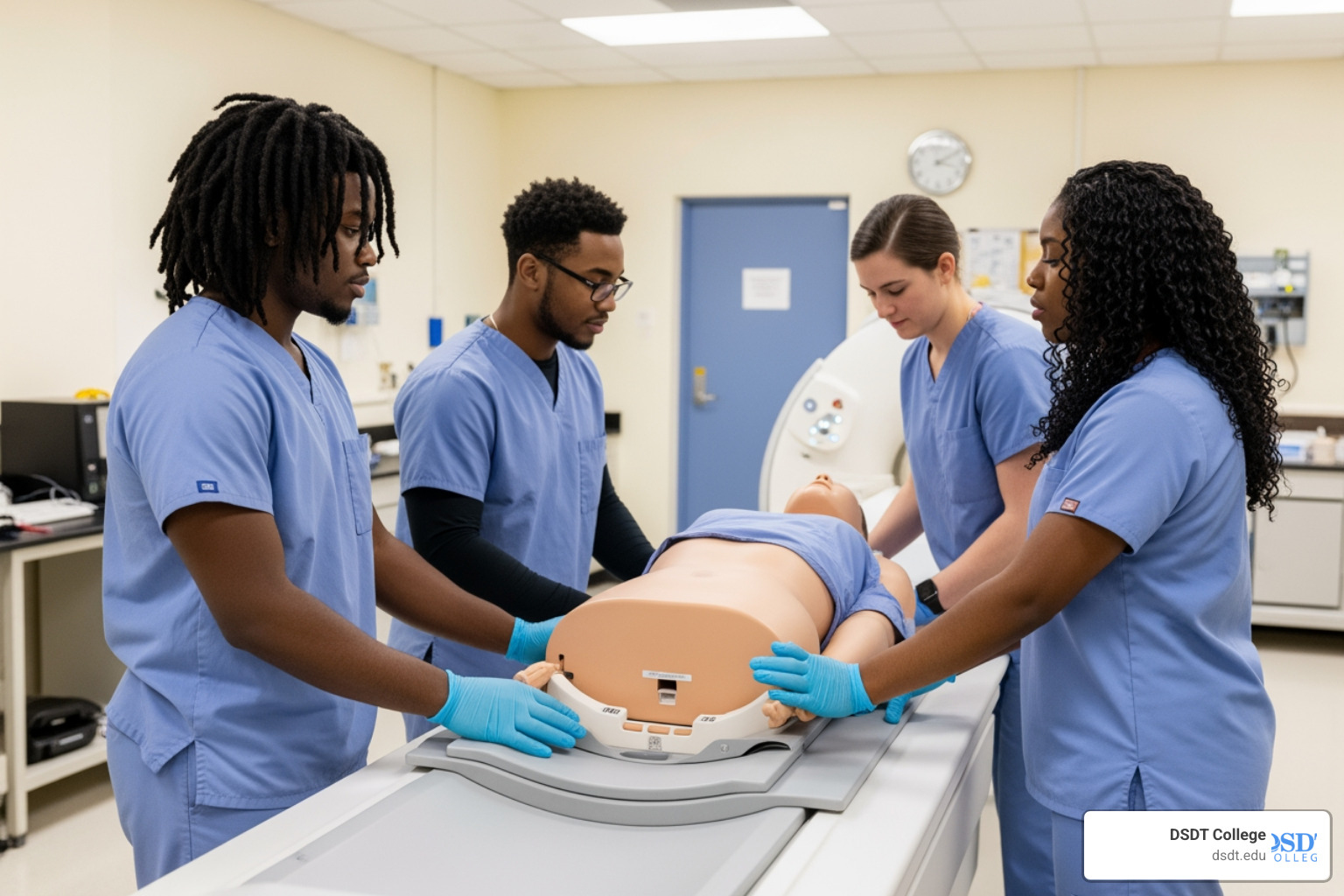
Modern programs often use a hybrid learning model. This means we provide the flexibility of online lectures for your “book work,” while requiring you to come on-site for hands-on laboratory experience.
Accreditation is the most critical factor when choosing a school. You want to ensure your program is recognized by the ARRT or ARMRIT. Choosing an accredited MRI Technology Associate degree ensures that your education meets national standards and that you are eligible for the national registry exams that employers require.
Admission Requirements for an MRI Technology Associate Degree
Getting into a program is competitive, as clinical spots are often limited to ensure every student gets enough “scanner time.” Common prerequisites include:
- A high school diploma or GED.
- A solid background in math and science (think Algebra, Biology, and Physics).
- Minimum GPA requirements (often a 3.0 in core prerequisites).
- Entrance exams, such as the Wonderlic.
- Background screenings and up-to-date immunization records to protect you and your patients during clinical rotations.
Curriculum and Hands-on Experience in an MRI Technology Associate Degree
What will you actually study? It’s a fascinating mix of hard science and interpersonal skills. Your curriculum will likely cover:
- Anatomy and Physiology: Knowing exactly where every organ and bone should be.
- MRI Physics: Understanding how magnetic fields interact with human atoms (it’s basically real-life sci-fi!).
- Patient Safety: Learning the strict protocols regarding “Zone 4” (the magnet room).
- Pathophysiology: Recognizing how diseases look on a scan.
- Pulse Sequences: The technical “recipes” used to create different types of images.
The “crown jewel” of your education is the externship. Most programs require about 6 months (or roughly 1,000 hours) of clinical rotations. This is where you work in a real hospital or imaging center under the guidance of a mentor, taking everything you learned in the lab and applying it to real patients.
Certification and Licensing After Graduation
Graduating with your MRI Technology Associate degree is a massive achievement, but there is one more step before you can call yourself a “Registered” Technologist: the registry exam.
ARRT vs. ARMRIT
Most of our students aim for ARRT certification and registration. The American Registry of Radiologic Technologists is the most widely recognized body in the U.S. However, some students pursue the ARMRIT registry, which focuses exclusively on MRI. Both demonstrate to employers that you are a master of your craft.
State Licensing
While certification is national, some states require a separate license to practice. It is vital to check your state’s licensing board to see the specific rules for your area. For example, Washington state has specific licensure requirements handled by their Department of Health, while other states may simply accept your ARRT credentials.
Continuing Education
The medical field never stops evolving. To keep your “R.T. (MR)” credentials, you will need to complete continuing education credits every two years. This ensures you stay up-to-date on the latest safety protocols and imaging technologies.
How Long Does it Take to Complete an MRI Technology Associate Degree?
Typically, you are looking at 18 to 24 months of full-time study. This includes your general education courses, your core MRI classes, and your clinical externships. Some accelerated programs may allow you to finish slightly faster, but the 21-month mark is a standard timeframe for a comprehensive AAS degree.
Career Outlook and Employment Settings
The future for MRI technologists is bright, particularly in the regions we serve. While the BLS projects a 6% national job growth, some areas are seeing even higher demand. For instance, projected growth for MRI technologists in Arizona is a staggering 39% through 2030, and California sits at about 12%.
Where Will You Work?
As a graduate with an MRI Technology Associate degree, you aren’t limited to just one type of environment:
- Hospitals: Over half of all MRI techs work in state, local, or private hospitals. These roles often involve diverse caseloads and emergency situations.
- Outpatient Care Centers: These facilities focus on high efficiency and scheduled diagnostic appointments.
- Diagnostic Laboratories: Specialized centers that focus solely on imaging.
- Physician Offices: Larger group practices often have their own in-house MRI suites.
- Mobile Imaging Units: Some techs travel to different rural clinics in specially equipped trucks, bringing advanced diagnostics to underserved communities.
Frequently Asked Questions about MRI Technology Degrees
Can I earn an MRI Technology Associate degree online?
While you cannot learn to operate a multi-ton magnet entirely from your couch, many programs offer a hybrid format. This means your lectures and theory classes are online, giving you the flexibility to study when it fits your schedule. However, you must attend in-person labs and complete your clinical rotations at a physical healthcare facility.
What is the difference between ARRT and ARMRIT?
The ARRT is a broader credentialing body that covers many imaging modalities (X-ray, CT, MRI, etc.). ARMRIT is a specialized organization that focuses specifically on MRI. Many employers prefer ARRT because of its long-standing reputation across all of radiology, but ARMRIT is an excellent pathway for those who want to be MRI specialists from day one.
Is financial aid available for MRI programs?
Yes! Most accredited colleges offer various forms of financial aid. This can include:
- Federal Pell Grants: Money that generally does not have to be repaid.
- Subsidized and Unsubsidized Loans: Federal student loans with fixed interest rates.
- Veteran Benefits: Programs like the GI Bill® are often used by our transitioning military members.
- Scholarships: Many institutions offer internal scholarships, and sites like FastWeb can help you find outside funding.
Conclusion
The path to becoming an MRI technologist is one of the most rewarding “short-term” educational investments you can make. With an MRI Technology Associate degree, you gain the skills to work at the cutting edge of medicine, help patients through difficult times, and secure a high-paying career in a growing field.
At DSDT College, we are committed to providing the Detroit and Midwest markets—and students nationwide—with the practical, career-focused training needed to excel. Whether you are in Michigan, Texas, Florida, or any of our other service locations, we are here to help you navigate the ARRT Primary Pathway and launch your career in medical imaging.
Ready to take the first step? Start your MRI career today by exploring our program details and connecting with an admissions advisor. Your future in healthcare is closer than you think!