What Are Veteran Spouse Education Benefits — and Which Ones Can You Use Right Now?
Veteran spouse education benefits are a collection of federal programs, state grants, and military support resources that help spouses of veterans and active-duty service members pay for college, career training, and professional certifications.
Here is a quick overview of the main programs available to you:
| Program | Who It’s For | Max Benefit |
|---|---|---|
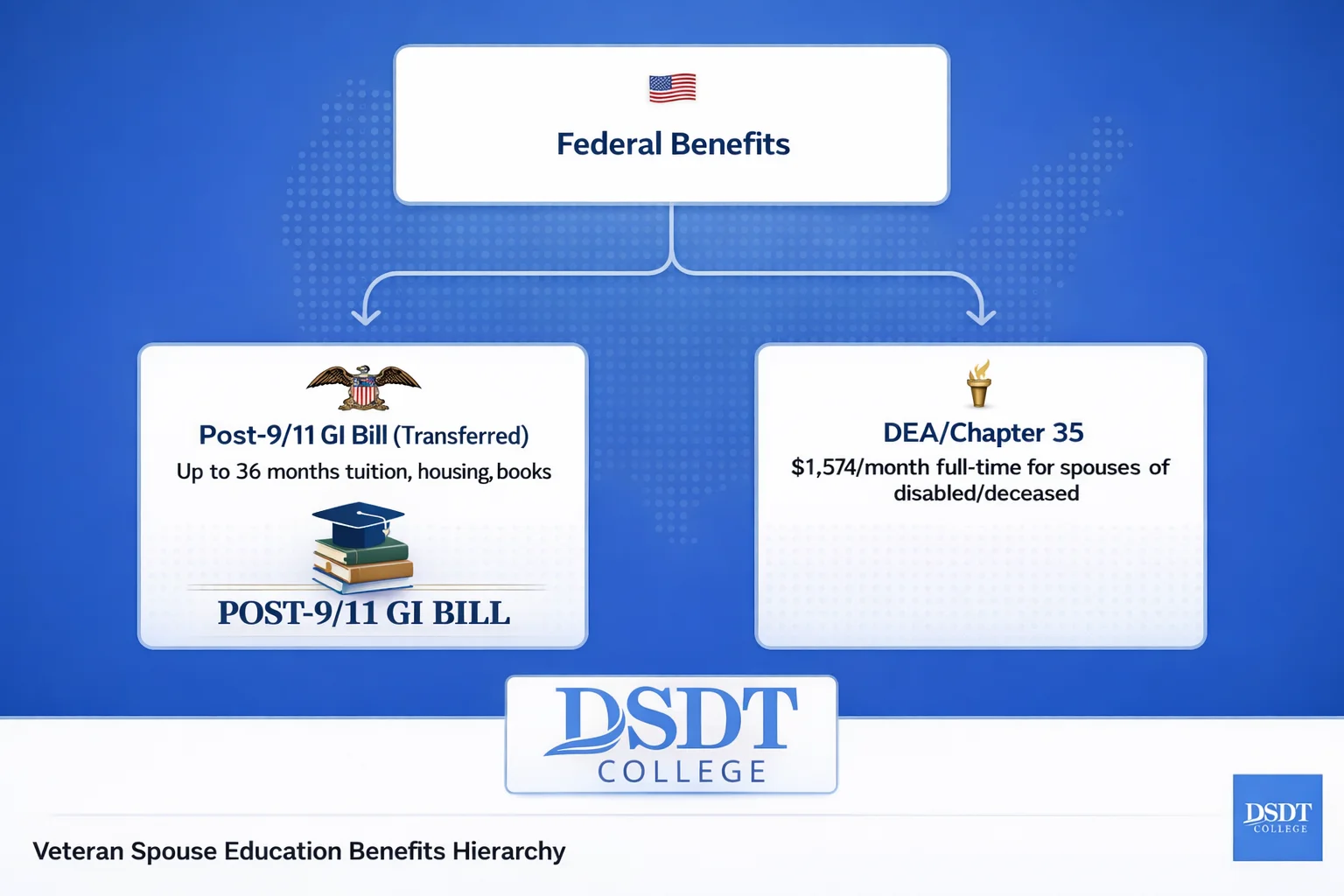
| Post-9/11 GI Bill® (Transferred) | Spouses of eligible service members | Up to 36 months of tuition, housing, and books |
| DEA / Chapter 35 | Spouses of 100% disabled or deceased veterans | Up to $1,574/month for full-time enrollment |
| Fry Scholarship | Surviving spouses of post-9/11 service member deaths | Post-9/11 GI Bill®-equivalent coverage |
| MyCAA Scholarship | Spouses of active-duty members (certain pay grades) | Up to $4,000 for degrees or certificates |
| Hazlewood Act (Texas) | Spouses of eligible Texas veterans | Up to 150 hours of tuition exemption |
| SECO Program | All eligible military spouses | Free career coaching |
These programs can be used separately or stacked, depending on your situation. Understanding which ones apply to you is the first step.
I’m a director at DSDT College — a nationally accredited, Military-Friendly institution that specializes in career training for military families through programs approved for veteran spouse education benefits like MyCAA and the Post-9/11 GI Bill®. In this guide, I’ll walk you through every major benefit available, how to qualify, and how to put them to work for a real career outcome.
Navigating Your Veteran Spouse Education Benefits
Navigating military benefits can sometimes feel like reading a bowl of alphabet soup. However, these programs are designed to be life-changing. Whether you are looking to finish a degree or pivot into a high-growth field like Information Technology or Healthcare, there is likely a bucket of funding waiting for you.
Federal Education and Career Benefits for Family Members don’t just cover tuition; many provide stipends for housing, books, and supplies. At DSDT College, we see how these benefits empower spouses to gain independence and professional stability, regardless of where the military moves them. More info about DSDT programs can help you match these benefits to a specific career path.
Eligibility for Veteran Spouse Education Benefits under Chapter 33
The Post-9/11 GI Bill® (Chapter 33) is perhaps the most well-known benefit. While veterans earn this through their service, they have the option to “Transfer of Entitlement” (TEB) to their spouse or children. This is a powerful tool for military families, but it comes with specific “hoops” to jump through.
According to the Post-9/11 GI Bill®: Transferability guidelines, a service member must typically have at least 6 years of service and agree to serve 4 more years to be eligible to transfer benefits. The transfer must be initiated while the member is still on active duty or in the Selected Reserve through the milConnect portal.
Once transferred, spouses can use the benefit immediately. A major win for spouses is the “Forever GI Bill®” update. If the service member’s last discharge was on or after January 1, 2013, the 15-year time limit to use the benefits has been eliminated. This means you can pursue your education whenever the timing is right for your family.
Maximizing Veteran Spouse Education Benefits through SECO
If you are the spouse of an active-duty service member, you have access to the Spouse Education and Career Opportunities (SECO) program. This is more than just a website; it’s a comprehensive support system offering free career coaching to help you find your “what’s next.”
A cornerstone of SECO is the My Career Advancement Account (MyCAA) Scholarship. This program provides up to $4,000 (with a $2,000 annual fiscal year cap) for spouses of service members in pay grades E-1 to E-6, W-1 to W-2, and O-1 to O-3. This money is specifically for “portable” careers—occupations that you can take with you from base to base.
Military Spouse Career & Education Benefits | Military OneSource lists MyCAA as a top resource for obtaining associate degrees, professional certificates, or licenses. For example, you could use MyCAA to fund More info about Digital Marketing training, a field that is perfect for remote work and telecommuting.
Survivors’ and Dependents’ Educational Assistance (DEA) Rates
The DEA program, or Chapter 35, is specifically for the spouses and children of veterans who are permanently and totally disabled due to a service-connected condition, or who died while on active duty or as a result of a service-connected condition.
Unlike the GI Bill®, which pays tuition directly to the school, DEA provides a monthly payment directly to the student. For the 2025-2026 period (effective October 1, 2025), the rates have been adjusted to account for the rising cost of living.
| Enrollment Status | Monthly Rate (2025-2026) |
|---|---|
| Full-Time | $1,574.00 |
| 3/4-Time | $1,244.00 |
| 1/2-Time | $912.00 |
| Less than 1/2-time | Up to $912.00 (capped at tuition/fees) |
| 1/4-Time or less | Up to $393.50 (capped at tuition/fees) |
Spouses generally have 20 years from the date of the veteran’s death or the date the VA rates the veteran as permanently and totally disabled to use these benefits. This program also covers non-traditional paths like apprenticeships and correspondence training, though correspondence is uniquely available to spouses and not children under this chapter.
State-Specific Programs and Specialized Career Training
While federal benefits are the “heavy hitters,” many states offer incredible supplements for veteran spouse education benefits. If you live in a military-heavy state like Texas, Illinois, or California, you might be eligible for even more tuition assistance.
The Education – Hazlewood Act – Texas Veterans Commission is one of the most generous state benefits. It provides up to 150 credit hours of tuition exemption at Texas public institutions for eligible veterans, spouses, and dependent children. For a spouse to qualify, the veteran must typically be 100% disabled or deceased due to service-related causes. Similarly, Illinois offers the MIA/POW Scholarship, and California provides the CalVet College Fee Waiver for certain dependents.
Beyond just finding the money, it’s important to find the right program. At DSDT College, we specialize in high-demand fields. For instance, our More info about AI Prompt Specialist training prepares you for the cutting edge of the tech industry.
One of our most popular paths is the MRI Primary Pathway. Unlike traditional routes that require you to be an X-ray technician first, our accredited Associate of Applied Science in MRI Technology allows you to become an MRI tech directly. This program is 100% online for the didactic portion, making it incredibly mobile-friendly for military spouses. We then help you find a clinical site near your current location to complete your hands-on training. More info about MRI Technology is available for those looking for a stable, high-paying career in healthcare.
Application Procedures and Documentation Requirements
Ready to get started? The application process is relatively straightforward, but you will need to gather your “ammo” (documentation) first.
- Gather Documents: You will need the veteran’s DD214 (Discharge Papers), proof of marriage (Marriage Certificate), and, if applying for Chapter 35, the VA Rating Decision showing permanent and total disability.
- Submit VA Form 22-1990e: This is the “Application for Family Member to Use Transferred Benefits.” You can complete this online via the VA website.
- Get your COE: Once approved, the VA will send you a Certificate of Eligibility (COE). This is the “golden ticket” you provide to your school’s School Certifying Official (SCO).
- Enroll in DEERS: Ensure you are properly enrolled in the Defense Enrollment Eligibility Reporting System (DEERS) to verify your relationship to the service member.
For more detailed steps, you can visit Transferred Education Benefits For Family Members. Don’t forget that the VA also offers reimbursements for licensing fees and national test fees (like the CompTIA Security+ or ARRT exams). If you are attending a private or out-of-state school where the GI Bill® doesn’t cover the full tuition, ask if they participate in the Yellow Ribbon Program to bridge the gap.
For those located near Killeen, Texas, we offer a specialized, in-person Cybersecurity program. More info about Cybersecurity at Fort Hood provides details on this SkillBridge-aligned opportunity for those looking for intensive, face-to-face training.
Frequently Asked Questions about Veteran Spouse Education Benefits
Can I use my spouse’s GI Bill® while they are still on active duty?
Yes, you can! However, there is a catch regarding the Monthly Housing Allowance (MHA). If the service member is still on active duty, the family is already receiving a Basic Allowance for Housing (BAH). Therefore, the VA will not pay the MHA to a spouse using transferred benefits while the member is active. Once the service member separates from the military, the spouse becomes eligible to receive the MHA stipend.
What happens to my education benefits if we get a divorce?
This is a common concern. If the service member has already transferred the benefits to you, you typically keep them even after a divorce. However, the service member retains the right to revoke or change the transfer at any time while they are still in the military. It is important to check the specific “revocation rules” in your divorce decree, as some legal settlements include the GI Bill® as a negotiated asset.
Are there age limits for spouses using Chapter 35 or Transferred GI Bill® benefits?
For spouses, there is generally no age limit. This is a major difference compared to children, who must usually use their benefits before age 26. Under the Post-9/11 GI Bill®, if the veteran’s service ended before January 1, 2013, there is a 15-year window to use the benefits. If they served after that date, the benefits never expire for the spouse. For Chapter 35 (DEA), spouses usually have a 20-year window from the date of eligibility.
Conclusion
At DSDT College, we are proud to be a bridge between military service and a successful civilian career. We understand the unique challenges military spouses face—the frequent moves, the resume gaps, and the need for flexible, portable careers. That is why our programs in Healthcare and Information Technology are designed with you in mind.
Your service to your family and our country deserves to be rewarded with a bright professional future. For More info about Information Technology degrees or any of our other military-friendly programs, reach out to us today. Let’s put your veteran spouse education benefits to work.