What is Machine Learning: A Brief Explanation for Beginners
What is machine learning? It is a subset of artificial intelligence focused on building systems that learn from data to improve their performance.
Quick Answers:
| Question | Short Answer |
|---|---|
| What is machine learning? | A subset of AI where machines learn from data independently |
| Where is it used? | In various industries including security, entertainment, and finance |
| Is it the same as AI? | No, it is a specific subset of the broader AI field |
This guide explains everything from scratch—no technical background required.
At DSDT College, a nationally accredited institution, we train professionals in high-demand technology fields, including AI Prompt Engineering and Machine Learning. For us, understanding what machine learning is goes beyond theory—it is a tangible career path we prepare our students to excel in. Read on to understand how it works, its types, and the real-life applications of machine learning.
Understanding What Machine Learning Is and Its History
To truly understand what machine learning is, we must look back at its history. The term was first coined by Arthur Samuel in 1959. While working at IBM, Samuel created a checkers program that allowed the computer to learn from its own playing experience, eventually defeating its own creator.
Technically, the primary focus of Machine learning is generalization. This means that after a machine is trained with a set of data, it must be able to make accurate conclusions or predictions when facing new data it has never seen before. Unlike traditional programming where humans provide explicit instructions, the machine finds its own patterns and mathematical logic. This flexibility allows the technology to handle complex tasks that are difficult for humans to define manually.
The Difference Between AI, Machine Learning, and Deep Learning
People often use the terms AI, Machine Learning, and Deep Learning interchangeably. However, the three have different scopes. Imagine it like a Russian Matryoshka doll, where one part sits inside a larger part.
| Category | Definition | Scope |
|---|---|---|
| Artificial Intelligence (AI) | An umbrella term for machines capable of mimicking human intelligence. | Includes rule-based systems, logic, and robotics. |
| Machine Learning (ML) | A subset of AI focused on the machine’s ability to learn from data independently. | Statistical algorithms, regression, clustering, and decision trees. |
| Deep Learning (DL) | A subset of ML that uses multi-layered artificial neural networks. | Facial recognition, Natural Language Processing (NLP), and generative AI. |
Artificial Intelligence is the big vision—creating intelligent systems. Within it lies Machine Learning, which is the method for achieving that intelligence through data. Then, inside machine learning, there is Deep Learning.
Deep learning is a more advanced technique inspired by the workings of the human brain. It uses “layers” of artificial neurons to process highly complex information. Modern neural networks today can have hundreds or even thousands of layers to analyze data such as video or voice. In the academic world, these neural networks are often called universal approximators because they are theoretically capable of mimicking any mathematical function.
How Machine Learning Works in Processing Data?
How exactly can an inanimate object “learn”? The process is similar to how we learn in school. We are given practice problems (data), we study them, and then we are tested with new problems.
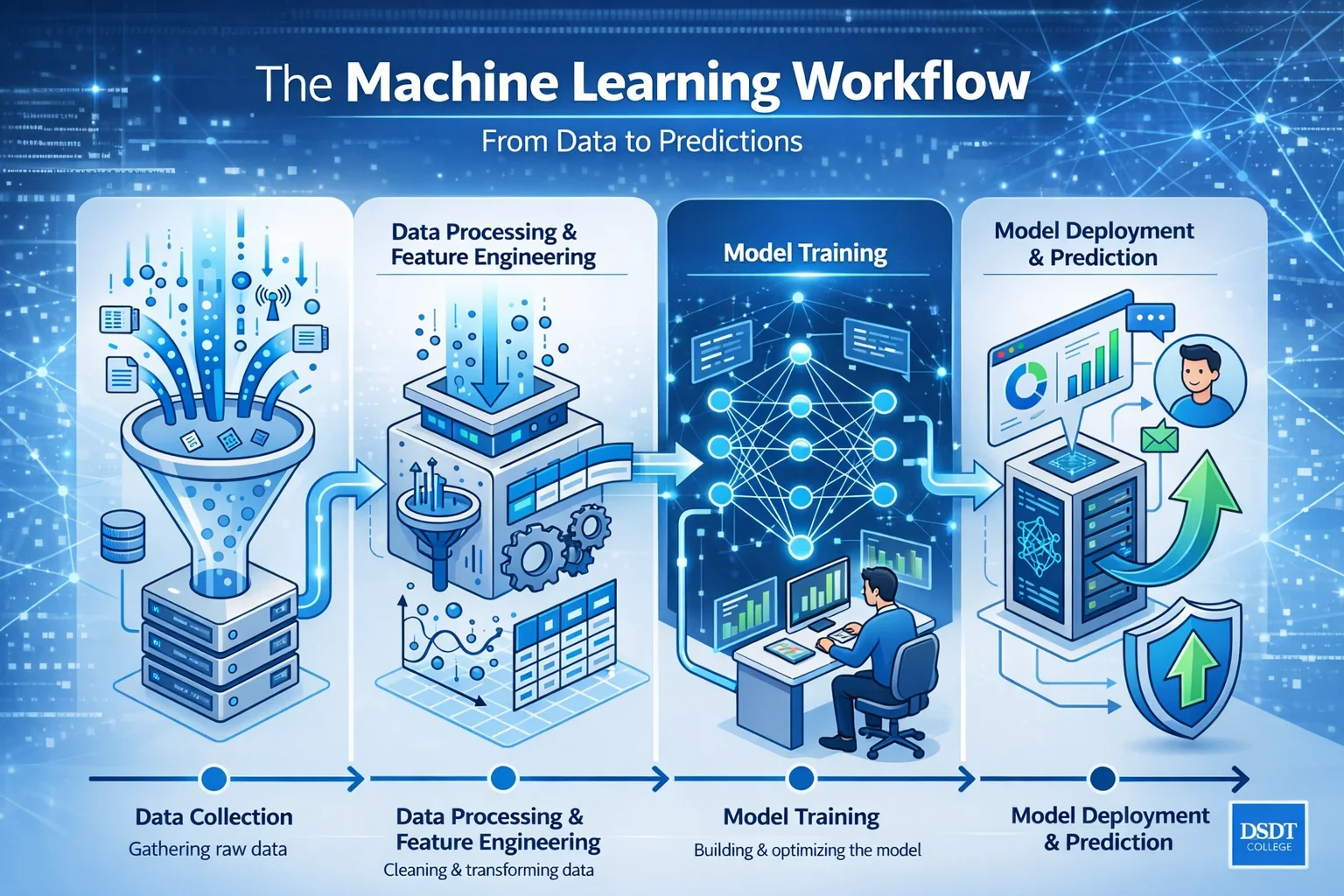
In general, the machine learning workflow involves several stages:
- Data Collection: Gathering relevant information that the machine will learn from.
- Feature Engineering: Selecting the most important data characteristics (e.g., to predict house prices, important features are land area and location).
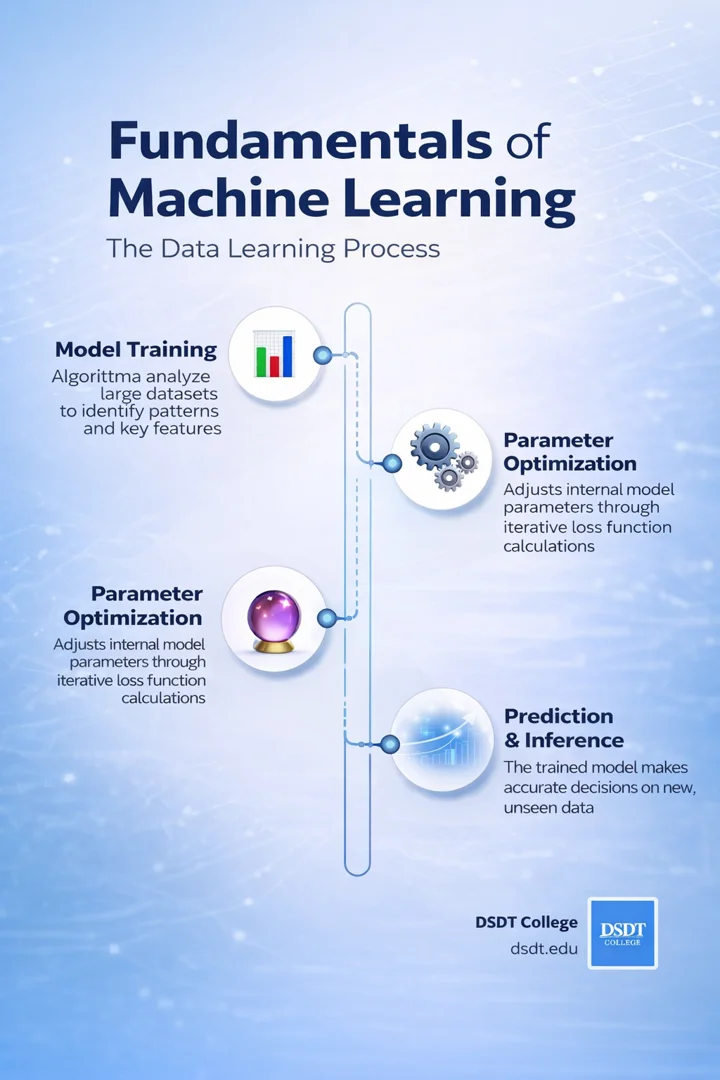
- Model Training: The algorithm processes data to find mathematical patterns.
- Optimization & Loss Function: The machine calculates how far its prediction is from reality (error). Through a loss function, the algorithm adjusts its internal parameters iteratively to minimize those errors.
- Evaluation: The model is tested with data it hasn’t seen before to ensure its accuracy.
- Inference: The model is ready to be used to predict real-world data.
The Vital Role of Data in Machine Learning
Data is the “fuel” for machine learning. Without quality data, the machine cannot learn correctly. In today’s Big Data era, we generate massive amounts of data every second, making traditional analysis impossible without the help of ML.
Data processing or preprocessing is crucial. Raw data is often messy, has missing values, or is inconsistent. We must clean and structure that data before feeding it into the model. The quality and quantity of training sets determine how accurate the model will be. As more historical data is processed, the machine can continue to improve its accuracy through a continuous adjustment process.
Main Types of Machine Learning Algorithms
Not all problems can be solved the same way. Therefore, experts divide machine learning into several main paradigms:

- Supervised Learning: This is the most common type. The machine is given data that already has “labels” or correct answers. For example, we give the machine thousands of photos of apples labeled “Apple.” The machine’s task is to learn the characteristics of those apples so that when given a new photo, it can guess correctly. Its main techniques are regression (predicting numbers) and classification (predicting categories).
- Unsupervised Learning: Here, the machine is given data without any labels. The machine must find hidden patterns or structures on its own. A popular example is clustering, where the machine groups customers based on similar shopping behavior without us telling it what categories exist.
- Reinforcement Learning: This is a method of learning through trial and error. The machine (called an agent) interacts with an environment and receives a “reward” for correct actions or a “penalty” for wrong ones. This method is very popular in robotics and AI game development.
- Semi-supervised Learning: A combination of both, where we use a small amount of labeled data and a large amount of unlabeled data to improve training efficiency.
Real-World Examples of Machine Learning Applications
You might not realize it, but machine learning is already in the palm of your hand. Here are some notable achievements and real-world applications of this technology:
- AlphaGo & Deep Blue: In 1997, IBM’s Deep Blue defeated world chess champion Garry Kasparov. A major leap occurred in 2016 when Google’s AlphaGo defeated the world champion of the game Go after being trained with 100,000 match data points and playing millions of times against itself.
- Face Unlock: Our smartphones use computer vision (a branch of ML) to recognize the owner’s face instantly.
- Recommendation Systems: Netflix, YouTube, and Spotify use ML to suggest content based on our viewing and listening history.
- Fraud Detection: Banks use ML to analyze millions of transactions in real-time and detect suspicious activities that are unusual for a customer.
- Autonomous Vehicles: Self-driving cars use sensors and ML algorithms to recognize objects on the road and make driving decisions.
- Language Services: Google Cloud services use ML to support speech-to-text in 125 languages and more than 220 voices for text-to-speech.
Challenges, Ethics, and the Future of ML Technology
While incredibly powerful, machine learning is not without its flaws. There are several major challenges we must face:
- Algorithmic Bias: If the data used to train the machine contains prejudices or is unbalanced, the machine’s predictions will also be biased. This is a serious ethical issue, especially in job recruitment systems or law enforcement.
- Data Privacy: Massive data collection triggers concerns about the security of personal information. This is why concepts like Privacy-Preserving and Explainable AI in Industrial … are becoming vital to protect user privacy.
- Transparency (Black Box): Highly complex deep learning models are often difficult to explain (the black box phenomenon). Currently, the industry is developing Explainable AI (XAI) so that machine decisions can be understood by humans.
- Technical Issues: Overfitting (the model is too good at memorizing training data but fails in the real world) and underfitting (the model fails to learn basic patterns) are daily challenges for data scientists.
The future of machine learning will focus on Responsible AI—developing technology that is not only smart but also fair, safe, and transparent for everyone.
Frequently Asked Questions about Machine Learning
Will Machine Learning replace human jobs?
Machine learning is more about automating routine tasks and heavy data analysis. Instead of totally replacing humans, this technology creates new roles such as AI Prompt Engineers, Machine Learning Specialists, and Data Architects. Humans are still needed to provide ethical context, creativity, and strategic decision-making.
Does learning Machine Learning require high-level math skills?
Understanding the basics of statistics, linear algebra, and calculus is very helpful in understanding algorithms. However, with the many modern libraries and frameworks like TensorFlow or PyTorch, beginners can start building simple models without having to memorize complex mathematical formulas at the start of their learning journey.
What is the difference between Machine Learning and Data Mining?
Data mining focuses on finding hidden patterns or new information from large existing datasets. Meanwhile, machine learning uses those patterns to make predictions or take actions on new incoming data. In short, data mining seeks insights, while machine learning seeks predictions.
Conclusion
Mastering what machine learning is opens doors to a transformative field impacting industries from healthcare to cybersecurity. DSDT College is a military and veteran-friendly institution supporting the GI Bill® and MyCAA programs to assist in career transitions. For those seeking intensive, hands-on experience, our Cybersecurity CSP/SkillBridge program is available as an in-person program at Fort Hood. Additionally, our MRI Technology (ARRT Primary Pathway) is offered 100% online for flexible learning.
Ready to master the technology of the future? Start a Career in Machine Learning with DSDT College today!