Mastering the Machine with an AI Prompt Engineer Course
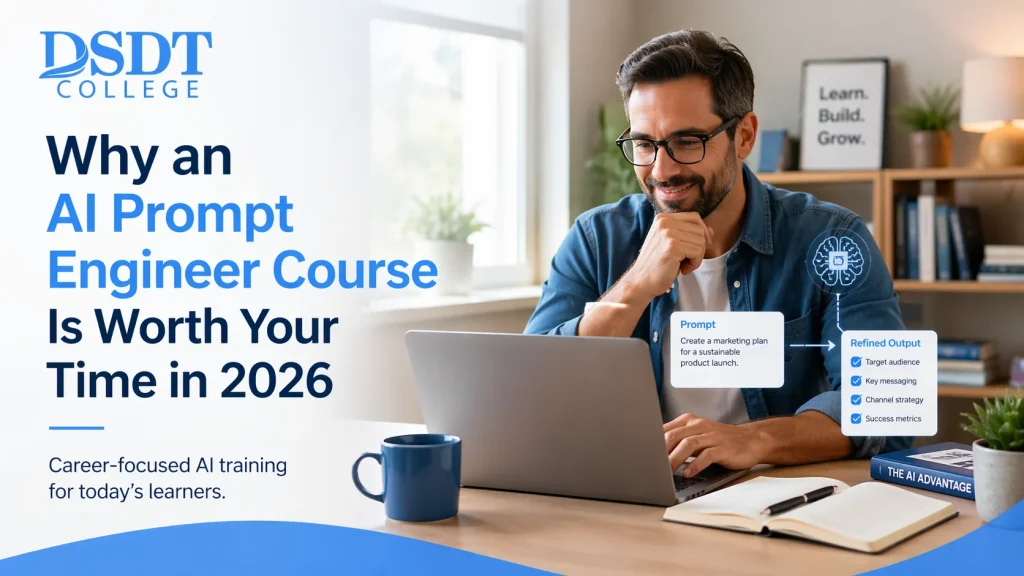
Master AI prompt engineering: Enroll in top ai prompt engineer course, gain skills, certifications & career boost in 2026!
Why an Associate Degree in AI is the Ultimate Career Hack

Discover why an associate degree in AI unlocks high-paying jobs, essential skills, and career growth in a $118B industry. Start your future today!
What Is the Main Purpose of a Prompt Builder AI Specialist?

Introduction: The Rise of AI and the Emergence of a New Role In the rapidly evolving world of artificial intelligence, new career opportunities are emerging at an unprecedented pace. Among the most exciting—and arguably most essential—is the role of the Prompt Builder AI Specialist. As AI systems, especially large language models (LLMs), grow in capability and complexity, the need for professionals who can craft effective prompts has become critical. At the core of modern AI systems is a simple concept: the prompt. A prompt is the input or instruction that tells an AI what to do. Whether it’s generating a blog post, summarizing a legal document, designing a website layout, or holding a conversation with a user, AI requires human instruction in the form of prompts. The person who creates these inputs is known as a Prompt Builder AI Specialist. But what exactly is the main purpose of this role? Why is it becoming so valuable? And how can you become one? Let’s dive into the purpose, impact, and career path of a Prompt Builder AI Specialist—and how you can start your journey through DSDT’s AI Prompt Specialist Program and Machine Learning Specialist Program. Understanding the Role: What Does a Prompt Builder AI Specialist Do? The primary purpose of a Prompt Builder AI Specialist is to create, refine, and optimize the instructions that guide AI behavior. While AI models can perform incredible tasks, they don’t inherently know what users want unless they’re given well-structured input. That’s where a Prompt Builder comes in. Key Responsibilities: In essence, a Prompt Builder AI Specialist is the “translator” between human intent and machine output. They don’t write code, but their instructions shape everything the AI generates. Why Prompt Engineering Matters in 2025 and Beyond As AI adoption becomes more widespread, organizations increasingly rely on natural language interfaces. From chatbots and AI writers to virtual agents and recommendation engines, AI is only as effective as its prompts. That’s why the Prompt Builder AI Specialist has become such a pivotal role. Imagine you’re launching a customer support bot for a major telecom company. The bot needs to understand questions, give the correct answers, and avoid offending or frustrating users. If the prompts it receives aren’t well-designed, it could provide poor service or even deliver incorrect information. The prompt builder ensures that the AI operates responsibly, clearly, and consistently, improving both efficiency and customer satisfaction. The Main Purpose of a Prompt Builder AI Specialist: Breaking It Down Let’s look at the deeper core purposes of the role. 1. Guiding AI to Understand Human Intent AI, especially large language models, are trained on billions of words—but that doesn’t mean they understand context or intent automatically. Prompt builders help AI interpret commands properly by designing inputs that reflect user goals with clarity and nuance. 2. Maximizing Output Quality Whether an AI is generating text, images, summaries, or dialogue, the quality of that output depends on how it’s prompted. Specialists test different prompt structures to see which ones yield the best results, then fine-tune accordingly. 3. Reducing Bias and Inaccuracy AI can produce biased or factually incorrect content if not properly instructed. Prompt builders create safe, ethical instructions that minimize risk and ensure content aligns with brand standards, legal requirements, and public expectations. 4. Training AI Assistants and Bots Many prompt builders help train conversational agents that interact with users daily. From customer support bots to AI tutors, these systems rely on prompt libraries to perform their tasks smoothly and naturally. 5. Enhancing User Experience When AI is powered by effective prompting, the user experience is seamless. Whether it’s helping a user find a product, learn a skill, or generate creative work, a well-trained AI (guided by a prompt expert) makes the process fast, helpful, and intuitive. A Day in the Life of a Prompt Builder AI Specialist What does the day-to-day work of a prompt builder look like? While tasks vary, the consistent goal is always the same: improve how AI communicates and responds. Where Prompt Builders Work: Industry Applications AI Prompt Builders are now essential across industries: This cross-sector relevance means Prompt Builder AI Specialists enjoy high job mobility and wide employment opportunities. Skills Needed to Succeed as a Prompt Builder AI Specialist You don’t need to be a programmer to excel in this role, but you will need a unique combination of skills: If you love language, critical thinking, and solving problems creatively, this career path could be perfect for you. How to Become a Prompt Builder AI Specialist You might be wondering how to get started. The best path? Enroll in a focused, hands-on training program like DSDT’s AI Prompt Specialist Program. Why DSDT? Want to deepen your understanding of how AI models work? Pair your studies with the Machine Learning Specialist Program to gain technical insight into model training, architecture, and ethical AI development. Start Your Journey Today In a world driven by artificial intelligence, Prompt Builder AI Specialists are the new power users—the individuals who understand how to communicate with machines in ways that are useful, ethical, and intelligent. Their work is shaping everything from how businesses operate to how people learn, shop, and interact online. It’s creative, high-impact, and growing fast. Whether you’re switching careers, graduating high school, or looking to upskill in a rapidly evolving tech landscape, this is your moment. Ready to get started? Apply now and launch your career as a Prompt Builder AI Specialist today.
An AI Specialist Wants to Ground a New Prompt Template: Exploring the Art and Science of Prompt Engineering

In today’s AI-driven world, intelligent systems are revolutionizing the way we communicate, analyze, and create. From chatbots that mimic human interaction to enterprise tools that automate decision-making, artificial intelligence is everywhere. But behind the seamless responses and intuitive outputs lies a critical component: the prompt template. And when an AI specialist wants to ground a new prompt template, they’re not just crafting clever words — they’re designing the architecture of human-machine communication. This article takes you inside the mind and method of an AI prompt specialist — someone trained to configure, structure, and ground prompts for maximum reliability and contextual accuracy. You’ll discover what grounding a prompt means, why it’s vital for large language models, and how programs like DSDT’s AI Prompt Specialist Program and Machine Learning Specialist Program can equip you with the skills needed for this high-demand field. Understanding Prompt Grounding: The Core of Reliable AI When we say that an AI specialist wants to “ground” a prompt template, we’re talking about anchoring the AI’s response to factual data, source material, or a fixed context. In the absence of grounding, a model may hallucinate — generating content that sounds plausible but is untrue or irrelevant. Prompt grounding ensures that AI models like GPT-4 or similar architectures produce output that is: In real-world applications like medical advice, financial forecasting, legal guidance, and educational tools, grounded prompts reduce risk and elevate trust in AI systems. The Role of an AI Prompt Specialist An AI prompt specialist is a highly trained professional responsible for crafting prompt templates that shape and control the behavior of language models. This role requires a blend of skills from linguistics, psychology, machine learning, and software engineering. Key responsibilities include: Professionals in this field often pursue an AI prompt certification to validate their expertise. At DSDT, the AI Prompt Specialist Program is designed specifically to train individuals in this emerging career path. Why Grounded Prompt Templates Are Critical In an era of increasing reliance on AI, the demand for quality, accountability, and transparency is high. That’s where grounding comes in. Here’s why grounding is essential: 1. Prevents AI Hallucinations Without grounding, AI may fabricate facts. Grounding ensures responses come from real data or verified input. 2. Improves Contextual Accuracy Grounded prompts keep the conversation aligned with the user’s intent, improving the user experience. 3. Enables Real-Time Knowledge By grounding prompts with API inputs or dynamic databases, AI systems can produce up-to-date and personalized outputs. 4. Increases Trust and Adoption Reliable and grounded AI systems are more likely to be adopted in enterprise and regulatory environments. These benefits make prompt grounding a high-stakes activity — and a top priority for organizations deploying AI. Step-by-Step: How an AI Specialist Grounds a New Prompt Template Let’s walk through the process an AI specialist follows when developing a grounded prompt template from scratch. Step 1: Define the Objective Everything begins with clarity of purpose. Whether the AI is meant to answer medical questions, summarize articles, or generate marketing content — the goal must be explicitly defined. Example: Objective: Summarize patient records based on HIPAA-compliant data. Step 2: Identify Grounding Sources The AI specialist selects sources that will serve as the foundation for the AI’s response. This may include: This content becomes the “anchor” that the AI will refer to during generation. Step 3: Build a Prompt Structure Next, the specialist creates a template with placeholders and instructions: “Based on the following medical report: {document}, summarize the patient’s condition and recommended treatment plan.” This structure enforces format and scope, guiding the AI’s response generation. Step 4: Apply Constraints and Controls To avoid inaccuracies or bias, the prompt might include constraints such as: These rules are embedded directly into the template or applied through additional programming logic. Step 5: Test and Optimize Once the prompt is active, the AI specialist runs multiple test cases, measures performance, and adjusts variables or language to fine-tune the model’s output. At DSDT, students enrolled in the AI Prompt Specialist Program gain hands-on experience in each of these stages, preparing them for careers in real-world AI deployment. Prompt Engineering and Machine Learning: The Perfect Pair While prompt design is crucial, it often overlaps with machine learning workflows — especially in enterprise applications. That’s why many specialists combine their prompting skills with formal training in machine learning. Professionals who earn a machine learning specialist credential can: To become a certified AI and machine learning specialist, students can enroll in DSDT’s Machine Learning Specialist Program, which provides deep knowledge of algorithms, model deployment, and ethical AI practices. Real-World Use Cases of Grounded Prompt Templates Let’s look at how grounded prompts are transforming various industries: Healthcare Prompt: “Based on the following Mayo Clinic guidelines, explain this patient’s treatment path for Type 2 Diabetes.”Source: Verified clinical documentsImpact: Ensures AI-generated advice adheres to medical standards. Legal Prompt: “Given this case precedent and current law, explain potential outcomes for the scenario: {user_input}.”Source: Legal databasesImpact: Reduces liability from AI misinterpretation. Education Prompt: “Using content from this textbook chapter, summarize the causes of World War II in under 300 words.”Source: Curriculum-based textbookImpact: Keeps educational AI aligned with lesson plans. Finance Prompt: “Based on today’s Fed interest rate, provide a recommendation for the user profile: {client_data}.”Source: Real-time financial APIsImpact: Enhances personalization and accuracy. In each case, prompt grounding reduces risk and improves confidence in the system — which is exactly what employers and users expect from AI professionals The Growing Demand for Certified Prompt Specialists AI prompting is no longer a novelty skill — it’s fast becoming a core requirement in tech-driven industries. Roles such as “Prompt Engineer,” “Conversational AI Designer,” and “AI Interaction Architect” are on the rise. Employers seek professionals with: Whether you’re reskilling or launching a new career, getting your AI prompt certification is one of the best steps you can take. DSDT is committed to helping students enter this career path. Through hands-on labs, industry-aligned curricula, and portfolio-ready projects, the AI Prompt Specialist Program helps you build skills that employers demand. Tools
When Configuring a Prompt Template: An AI Specialist’s Ultimate Guide

In today’s digital frontier, artificial intelligence is rewriting how we interact with data, systems, and even each other. At the heart of this transformation lies a powerful and often underestimated role — the AI Prompt Specialist. While the term might sound niche, this profession is quickly becoming one of the most in-demand across industries. Whether you’re building large language models, training AI for customer interaction, or deploying enterprise-level automation, knowing how to configure a prompt template is a foundational skill. This article explores the intricate process of prompt template configuration, the competencies required, and why earning your AI prompt certification is a strategic step forward. Whether you’re an aspiring machine learning specialist or just curious about this emerging domain, this deep dive will give you clarity on the path ahead. Understanding the Prompt Template Before diving into the “how,” it’s essential to answer the “what.” A prompt template in the context of AI is a predefined structure or format used to instruct a language model on how to respond. In other words, it’s the bridge between human intention and machine understanding. Imagine working with a conversational AI that’s meant to respond like a customer service agent. The prompt template might look something like this: “You are a helpful customer service assistant. The user says: {user_input}. How do you respond?” Here, {user_input} acts as a variable placeholder for the actual content the user provides. This setup gives the AI both context and role, ensuring it responds appropriately. When configuring such templates, the AI Prompt Specialist must consider tone, logic, format, goal, and model limitations. This is both a creative and technical task — a perfect synergy of linguistics and computation. The Role of an AI Prompt Specialist An AI Prompt Specialist is responsible for designing, testing, and refining prompt structures to produce accurate, relevant, and ethical responses from AI systems. These professionals understand both the capabilities and boundaries of AI models, such as GPT, Claude, or Gemini, and know how to optimize inputs for the best results. In essence, they serve as the architects of machine communication. Their core responsibilities include: To get started in this exciting career, DSDT offers a comprehensive AI Prompt Specialist Program that equips you with industry-relevant skills and hands-on training. Key Elements When Configuring a Prompt Template Whether you’re working in chat-based applications, recommendation engines, or dynamic data reporting, the steps to configuring an effective prompt template follow a common blueprint. 1. Define the Objective Start by determining the goal of the prompt. Is it to summarize content, answer a question, generate creative text, or perform a function like code completion? A clear objective prevents ambiguity and ensures alignment between user input and model output. Example Objective: Generate a product description from a list of features. Prompt Template: “Write a compelling product description using the following features: {features_list}.” 2. Identify Variable Components Decide which elements in the prompt need to be dynamic. These variables are what make your prompt scalable and reusable across different tasks. Example Variable: {features_list} can be swapped with actual product specs. 3. Choose the Prompt Style There are various prompt styles: zero-shot, few-shot, chain-of-thought, and instructional. Your choice depends on the complexity of the task and the model’s capability. Prompt specialists typically experiment with these styles to determine the most effective approach. Training and Certification: Why It Matters Configuring prompt templates isn’t just about clever wording. It requires knowledge of natural language processing, cognitive psychology, model architecture, and ethical AI use. This is why formal training — such as the AI Prompt Specialist Program at DSDT — is so vital. The program helps students develop foundational and advanced skills, and culminates in a recognized AI prompting certificate that signals your competency to employers. Here’s what you’ll gain from pursuing your AI prompting certification: Graduates of the program emerge with both the technical know-how and strategic mindset needed to succeed. The Intersection of AI Prompting and Machine Learning Prompting may seem like a soft skill at first glance, but it’s deeply tied to the hard science of machine learning. While machine learning specialists build the models, AI prompt specialists optimize their usability. This growing synergy between prompt engineering and machine learning is giving rise to hybrid roles. Many professionals are now enrolling in courses like DSDT’s Machine Learning Specialist Program to complement their prompting expertise. If you’re aiming to be an AI and machine learning specialist, understanding both ends — from model architecture to interface prompting — will significantly elevate your career. Common Challenges in Prompt Configuration Even for experienced specialists, prompt configuration isn’t always straightforward. Here are a few hurdles professionals often encounter — and how training helps overcome them. 1. Model Hallucinations When AI generates false or unverifiable information.Solution: Reinforce prompts with context and constraints. 2. Inconsistent Output Formats Especially in data generation tasks or customer service automation.Solution: Use clearly defined templates and post-processing tools. 3. Bias and Ethics Some prompts can unintentionally yield biased outputs.Solution: Inclusive language design and continual audit testing. 4. Token Limits All models have input/output token constraints.Solution: Keep prompts concise, and chunk large inputs strategically. These challenges reinforce the need for formal education through AI prompting certification and practical workshops. Tools AI Prompt Specialists Use Prompt engineers leverage several tools to streamline their workflow: Mastering these tools is part of the curriculum in DSDT’s AI programs — ensuring students graduate job-ready. Real-World Applications of Prompt Templates Here are just a few sectors where prompt configuration is transforming the landscape: 1. Healthcare Generating discharge summaries, triage instructions, and patient education guides. 2. Education Creating automated tutoring agents and curriculum recommendations. 3. Finance Designing bots for fraud detection explanations or investment advice. 4. Marketing Auto-generating ad copy and SEO-rich product descriptions. 5. Legal Services Drafting contracts, summarizing case law, and preparing legal briefs. The demand for AI and machine learning specialists who understand prompting grows with every new use case. Building a Career as an AI Prompt Specialist If you’re intrigued by the idea of configuring machines
AI Prompting: The Hottest Skill You’ve Never Heard Of (Until Now)

Introduction: A Silent Revolution Is Underway What if we told you that one of the most in-demand, high-paying, and creatively fulfilling skills in 2025 didn’t exist in job descriptions just five years ago? What if the key to unlocking the power of artificial intelligence (AI) wasn’t coding, engineering, or data science—but simply knowing how to communicate with a machine? Welcome to the world of AI prompting—the hottest skill you’ve never heard of (until now). As AI continues to revolutionize industries worldwide, a new role has emerged at the forefront of innovation: the AI Prompt Specialist. These professionals aren’t software developers—they’re language experts, problem-solvers, creatives, and strategists who bridge the gap between human intent and machine interpretation. This article will explore what AI prompting is, why it’s booming in 2025, the skills required to master it, and how institutions like DSDT are equipping a new generation of professionals through their AI Prompt Specialist Program and Machine Learning Specialist Program. If you’re looking for a future-proof career that combines creativity, critical thinking, and tech fluency—read on. What Is AI Prompting? At its core, AI prompting is the practice of crafting well-structured inputs—called prompts—that guide AI systems to generate accurate, relevant, and useful outputs. Think of a prompt as a conversation starter. The better you are at asking the right questions or issuing the right commands, the more valuable and precise the AI’s responses will be. This is especially important with large language models (LLMs) like ChatGPT, Claude, and Gemini, which power everything from virtual assistants to content creation tools, medical AI diagnostics, legal support bots, and enterprise automation platforms. AI prompting determines the quality, tone, accuracy, and even ethics of AI behavior. In a world where AI is now making business decisions, writing content, managing customer service, and tutoring students, prompting is no longer a hidden talent—it’s a frontline skill. The Rise of Prompt Engineering Why Prompting Is Booming in 2025 AI used to be the domain of coders and researchers. Today, thanks to powerful LLMs, everyday users can interact with AI using plain language. But here’s the catch: these models are only as smart as the instructions they’re given. Garbage in, garbage out. This realization has sparked an explosion of demand for prompt engineers—professionals who know how to coax the best results from AI. Businesses now recognize that effective prompting can lead to better customer experiences, streamlined operations, faster content generation, and improved decision-making. In 2025, prompting isn’t just a skill—it’s a strategic advantage. How AI Prompting Impacts Every Industry Prompt engineering isn’t limited to big tech companies. It’s impacting sectors you interact with daily: Wherever AI goes, prompting follows. The Skillset of an AI Prompt Specialist You don’t need to be a programmer to succeed in prompting, but you do need a combination of the following skills: 1. Language Mastery The most critical skill? The ability to write clearly, concisely, and strategically. Prompting is all about knowing which words to use, how to structure them, and how to anticipate what the AI will do. 2. Creative Thinking Prompts aren’t one-size-fits-all. Prompt specialists must think creatively to find new ways to phrase requests, trigger specific behaviors, or generate unique results. 3. Analytical Skills Prompting is iterative. AI Prompt Specialists test, measure, and refine their inputs. This means having a sharp eye for patterns, inconsistencies, and opportunities to improve outcomes. 4. Technical Fluency You don’t need to code, but you should understand how LLMs and AI systems work—what they’re good at, what their limits are, and how to avoid unintended outputs. 5. Ethical Awareness AI can unintentionally produce biased, harmful, or misleading content. Prompt specialists must understand how to avoid these risks through prompt design and oversight. Why AI Prompting Is the Perfect Career in 2025 1. Explosive Job Market New job titles like “Prompt Engineer,” “AI Conversation Designer,” “AI Content Specialist,” and “AI Interaction Architect” are appearing across industries. Startups, Fortune 500 companies, governments, and nonprofits all need these skills. 2. Lucrative Salaries Even at the entry-level, prompt engineers are making strong salaries. Reports in early 2025 show compensation ranging from $85,000 to $150,000, with senior-level roles and specialized consultants earning upwards of $300,000 annually. 3. Low Barriers to Entry Unlike roles in data science or software development, you don’t need years of training or a technical degree. Programs like DSDT’s AI Prompt Specialist Program are designed to make this career path accessible to learners from all backgrounds. 4. Remote and Flexible Work Many prompting jobs are fully remote, freelance, or hybrid—making them ideal for career changers, parents, military spouses, and individuals seeking greater work-life balance. 5. Career Growth and Mobility Prompting is a launchpad. From here, you can transition into roles in AI product management, ethical AI oversight, conversational UX, or even AI research. How DSDT Is Leading the Way in AI Prompt Training At DSDT, the future of AI prompting isn’t a buzzword—it’s a reality. Through its AI Prompt Specialist Program, DSDT prepares students to enter this emerging profession with confidence, creativity, and real-world skills. Program Highlights You can also take your expertise further by enrolling in the Machine Learning Specialist Program to gain deeper technical insight into how these models are trained and deployed. And if you’re ready to make your move, apply here. Real-World Use Cases of Prompting in 2025 To understand the power of prompting, consider how it plays out in real jobs: Prompting is no longer theoretical—it’s practical, impactful, and indispensable. A Career That Aligns with the Future AI prompting is about more than technology. It’s about human-centered design—figuring out how machines can better understand and serve us. That’s why this skill is so important now and will be even more critical in the years to come. As AI evolves to become more personalized, multimodal, and autonomous, the need for skilled human prompters will grow. These professionals will be the guardians of quality, safety, creativity, and innovation in AI. By getting in early, you don’t just follow the trend—you shape it. Ready to Learn
Why You Should Consider Becoming an AI Prompt Specialist in 2025

Introduction: The Future Is Written in Prompts Artificial Intelligence (AI) is no longer just the future—it’s the present. In 2025, AI technologies are reshaping how industries operate, how businesses communicate, and how individuals interact with the digital world. But behind every intelligent chatbot response, content-generating AI tool, and voice assistant is something crucial: the prompt. As AI becomes increasingly integrated into daily life, a new profession has emerged—the AI Prompt Specialist. These professionals play a key role in crafting and refining the instructions that guide AI systems to deliver relevant, accurate, and ethical outputs. Whether you’re a writer, technologist, creative thinker, or just someone looking for a future-proof career, there’s never been a better time to become an AI Prompt Specialist. This article explores the reasons why 2025 is the ideal year to join this fast-growing field, and how you can get started through programs like DSDT’s AI Prompt Specialist Program and Machine Learning Specialist Program. The Rise of the AI Prompt Specialist What Is Prompt Engineering? Prompt engineering is the art and science of writing instructions that AI systems—particularly large language models (LLMs)—can understand and respond to effectively. It’s not about coding algorithms, but about understanding how AI thinks, so you can communicate with it in ways that yield powerful results. A prompt could be as simple as asking an AI to write an email, or as complex as directing it to simulate a detailed customer service conversation or analyze sensitive data. Why It Matters in 2025 In 2025, AI tools are embedded in education, marketing, healthcare, design, business operations, law, and entertainment. Every one of these tools relies on prompts—some typed, some spoken, some integrated into multimodal systems. With the explosion of generative AI, organizations are realizing that well-crafted prompts are essential for quality outputs. This makes AI Prompt Specialists more valuable than ever. Top Reasons to Consider This Career in 2025 1. Massive Industry Demand Companies across all sectors—tech, retail, healthcare, finance, government—are adopting AI. But they need professionals who can interact with these systems in meaningful ways. Demand for AI Prompt Specialists has surged, and 2025 shows no signs of slowing down. Job titles such as “Prompt Engineer,” “AI Interaction Designer,” and “AI Content Strategist” are popping up across platforms like LinkedIn, Indeed, and Upwork. 2. No Advanced Degree Required Unlike roles that require years of coding or a PhD in machine learning, becoming an AI Prompt Specialist does not require a high-level technical degree. Programs like the one at DSDT make it possible for high school graduates or career changers to enter this field quickly. DSDT accepts students with no GPA or SAT requirement, making it one of the most accessible training paths into tech in 2025. 3. High Earning Potential Despite being a relatively new job title, AI Prompt Specialists are already earning impressive salaries. Entry-level roles can start at $80,000–$100,000 per year, with experienced specialists reaching $150,000–$300,000 or more annually, especially at major tech companies and startups. Freelancers and consultants with specialized industry knowledge can charge premium rates for project-based work. 4. Creative and Strategic Work If you enjoy language, creativity, and problem-solving, prompt engineering is a dream job. You’ll be testing different ways of phrasing prompts, thinking through logic, predicting AI behavior, and refining wording to get the best outcomes. It’s a blend of writing, psychology, communication, and technical thinking that few other careers offer. 5. Career Flexibility and Remote Opportunities AI Prompt Specialists can work across different sectors and in different environments. Whether you’re in healthcare or digital marketing, there’s a place for prompt specialists. Many roles are remote or hybrid, offering flexibility that fits modern lifestyles. It’s also an ideal career for parents, military spouses, and professionals looking for better work-life balance. 6. Gateway to Other AI Roles Prompt engineering is often the entry point into more advanced roles in AI. It gives you exposure to how AI systems work, how they’re trained, and how they can be applied in real-world settings. With experience, you can transition into roles like AI Product Manager, Conversational AI Designer, or AI Ethics Consultant. What You’ll Actually Do as an AI Prompt Specialist The day-to-day work of a prompt specialist varies depending on the industry, but core responsibilities often include: Real-World Applications in 2025 AI Prompt Specialists aren’t just working at tech companies. They’re embedded across industries: Wherever language meets logic, AI prompt specialists are needed. What Sets DSDT Apart At DSDT College, the AI Prompt Specialist Program is built for the future. Whether you’re just graduating or shifting careers, the curriculum is tailored to real-world outcomes. Key Features of the Program DSDT also offers the Machine Learning Specialist Program, which can complement your prompt engineering knowledge with a deeper understanding of model training and AI design. And the best part? You can apply today with no GPA or SAT requirement—just your determination to succeed. Why 2025 Is the Perfect Time to Start A Turning Point in AI Development In 2025, we’re witnessing rapid growth in generative AI, multimodal systems, and autonomous agents. Prompt engineering is no longer a niche—it’s a core component of these technologies. By entering the field now, you’re not just catching up—you’re getting ahead. Early Movers Will Lead Those who begin learning and working in prompt engineering now will be tomorrow’s leaders. You’ll be the one training others, refining systems, and setting industry standards. As the field matures, employers will look for experienced prompt specialists. By starting in 2025, you’ll be positioning yourself as a pioneer with a head start. Tech Needs People Who Understand People AI systems are only as good as their human guides. In an age where human-AI collaboration is the norm, companies are prioritizing hires who can bridge the gap between language and logic. If you’re empathetic, curious, communicative, and imaginative—prompt engineering was made for you. A Career with Purpose and Possibility AI has the potential to enhance lives, make information more accessible, and power creative breakthroughs. But it needs people who care—people who want
What Is an AI Prompt Specialist? Career Overview & Future Trends

Introduction: A New Frontier in Artificial Intelligence Artificial Intelligence (AI) is not just a technological revolution—it’s a workforce revolution. As more businesses integrate AI into their products, services, and operations, a new role has emerged at the heart of this transformation: the AI Prompt Specialist. Unlike traditional roles in software engineering or data science, the AI Prompt Specialist blends creativity, communication, psychology, and machine learning to “talk” to machines—guiding them to deliver better, more human-like responses. Whether for chatbots, virtual assistants, search engines, creative content generation, or advanced enterprise tools, prompt specialists are the unsung heroes powering the next era of intelligent systems. In this article, we’ll explore the vital role of an AI Prompt Specialist, key skills needed, career paths, industry demand, and future trends. We’ll also introduce you to how DSDT College can prepare you for success with specialized programs such as the AI Prompt Specialist Program and the Machine Learning Specialist Program. Understanding the Role of an AI Prompt Specialist What Is an AI Prompt Specialist? An AI Prompt Specialist is a professional trained to design, test, and optimize the language inputs—called “prompts”—that are fed into AI systems. These prompts help AI models like ChatGPT, DALL·E, and other large language models (LLMs) produce accurate, context-aware, and creative outputs. Their work is critical for a wide variety of industries, including healthcare, education, marketing, finance, and customer service, where the quality of AI-generated content can make or break a user experience. The Art of Prompting AI models don’t “think” like humans. They rely on cues and structures in the prompts they receive. A well-designed prompt can be the difference between a helpful response and a nonsensical or even harmful one. An AI Prompt Specialist must be a strategist—knowing which words to use, how to structure sentences, and how to sequence instructions to get the most useful and ethical results. Key Responsibilities of an AI Prompt Specialist AI Prompt Specialists wear many hats. Their day-to-day duties often include: This work not only supports AI performance but also plays a key role in shaping user trust and satisfaction. The Skills You Need to Succeed Language Mastery AI prompt engineering is all about words. A command of grammar, syntax, tone, and structure is essential. The more nuanced your writing, the better you can guide AI systems to mimic human-like reasoning and tone. Analytical Thinking Prompt specialists must evaluate results, identify patterns, and determine why a particular prompt worked—or failed. This demands a sharp analytical mind and the patience to fine-tune inputs for optimal results. Technical Awareness While deep programming skills aren’t mandatory, an understanding of AI, machine learning, and natural language processing (NLP) helps specialists communicate effectively with development teams and understand the capabilities and limitations of the tools they work with. Creativity Imagination is crucial when crafting prompts for storytelling, marketing, design, or even humor. A good prompt specialist thinks outside the box and experiments with unconventional approaches to get the best outcome. Ethical Awareness Prompt specialists must be aware of how AI can inadvertently reinforce stereotypes, bias, or misinformation. Crafting responsible prompts is key to building trustworthy, transparent systems. Industries Hiring AI Prompt Specialists As AI becomes foundational across sectors, demand for AI Prompt Specialists is rising across a range of industries: This cross-industry applicability makes AI prompt engineering one of the most versatile emerging careers today. Career Outlook and Salary Expectations Rising Demand Job platforms like LinkedIn, Indeed, and Upwork have seen a notable rise in listings for “AI Prompt Engineer,” “Prompt Designer,” and “AI Content Specialist.” This demand is expected to soar further as AI becomes a staple in everyday business operations. Salary Range The earning potential is impressive. Entry-level roles can start around $80,000 to $100,000 annually. With experience, salaries can exceed $150,000. At large tech firms or AI research organizations, prompt engineers have reported salaries as high as $300,000–$335,000 annually. Contract or freelance positions are also available, with hourly rates ranging from $50 to $200 based on specialization and project scope. Future Trends in Prompt Engineering The field is evolving rapidly, and AI Prompt Specialists will need to stay ahead of the curve. Here are some trends shaping the future: 1. Automated Prompt Optimization AI models will begin learning from their own outputs and self-adjusting, reducing the need for manual prompt design. However, specialists will still be needed to train, supervise, and fine-tune these systems. 2. Multimodal Prompting The rise of multimodal AI models like GPT-4o means prompt specialists will soon be writing prompts that combine text, voice, and images. This opens new creative and technical possibilities. 3. Conversational Agents Prompt specialists will contribute heavily to the development of AI agents that can handle complex conversations, tasks, and memory-based interactions. These agents will function more like coworkers than tools. 4. AI Alignment and Ethics As AI systems gain influence, ensuring their outputs are safe, non-biased, and aligned with human values will be critical. Prompt specialists will increasingly serve as guardians of ethical AI behavior. 5. Domain-Specific Prompting More industries are investing in domain-specific AI models, requiring specialists who understand both prompting and subject matter—from law to medicine to manufacturing. How DSDT College Prepares You for the Role If you’re inspired by the potential of this field and wondering how to start, DSDT College offers a targeted AI Prompt Specialist Program tailored to equip students with everything they need to enter the job market with confidence. What You’ll Learn You can also complement this program with DSDT’s Machine Learning Specialist Program for a deeper understanding of how AI models are built and how prompts influence their behavior. Who Can Enroll? At DSDT, there are no GPA or SAT requirements. If you’re a high school graduate or someone looking to make a career switch, you are welcome to apply. The programs are designed to be accessible and practical—offering a real chance at upward mobility in the tech world. Flexible Learning Options With both online and in-person options, DSDT makes it easy to fit training into your life.